⏱️ Estimated Reading Time: 5 min read
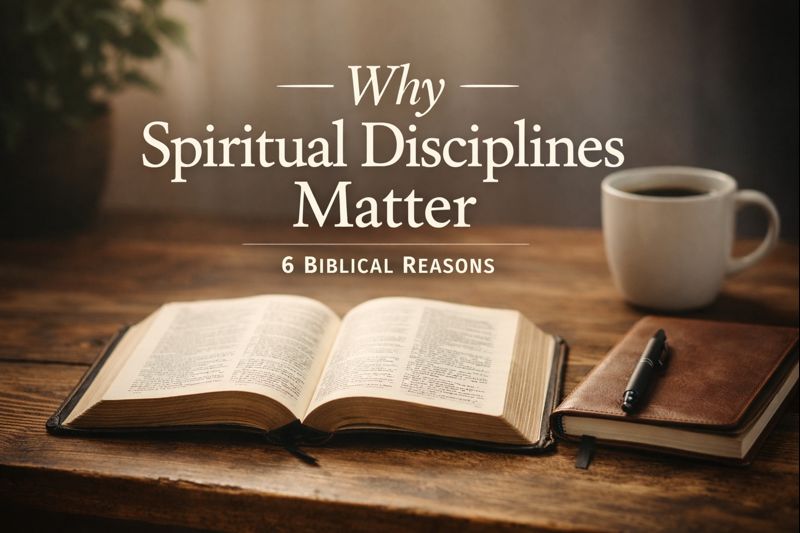
Why Spiritual Disciplines Matter: Six Reasons to Pursue Them
by Landon Coleman
Series: Starting the Year Rooted in Christ
During my pastoral ministry, I’ve often with people in my local church about Bible intake, prayer, giving, and reading. Along the way, we’ve tried to be practical, helping our people know how to put the disciplines into practice on a regular basis. We’ve also tried to be kindly confrontational, explaining that these disciplines are for all followers of Jesus, not just an elite few.
In the midst of practicality and confrontation, we’ve had another aim in mind. In teaching the disciplines, we’ve tried to keep the big picture in mind. That big picture is summed up with one word: Why? Why practice spiritual disciplines? Why devote ourselves to these things that take time and don’t come naturally? Who commits to Bible intake, prayer, giving, and reading? Why do we need to do these things?
Throughout our study on these topics over time, we’ve tried to keep focused on the motivations of our heart. We don’t want to fall into the trap of legalism, whereby we impose a set of manmade rules on people and call them to earn their way with God. Neither do we want to fall into the trap of antinomianism, whereby God’s grace is distorted into an excuse for lawless living and obedience is dismissed as unnecessary. To that end, here are six reasons every Christian ought to be devoted to the spiritual disciplines in a regular, intentional way.
1. We Practice Spiritual Disciplines to Enjoy God
(Psalm 63; Psalm 73:25–28)
We practice spiritual disciplines so that we can enjoy God. When you read the book of Psalms, you don’t come away thinking the psalmist was burdened with the responsibility of spiritual disciplines. Bible intake, prayer, and giving were not burdens to endure, but means by which the psalmist delighted in God and enjoyed the very presence of the Lord.
2. We Practice Spiritual Disciplines for the Purpose of Godliness
(1 Timothy 4:7–8)
We practice spiritual disciplines for the purpose of godliness. Paul called Timothy to “train” for the purpose of “godliness.”
No one accidentally slides toward holiness.
No one naturally drifts toward holiness. We must train. We must be disciplined. In heeding the biblical calls for God’s people to be holy, we must see the disciplines as a means of training.
3. The Psalms Expect God’s People to Practice Spiritual Disciplines
(Psalms 1; 19; 119)
The book of Psalms expects God’s people will practice spiritual disciplines. Just as the book of Genesis assumes the existence of God, the Psalms presume God’s people will engage in spiritual disciplines. Psalm 1 expects we will meditate on God’s Word. Psalm 19 expects we will desire God’s Word more than gold or honey. Psalm 119 expects we will memorize God’s Word.
4. Jesus Assumes His People Will Practice Spiritual Disciplines
(Matthew 6:1–18)
Jesus talked about spiritual disciplines in the most famous sermon he ever preached, the Sermon on the Mount. Jesus assumes we will be people who pray and give and fast. There is no consideration given to the possibility that we simply will not do these things. Jesus just assumes we will practice these disciplines.
Jesus’s concern is never whether His people will practice these disciplines, but why and how they do so.
5. Nothing Great Happens Without Discipline
Nothing great happens without discipline. Concert pianists don’t reach the pinnacle of their craft without discipline. NBA All-Stars don’t bask in the limelight without discipline. College graduates don’t walk across the stage without discipline. Nothing great happens without discipline. Oddly, many hopeful believers may assume something great will happen in their spiritual life without discipline.
6. Discipline Leads to Freedom
Discipline leads to freedom. The hours of piano practice may have seemed like drudgery, but the result is freedom to play complex pieces of music. The hours of running and weight lifting may have seemed like torture, but the result is the freedom to do what the rest of us only dream about. The hours of study and writing may have seemed like a prison, but the result is freedom to think great thoughts.
In the same way, spiritual discipline frees us not from effort, but from immaturity, instability, and spiritual drift.
Start Today
I don’t know where you are spiritually, but I do know you can start today. Be intentional. If Bible reading is a struggle, start with 5 minutes a day. If prayer is a struggle, start with a journal where you can record the prayer requests of your family and friends. If meditation is a struggle, try to set aside a few minutes at the end of the day to reflect on God’s Word. The spiritual disciplines are not always easy, hence the name “disciplines.”
As we begin a new year rooted in Christ, the goal is not radical overnight transformation, but faithful, grace-dependent steps of obedience. The good news is that God gives grace to His people. God’s grace moves us to the disciplines, and the disciplines enable us to experience God’s grace.
For more from our latest series please visit: Starting the Year Rooted in Christ

Landon Coleman serves as the teaching pastor of Immanuel Baptist Church in Odessa, Texas, where he lives with his wife Brooke. They have four children, Emma, Noelle, Amelia, and Clayton. Landon is a graduate of West Texas A&M University (BBA), and a two-time graduate of The Southern Baptist Theological Seminary (MDiv and PhD). He is the author of Pastor to Pastor: Practical Advice for Regular Pastors and Pray Better: Learning to Pray Biblically, both of which were published by Rainer Publishing. Landon has pastored churches in Kentucky and Oklahoma, and he has taught for Oklahoma Baptist University and BH Carroll Theological Institute.