⏱️ Estimated Reading Time: 6 min read
Waiting on the Lord in Seasons of Suffering
Most of us do not like waiting. Yet seasons of suffering often involve long periods of waiting on the Lord,
when answers do not come quickly and relief feels distant. Scripture teaches believers how to wait with quietness,
diligence, and expectant faith.
Most of us do not like waiting.
We are annoyed with lengthy checkout lines at the store, frustrated by long red lights, and, if you live in northern
Indiana like me, discouraged by the lingering of winter temperatures in the middle of April. But we especially
struggle with waiting on God.
Seasons of suffering often involve long periods of waiting on the Lord, when answers do not come quickly and relief
feels distant. Of all the commands of Scripture, this may be one of the hardest to obey. Yet the times and seasons
for waiting on the Lord are many and varied.
Scripture teaches us to wait on the Lord for guidance (Psalm 25:5), deliverance
(Psalm 33:20), answers to prayer (Psalm 38:15), strength
(Isaiah 40:31), and fresh assurance of God’s pardon and forgiveness (Psalm 130:5).
Of course, we want these things now. Our needs seem urgent. We want immediate answers. That is why waiting is so hard.
How to Wait
Waiting on the Lord is difficult, but it is not a passive activity. It is not like waiting in a dentist’s office
or waiting for surgery, where you may feel dread but little else. Waiting on the Lord is an act of faith.
The Puritan pastor and theologian John Owen compared waiting on the Lord to sailors at sea who were
far from land and surrounded by storms, yet sustained in hope by a distant glimpse of land on the horizon.
What does it mean to wait?
Owen, writing specifically about waiting on the Lord for the assurance of forgiveness and pardon, highlights three
things: quietness, diligence, and expectancy.
First, we need quietness. This is the opposite of a fretful mind and an anxious heart.
“It is good that one should wait quietly for the salvation of the Lord” (Lamentations 3:26).
“Be still before the Lord and wait patiently for him” (Psalm 37:7).
But we also need diligence. Quietness does not mean passivity, lethargy, or spiritual neglect.
Waiting involves faithfully following the Lord in everything we know to be right.
As the psalmist says,
“Wait for the Lord, and keep his way” (Psalm 37:34).
For Owen, this especially meant diligence in using the means of grace. In modern language, we might
call these spiritual disciplines.
“This, then, belongs unto the waiting of the soul: diligence in the use of means whereby God is pleased ordinarily
to communicate a sense of pardon and forgiveness. What these means are is known. Prayer, meditation, reading,
hearing of the word, dispensation of the sacraments—they are all appointed to this purpose; they are all means of
communicating love and grace to the soul.”
The third component of waiting is expectancy.
If quietness guards us from worry and diligence guards us from spiritual laziness, expectancy guards our hearts from
unbelief and despair. Waiting is meant to be hopeful.
“I wait for the Lord, my soul waits, and in his word I hope” (Psalm 130:5).
“From of old no one has heard or perceived by the ear, no eye has seen a God besides you, who acts for those who wait for him” (Isaiah 64:4).
Owen’s description of waiting shows remarkable balance. Quietness without diligence can make us passive and
spiritually careless. But diligence without a quiet heart becomes little more than disguised self-reliance. And
either of these without hope in God will leave us trusting ourselves rather than the promises of his Word.
The God on Whom We Wait
The most important part of waiting is remembering who it is that we are waiting for—God himself.
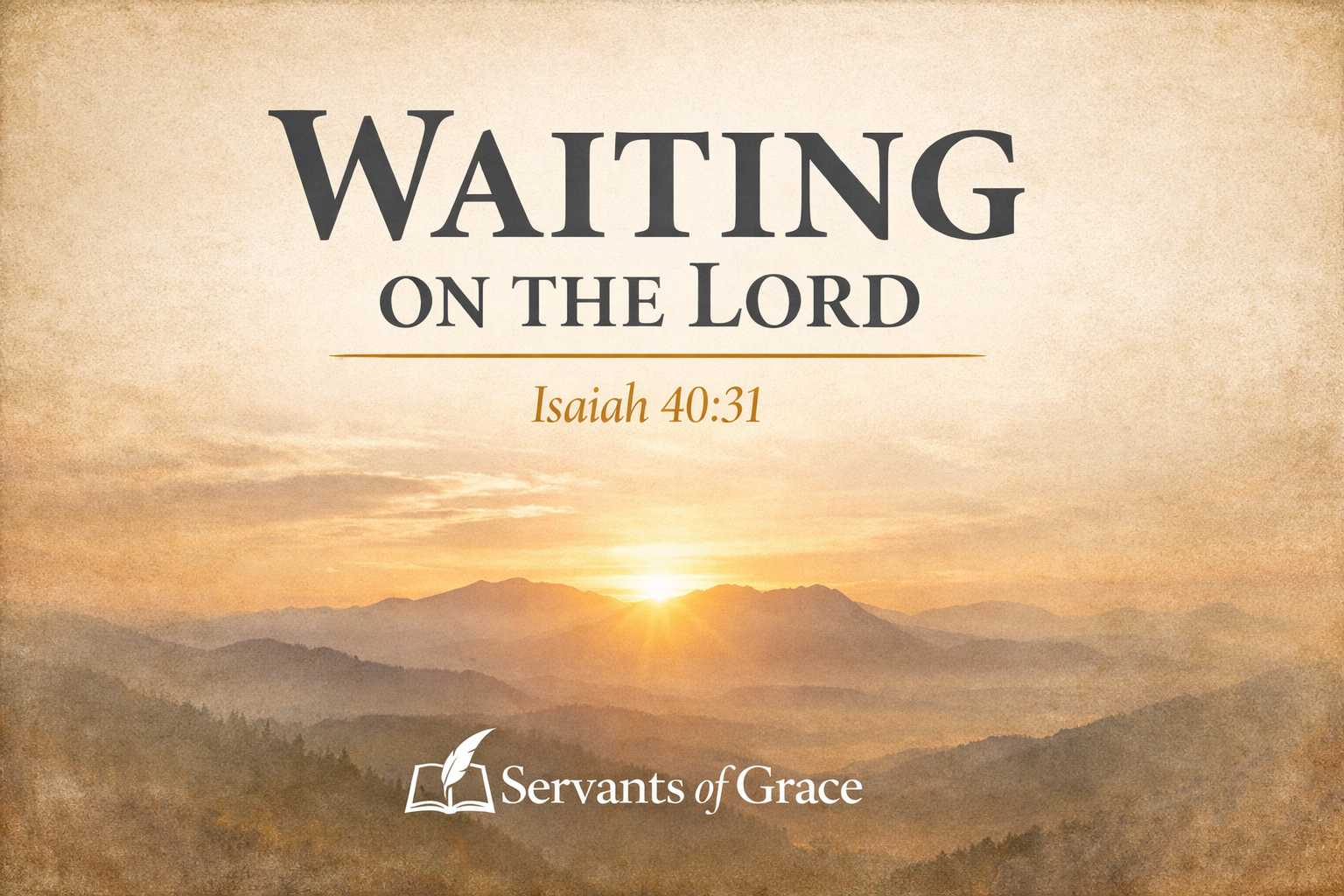
Isaiah 40:31 is one of the most well-known passages on waiting on the Lord. It is often quoted beneath images of
eagles soaring over mountains. But sometimes we forget the larger context of Isaiah 40, a magnificent chapter that
calls us to behold the greatness of God.
This is the God who holds the oceans in his hand and measures the sands of the earth the way a baker measures flour.
This is the God who weighs mountains in a balance and stretches the heavens like a curtain. This is the God who names
and numbers the stars.
A God this great might seem distant or unconcerned with the details of our lives. But Isaiah anticipates that very fear.
“Why do you say, O Jacob,
and speak, O Israel,
‘My way is hidden from the Lord,
and my right is disregarded by my God’?Have you not known? Have you not heard?
The Lord is the everlasting God,
the Creator of the ends of the earth.
He does not faint or grow weary;
his understanding is unsearchable.He gives power to the faint,
and to him who has no might he increases strength.Even youths shall faint and be weary,
and young men shall fall exhausted;
but they who wait for the Lord shall renew their strength;
they shall mount up with wings like eagles;
they shall run and not be weary;
they shall walk and not faint.”
(Isaiah 40:27–31)
The Lord, in other words, is not only a God of transcendent power and majestic greatness. He is also a God who strengthens the weak.
The God on whom we wait is not only great. He is also near.
And this is exactly the kind of God we need. If we lose either his greatness or his nearness, we will also lose faith and hope.
Testing Our View of God
So take a moment to examine your theology. What is your view of God?
If you think of God as remote and powerful but unconcerned with the details of your life, your faith will become cold and distant.
Prayer will fade. Trust will weaken. God will seem like a distant sovereign rather than a loving Father.
At best, God will feel far away. At worst, resentment or practical atheism may begin to creep in.
On the other hand, if you think of God only as near, personal, and comforting but not as infinitely wise, sovereign, and majestic,
your faith will lose its reverence. Your view of God may become sentimental and shallow.
It may feel comforting for a moment, but it will not sustain you in suffering.
But when your understanding of God rests on his self-revelation in Scripture, your faith will be both strong and warm. You may not
always understand God’s ways, but you will trust his wisdom and his steadfast love.
And because of that, you will be able to wait for him with quietness, diligence, and expectant faith.
For more from our latest series visit here or at our YouTube.

Brian Hedges is the lead pastor for Fulkerson Park Baptist Church in Niles, Michigan, and the author of Christ Formed in You: The Power of the Gospel for Personal Change (Shepherd Press, 2010) and Licensed to Kill: A Field Manual for Mortifying Sin (Cruciform Press, 2011).