When God’s Word Is Twisted: From Eden to Today
By Dave Jenkins
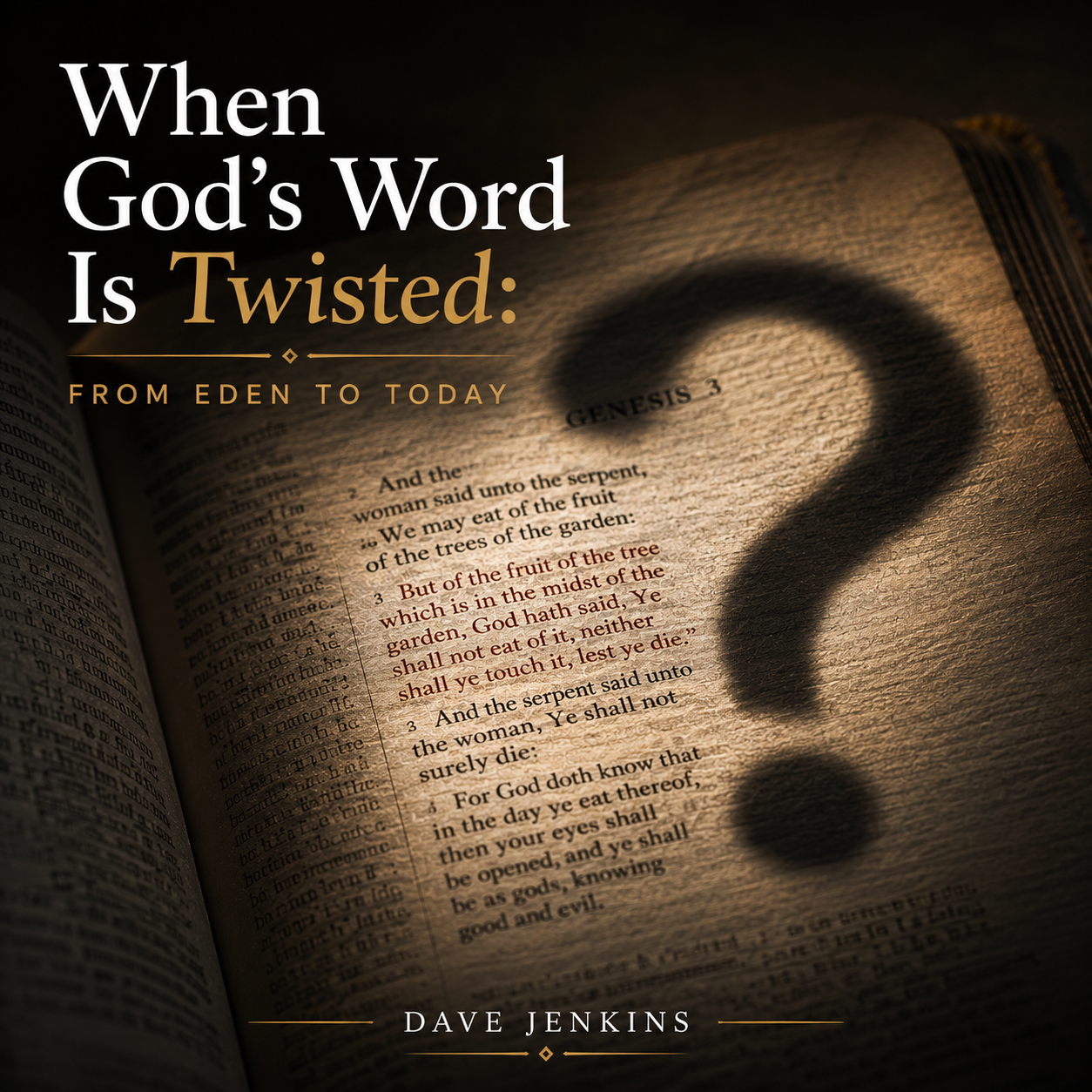
Spiritual deception did not begin with the denial of God’s Word — it began with the distortion of it. The first recorded temptation in Scripture was not an argument against religion, morality, or spirituality in general. It was a question aimed directly at God’s revealed speech: “Did God really say…?” With that question, the serpent did not immediately reject God’s authority. He subtly challenged God’s clarity, goodness, and intent. He introduced doubt about what God had spoken and how it should be understood.
From that moment forward, the twisting of God’s Word has been one of the enemy’s primary strategies. The pattern is remarkably consistent across Scripture and church history. Rarely is deception built on open rejection alone. More often it is built on misquotation, misinterpretation, selective emphasis, or confident misuse. Truth is not always denied — it is bent. And a bent truth becomes a dangerous lie.
The First Twist: Eden’s Question
Genesis 3 gives us the first recorded distortion of divine revelation. God had spoken clearly to Adam about the tree and the consequence of disobedience. The command was specific, understandable, and sufficient.
The serpent approached not with contradiction first, but with reframing: “Did God really say…?” Notice the move. He altered the wording. He broadened the restriction. He planted suspicion. He shifted the tone of God’s command from generous boundary to unreasonable limitation. Then came direct contradiction: “You will not surely die.” Then reinterpretation: God’s motive is questioned, God’s warning is recast, and disobedience is presented as enlightenment. Distortion → doubt → denial → disobedience. The fall was not caused by ignorance of God’s Word but by failure to hold to it faithfully.
Misusing Scripture in the Wilderness
The next major twisting comes not from a human teacher but from the devil himself — quoting Scripture. When Jesus is tempted in the wilderness, Satan cites biblical text. He quotes a Psalm. But he quotes it selectively and applies it falsely. The misuse is not in the words cited, but in the meaning assigned. This is crucial: Satan uses Scripture, but not truthfully.
Jesus responds not by rejecting Scripture but by interpreting it correctly and applying it faithfully. Each reply begins with grounding authority: It is written. He answers distortion with context and obedience. Right interpretation defeats misinterpretation. This account teaches us something vital: quoting Scripture is not the same as honoring Scripture. Accuracy of citation is not the same as faithfulness of meaning.
The Prophetic and Apostolic Warnings
Throughout the Old Testament, false prophets repeatedly claim divine authority while speaking distorted messages. They use God-language but deliver self-generated revelation. They promise peace where judgment is coming. They soften what God has made severe and intensify what God has not commanded. Their error is not always obvious rebellion — it is confident misrepresentation.
The New Testament continues this warning. Jesus rebukes religious leaders for knowing the text but missing its meaning. The Apostles warn repeatedly about teachers who twist Scripture to support destructive ideas. The danger is not merely outside the church but inside it. Distortion often wears a religious uniform.
How Twisting Happens Today
The same ancient pattern continues in modern form. Scripture is twisted today through: Selective quoting — using verses while ignoring context Reframing — redefining biblical terms to fit modern values
Reweighting — minimizing clear texts and maximizing obscure ones
Psychologizing — replacing sin categories with therapeutic ones
Spiritualizing — turning concrete truth into symbolic suggestion
Experiential override — letting experience reinterpret revelation In each case, Scripture is not always denied — it is redirected. Modern distortion is often confident, articulate, and emotionally compelling. That is why discernment must be grounded not in tone or personality but in textual faithfulness.
Why Distortion Is So Effective
Distortion succeeds because it often stays close to truth. A small twist can produce a large error. A partial truth can produce a complete misdirection. People rarely follow teaching they recognize as false. They follow teaching that feels almost right. Add to this our cultural moment — fast content, short attention, emotional persuasion, platform authority — and the conditions are ideal for misinterpretation to spread quickly. Without careful reading and sound teaching, believers can be drawn into error while thinking they are pursuing truth.
Guarding Against the Twist
Scripture itself gives us the safeguards. We read contextually, not fragmentedly. We interpret Scripture with Scripture. We test teaching carefully. We value faithful exposition. We grow in biblical literacy. We submit our preferences to the text. Discernment is not suspicion — it is careful listening anchored in God’s Word. Believers who know Scripture deeply are harder to deceive easily.
A Call Back to Trusting God’s Word
Every distortion ultimately questions God’s goodness, clarity, or authority. That is why returning to Scripture is not merely intellectual — it is relational. It is an act of trust. We trust that God speaks clearly. We trust that God speaks truthfully. We trust that God speaks sufficiently. The serpent’s ancient question still echoes: Did God really say? The faithful believer’s answer must still be: Yes — and we will listen carefully. From Eden until now, twisting the Word leads to confusion and loss. Holding fast to the Word leads to life and stability. Let us be people who read carefully, interpret faithfully, and stand confidently on what God has actually said.