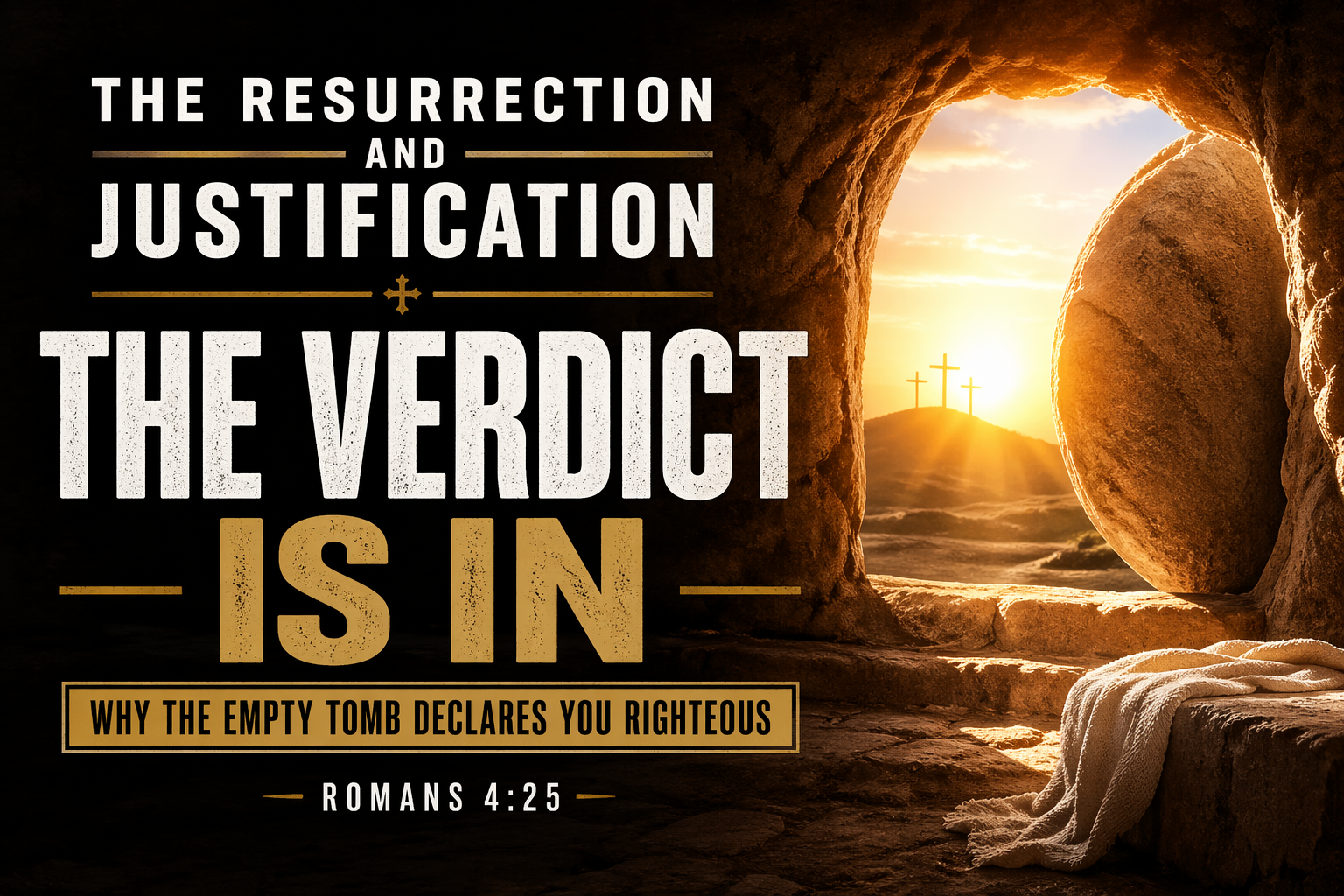
The Resurrection and Justification: Why the Empty Tomb Declares You Righteous
By Dave Jenkins
Introduction
The resurrection of Jesus Christ is often treated as the triumphant conclusion of the gospel. It is the moment where sorrow turns to joy and defeat gives way to victory. Yet Scripture presents the resurrection as more than a dramatic ending. It is a decisive declaration.
Many believers understand that Jesus died for their sins. Fewer grasp why His resurrection is essential to their salvation. The cross and the empty tomb belong together. If Christ had died but remained in the grave, there would be no assurance that His sacrifice had accomplished what He claimed. There would be no confidence that sinners are truly forgiven and accepted by God.
The resurrection is not only proof that Jesus lives. It is God’s declaration that His saving work is complete. It is the foundation of our justification and the reason believers can stand before God without fear.
What Is Justification?
To understand the significance of the resurrection, we must first understand justification. Justification is a legal declaration by God that a sinner is righteous in His sight. It is not a process of becoming righteous over time. It is not based on human effort or moral improvement. It is a once-for-all declaration grounded entirely in the person and work of Jesus Christ.
Scripture speaks with clarity on this point. We are justified by grace, through faith, because of Christ. Our sin is credited to Him, and His righteousness is credited to us. This great exchange lies at the heart of the gospel.
Justification means that the believer’s standing before God has been settled. The verdict has already been rendered. The question is no longer whether we might one day be accepted. The question has already been answered in Christ.
How the Resurrection Secures Our Justification
The connection between the resurrection and justification is not assumed. It is explicitly stated in Scripture. Romans 4:25 tells us that Jesus “was delivered up for our trespasses and raised for our justification.”
The death of Christ addresses the problem of sin. He bears the penalty that we deserve. He satisfies the justice of God. Yet the resurrection reveals something further. It is the confirmation that His sacrifice has been accepted. It is the public vindication of His work.
If Christ had remained in the grave, it would raise the question of whether the payment was sufficient. But the empty tomb answers that question decisively. The resurrection declares that the penalty for sin has been fully paid, that the wrath of God has been satisfied, and that death itself has been conquered.
The risen Christ stands as the living proof that justification has been secured for all who trust in Him.
Why the Resurrection Matters for Assurance
Assurance is a struggle for many Christians. It is easy to look inward and measure one’s standing before God by personal performance or spiritual consistency. When sin persists or emotions fluctuate, confidence begins to weaken.
The resurrection directs our attention away from ourselves and back to Christ. It reminds us that our standing before God is not grounded in our efforts, our feelings, or our progress. It is grounded in the finished and vindicated work of Jesus.
Because Christ has been raised, the believer’s justification is not uncertain. It does not depend on how we feel on a given day. It does not rise and fall with our circumstances. It rests on a completed work that God Himself has affirmed.
The empty tomb speaks with clarity where our hearts often waver. It tells us that the work is finished and that the verdict has been secured.
The Risen Christ and Your Standing Before God
The resurrection means that believers are not waiting to be accepted by God. They are already accepted in Christ. This is not a future hope that depends on our continued performance. It is a present reality grounded in what Christ has already accomplished.
Scripture declares that there is no condemnation for those who are in Christ Jesus. It speaks of peace with God and access to Him with confidence. These are not fragile blessings. They are rooted in the unchanging work of a risen Savior.
To be justified is to stand before God clothed in the righteousness of Christ. That standing does not shift with our successes or failures. It is anchored in the One who died and now lives.
Living in Light of the Empty Tomb
The doctrine of justification is not abstract. It shapes the way believers live each day. When we understand that we are declared righteous in Christ, it changes how we approach God, how we fight sin, and how we endure hardship.
We approach God with confidence, not because we are worthy, but because Christ is. We fight sin, not in fear of condemnation, but from a place of acceptance. We endure suffering with stability, knowing that our standing before God is secure.
The resurrection anchors the Christian life in something unshakable. It frees us from the burden of trying to earn God’s favor and calls us to live in the freedom of what Christ has already accomplished.
Conclusion
The empty tomb is more than a historical reality. It is a theological declaration that echoes through the life of every believer. Jesus was raised for our justification.
This means that our righteousness is not based on our efforts, our consistency, or our feelings. It is based entirely on Christ. The risen Savior is the guarantee that all who trust in Him are declared righteous before God.
In a world filled with uncertainty, the resurrection provides a foundation that does not move. The verdict has been given. The work has been completed. The Savior lives.
And because He lives, those who belong to Him stand justified forever.
For more from our latest series please visit here or at our YouTube.