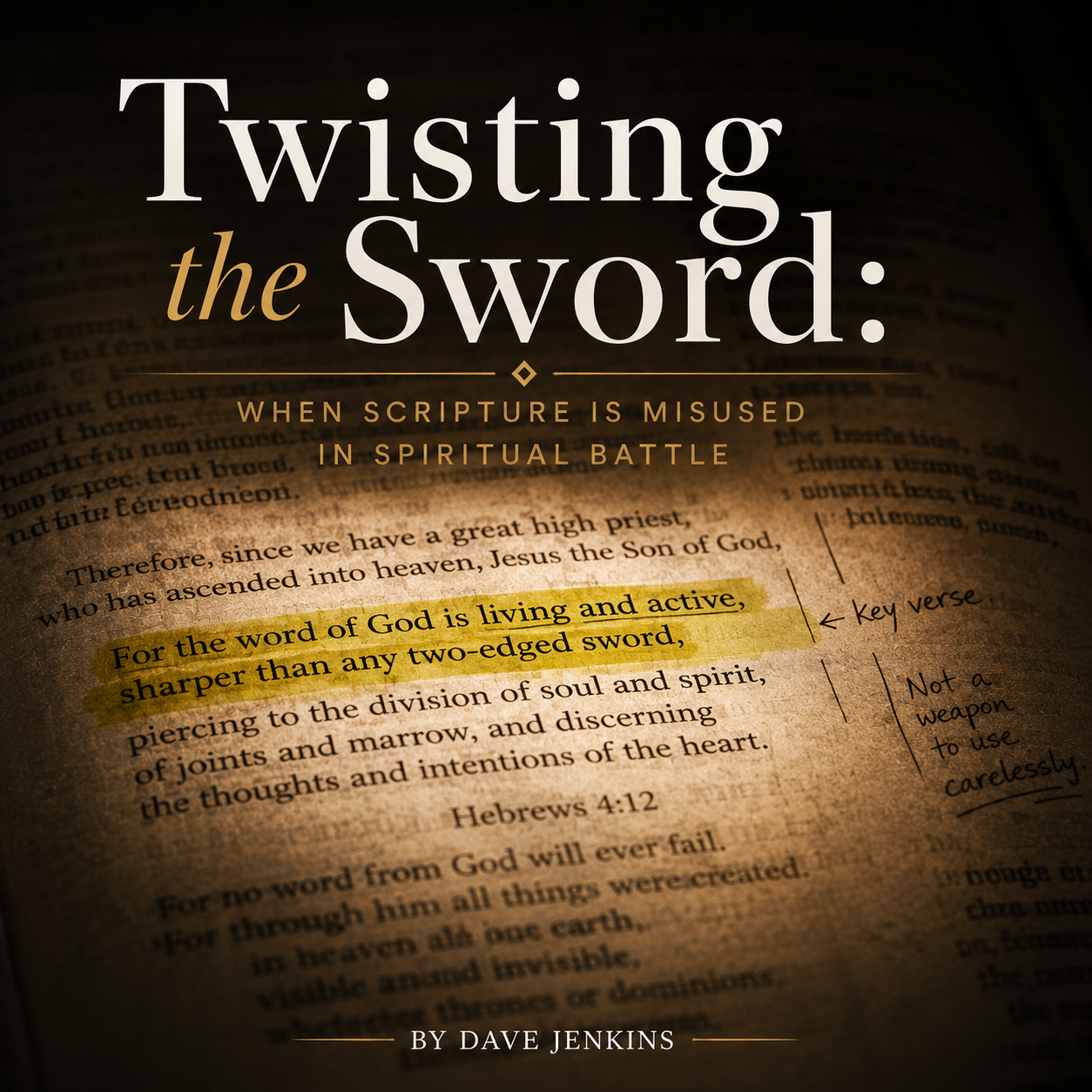
Twisting the Sword: When Scripture Is Misused in Spiritual Battle
By Dave Jenkins
Few images in Scripture are more vivid than the Word of God described as a sword. God’s Word is living and active, sharper than any two-edged blade. It pierces, exposes, judges, and frees. It is not decorative — it is decisive. It is not symbolic only — it is powerful. And like any powerful weapon, it can be used rightly — or wrongly.
In our time, few areas show the misuse of Scripture more clearly than popular teaching on spiritual warfare. Many Christians are eager to take spiritual conflict seriously, and that is a good instinct. The Bible plainly teaches that believers face real spiritual opposition. But alongside biblical teaching has grown a large body of unbiblical practice — much of it built on distorted, isolated, or misapplied Scripture. The tragedy is not only doctrinal error. The tragedy is that when Scripture is twisted in the name of spiritual battle, believers are weakened rather than strengthened. The very sword meant to steady them is bent out of shape.
The Sword Scripture Actually Describes
When Paul describes the armor of God, he names one offensive weapon: the sword of the Spirit, which is the Word of God. That image is not accidental. God’s Word is truth spoken with divine authority. It exposes lies. It defeats deception. It anchors the believer in reality. But notice how Scripture itself models the use of this sword.
When Jesus faced direct satanic temptation, He did not shout at demons. He did not invent formulas. He did not appeal to hidden revelations. He quoted Scripture — accurately, contextually, and obediently. Each response began with the same grounding: it is written. Christ did not treat Scripture as a magic incantation but as binding truth. He did not manipulate verses — He submitted to them. That is the model. The sword is used rightly when Scripture is handled faithfully.
How the Sword Gets Twisted
Scripture is twisted whenever it is removed from its context and reassigned a meaning God did not give it. This can happen accidentally through careless reading — or deliberately through agenda-driven teaching. In spiritual warfare circles, several patterns of misuse are common.
Verses describing Christ’s authority are sometimes turned into universal formulas that believers are told to declare mechanically. Narrative passages describing unique apostolic events are treated as repeatable commands. Symbolic language is pressed into literal technique. Promises are detached from their covenant context and applied as guaranteed outcomes. The Bible becomes a phrase bank instead of a revelation. This is not how Scripture is meant to function. God did not give His Word as a collection of verbal tools to control spiritual forces. He gave it as truth to be believed, obeyed, and trusted.
When Technique Replaces Truth
A major danger in distorted warfare teaching is the shift from truth to technique. Believers are taught methods instead of meaning. They are given scripts instead of doctrine. They are trained in verbal strategies instead of biblical understanding. The focus subtly moves from:
- knowing God → using formulas.
- trusting truth → performing steps.
- submitting to Scripture → wielding phrases.
But spiritual power in Scripture never comes from technique. It comes from truth believed and obeyed. The apostles did not teach warfare formulas — they taught sound doctrine, holy living, sober vigilance, and resistance through faith. The emphasis was always on standing firm in truth, not mastering methods.
Context Is Not Optional
Right use of Scripture requires context. Words mean what God intended them to mean in their setting. That includes literary context, historical context, covenant context, and authorial intent. When context is ignored, almost any verse can be made to support almost any practice. That is not spiritual insight — that is interpretive carelessness. Faithful handling of Scripture asks:
- Who is speaking?
- To whom?
- Under what covenant?
- About what situation?
- With what purpose?
This is not academic nitpicking. It is spiritual safety.
The Quiet Strength of Ordinary Means
One of the most overlooked truths in spiritual warfare teaching is this: the New Testament emphasizes ordinary means of grace far more than dramatic confrontation. Believers are told to:
- Put on the armor of God.
- Stand firm.
- Resist the devil.
- Pray.
- Know truth.
- Live righteously.
- Walk in obedience.
- Remain watchful.
These are steady practices, not sensational moments. Scripture points us to endurance more than spectacle. The most powerful spiritual defense is not a shouted phrase — it is a truth-shaped life.
Modeling Right Use of the Sword
Using the sword rightly means: Reading Scripture in context. Interpret Scripture with Scripture. Submit to what it says. Apply it where it truly applies. Trust its authority. Obey its commands. The sword cuts cleanest when it is handled carefully. Believers do not need creative reinterpretations. They need faithful exposition. They do not need secret warfare knowledge. They need sound doctrine and steady obedience.
A Warning and Encouragement
When Scripture is twisted, believers are burdened with practices God never commanded and expectations God never promised. That leads to frustration, fear, and disillusionment. But when Scripture is handled rightly, believers grow in confidence, clarity, and courage. They learn that Christ has already secured decisive victory. They learn that truth is their defense. They learn that obedience is their posture. They learn that God’s Word is sufficient. The sword is not dull. It does not need embellishment. It needs faithful handling. Let us not twist the sword. Let us use it well.