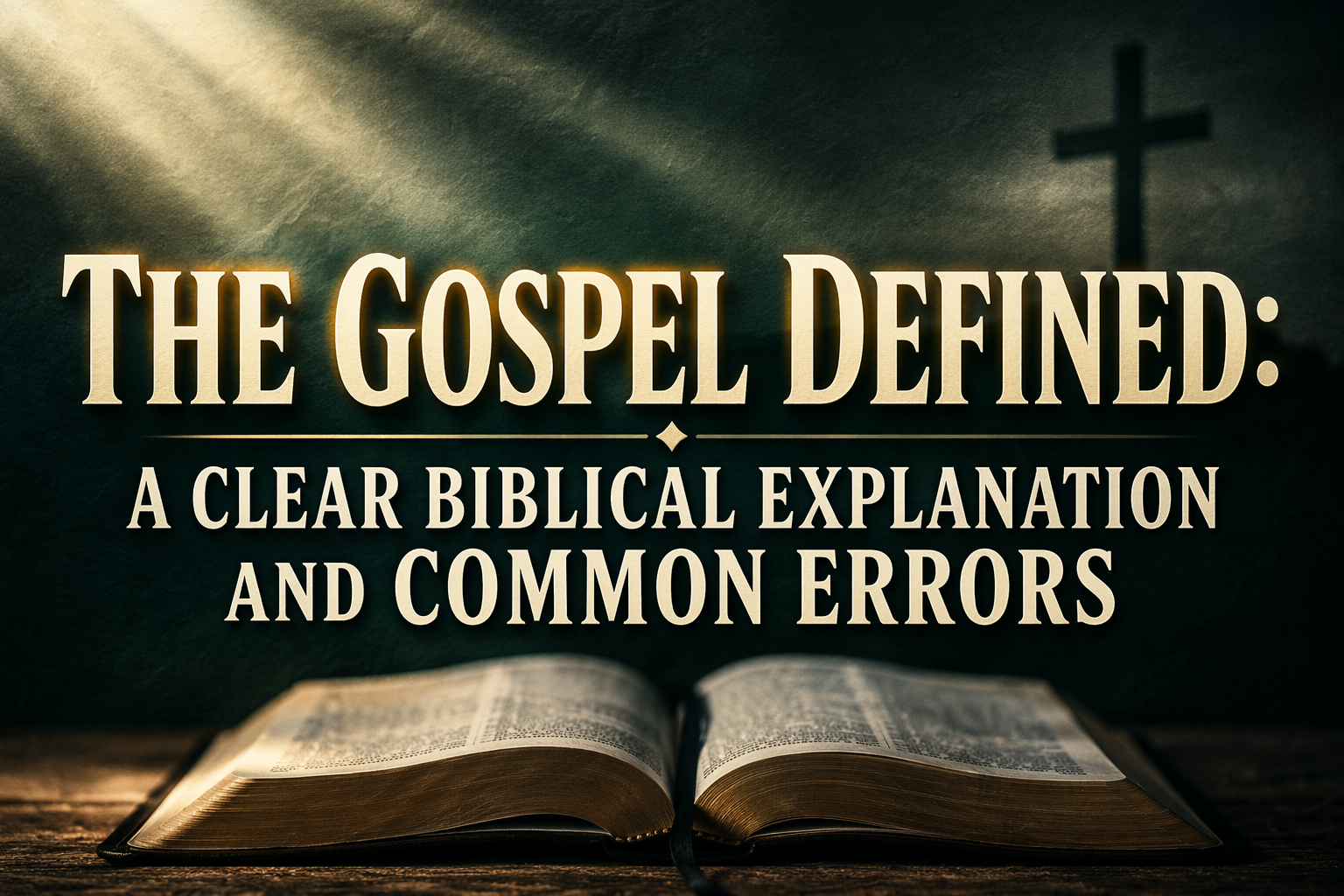
The Gospel Defined: A Clear Biblical Explanation and Common Errors
By Dave Jenkins
The word gospel is one of the most familiar terms in the Christian vocabulary, and yet it is often one of the most misunderstood. Many people assume they know what the gospel is, but when pressed to define it clearly and biblically, confusion often emerges. In a culture filled with competing messages about truth, identity, and salvation, clarity about the gospel is not optional. It is essential.
This message is not a vague spiritual idea or a general message of hope. It is not advice about how to live a better life, nor is it primarily about what we must do for God. At its core, the gospel is the good news of what God has done for sinners in and through the person and work of Jesus Christ. It is an announcement rooted in history, grounded in Scripture, and centered on Christ.
The gospel is the good news that Jesus Christ died for our sins, was buried, and rose again, offering salvation by grace alone through faith alone.
The Gospel Defined in Scripture
The apostle Paul provides one of the clearest summaries of this good news in 1 Corinthians 15:1–4, where he writes that Christ died for our sins in accordance with the Scriptures, that He was buried, and that He was raised on the third day in accordance with the Scriptures. This brief summary captures the heart of the message of Christ. Christ died for our sins. Christ was buried. Christ was raised. These are not abstract truths but historical realities with eternal significance.
To understand this message rightly, we must begin with God Himself. God is holy, righteous, and just. He is the Creator of all things and the rightful Lord over His creation. His holiness means that He is perfectly pure and set apart, and His justice means that He does not overlook sin. Sin, therefore, is not a minor issue or a simple mistake. It is rebellion against a holy God. Every person has sinned and stands guilty before Him, falling short of His glory and deserving His judgment.
Into this reality comes the person of Jesus Christ. The gospel is not merely a message. It is centered on a Person. Jesus is fully God and fully man, the eternal Son who took on human flesh. He lived a perfect, sinless life, fulfilling the law of God in every respect. Where humanity failed, Christ succeeded. Where we disobeyed, He obeyed completely.
The heart of this good news is found at the cross. Jesus did not merely die as a moral example or as a tragic victim. He died as a substitute. On the cross, He bore the wrath of God against sin in the place of sinners. He took upon Himself the judgment that we deserved. His death was not accidental or incidental. It was purposeful, substitutionary, and sufficient. In His death, the penalty for sin was paid in full.
Yet this message does not end at the cross. The resurrection of Jesus Christ is essential to the gospel. On the third day, Christ rose from the dead, conquering sin and death. The resurrection is the Father’s declaration that the work of Christ was accepted. It confirms that sin has been dealt with, that death has been defeated, and that Jesus is indeed Lord. Without the resurrection, there is no gospel. But because Christ is risen, there is hope, life, and assurance for all who believe.
The gospel, then, is the good news that God saves sinners through the life, death, and resurrection of Jesus Christ. This salvation is not earned. It is not achieved through human effort, religious activity, or moral improvement. It is received by grace alone through faith alone in Christ alone. The call of this good news is a call to repent and believe, to turn from sin and to trust wholly in the finished work of Christ.
Common Errors That Distort the Gospel Defined
Despite the clarity of Scripture, the gospel is often misunderstood or distorted. One common error is reducing the gospel to a simple statement that “Jesus loves you.” While it is gloriously true that God loves sinners, this statement by itself is not the gospel. Without the reality of sin, the necessity of the cross, and the call to repentance, the message becomes shallow and incomplete.
Another common distortion is turning the gospel into moralism. In this view, the gospel becomes a message about trying harder, doing better, and improving oneself. But the gospel is not a call to self-improvement. It is the declaration that we cannot save ourselves and that Christ has done what we could never do. Moralism shifts the focus from Christ’s finished work to human effort, undermining the very heart of the message.
A further error is neglecting the resurrection. Some presentations of the gospel focus almost entirely on the death of Christ while giving little attention to His resurrection. Yet Scripture makes clear that the resurrection is essential. It is through the resurrection that Christ is vindicated, that justification is secured, and that believers have the hope of new life.
There is also the danger of adding works to the gospel. Whenever salvation is presented as Jesus plus something, Jesus plus good works, Jesus plus obedience, or Jesus plus religious effort, the gospel is no longer the gospel. Salvation is by Christ alone. Any addition to His work diminishes its sufficiency and distorts the message of grace.
Finally, many modern presentations of the gospel minimize or ignore repentance. Faith is emphasized, but repentance is treated as optional or unnecessary. Yet Scripture consistently joins the two together. To believe the gospel is to turn from sin and to trust in Christ. It is a change of mind and heart that results in a changed life.
This truth is not merely the entry point into the Christian life. It is the foundation of the entire Christian life. It shapes how we understand God, how we understand ourselves, and how we live in the world. In an age marked by confusion and competing claims about truth, the gospel remains clear, sufficient, and unchanging.
The question is not simply whether we can articulate the gospel, but whether we have truly believed it. This good news calls for a response. It calls us away from self-reliance and toward Christ. It calls us to abandon all hope in ourselves and to rest entirely in Him.
This is the good news: Christ has come. Christ has died. Christ is risen. Christ saves sinners. And this message, once understood, is not something we move beyond. It is the truth we return to again and again, the foundation upon which the Christian life is built, and the hope that sustains us both now and for eternity.
For more from our latest series please visit here or at our YouTube.