⏱️ Estimated Reading Time: 8 min read
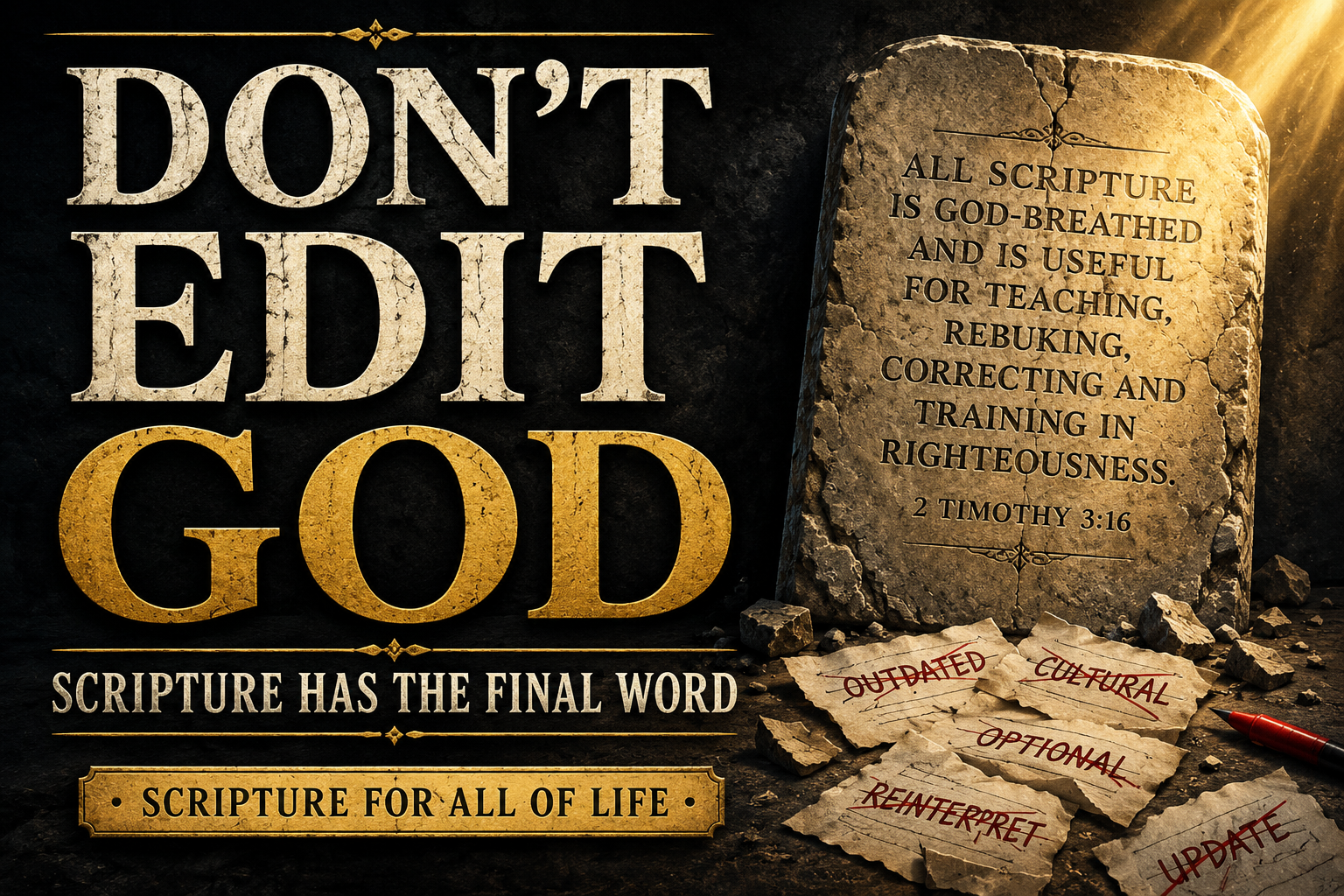
Don’t Edit God: What’s Really at Stake in the Sexuality Debate
By Dave Jenkins
In today’s cultural climate, biblical sexuality is under siege—and at the heart of the battle lies an even deeper issue: the authority and clarity of Scripture. As churches, parents, and Christian leaders face growing pressure to affirm what God calls sin, we must respond with unwavering conviction and pastoral clarity. The temptation to edit, soften, or reinterpret Scripture is not new, but the consequences are eternal.
This article continues our Scripture for All of Life series, where we examine how the Word of God speaks clearly and authoritatively into every sphere of human existence—including the most contested issues of our day.
We are witnessing not only a moral revolution but a theological rebellion. When the Church wavers on what God has clearly spoken about gender and sexuality, she loses her prophetic voice. The Church doesn’t need to be trendier. It needs to be truer. We don’t stand over the Word of God as editors; we stand under it as those who are called to submit and obey.
Today, many within professing Christianity are attempting to rewrite clear biblical teaching. Progressive theologians argue that the Bible is outdated and culturally bound when it speaks of sexual ethics. The Revoice movement seeks to create space for “celibate gay Christians” to identify with their orientation while still claiming orthodoxy. Influencers like Matthew Vines argue that Scripture has been misinterpreted, despite 2,000 years of consistent biblical understanding. The Evangelical Lutheran Church in America (ELCA) has embraced same-sex marriage and LGBTQ clergy. The United Methodist Church is undergoing a split over the same issue, with entire churches disaffiliating.
The tragedy is not simply in cultural decline but in spiritual confusion. Many Christians are not prepared to answer these claims because they’ve been catechized more by Instagram theology and emotional reasoning than the Word of God. The fruit of this compromise is devastating: doctrinal drift, moral confusion, and churches that lose both truth and power.
Why Scripture Matters in Every Area of Life
Scripture is not silent on the human condition. It speaks with clarity and authority about creation, identity, sin, salvation, marriage, and eternity. To attempt to redefine sexuality is not merely a social issue. It’s a theological crisis. If we cannot trust what God has said about the body, marriage, and sin, how can we trust Him about salvation?
Genesis 1:27 declares, “So God created man in his own image… male and female he created them.” Jesus affirms this in Matthew 19:4–6. Romans 1 outlines the descent of a society that suppresses truth, including the distortion of sexual behavior. 1 Corinthians 6:9–11 plainly states that homosexual practice, among other sins, is incompatible with inheriting the kingdom of God. Yet the same passage offers hope: “Such were some of you. But you were washed… justified in the name of the Lord Jesus Christ.”
The Apostle Paul warned of a time when people would not endure sound teaching, but “having itching ears… will accumulate for themselves teachers to suit their own passions” (2 Timothy 4:3). That time is now. Entire denominations are splitting over whether love means affirmation or obedience.
But the Church must not compromise. As Jude 3 commands, we are to “contend for the faith once for all delivered to the saints.”
The Battle Beneath the Battle: Is Scripture Still Enough?
This crisis of sexuality is fundamentally a crisis of Scripture’s sufficiency. Many who reject God’s design for marriage and gender do so because they no longer believe the Bible is enough. Instead of submitting to the text, they reinterpret it based on emotion, experience, or cultural pressure.
But 2 Timothy 3:16–17 says, “All Scripture is breathed out by God and profitable for teaching, for reproof, for correction, and for training in righteousness, that the man of God may be complete, equipped for every good work.” Hebrews 4:12 reminds us that God’s Word is living and active—cutting through our defenses and exposing our hearts.
When churches abandon the sufficiency of Scripture, they become vulnerable to every cultural wind. But when we believe God’s Word is enough, we proclaim it with confidence—even when it’s unpopular.
Don’t Edit God: What’s Really at Stake
What’s at stake is not simply sexual ethics. It’s the nature of truth. If the Word of God can be edited to accommodate culture, then the gospel itself is up for grabs. If we lose the doctrine of sin, we lose the doctrine of grace. If we redefine love apart from truth, we exchange biblical compassion for worldly affirmation.
The damage is already visible. Churches that compromise on sexuality often quickly abandon other core doctrines: the exclusivity of Christ, the necessity of the cross, the inerrancy of Scripture. Theological liberalism is not a softer form of Christianity—it is another religion altogether, as J. Gresham Machen warned.
Historically, this pattern is not new. Compromise on Scripture’s authority rarely stays contained to a single issue. In Spurgeon’s day, the Downgrade Controversy began when pastors within the Baptist Union grew uneasy affirming the full inspiration of Scripture and the substitutionary nature of the atonement—seemingly small concessions at the time. But once the authority of the text itself was treated as negotiable, there was no consistent ground left to resist what followed: a slide into universalism, denial of the atonement, and broader doctrinal drift. Spurgeon saw clearly that the real issue was never any single doctrine in isolation—it was whether Scripture still had the final word.
We can see the same pattern in our own time. Long before debates over sexuality, many mainline denominations had already begun treating Scripture’s authority as something to be negotiated—reinterpreting clear texts as culturally bound or in need of “updating” for a modern audience. The shifts on sexual ethics that followed decades later were not the cause of that drift, but a symptom of it. The lesson is sobering: when the authority of God’s Word is conceded on one front, it becomes far harder to hold the line anywhere else.
The Reformers understood this same principle from the opposite direction. Luther, Calvin, and others stood firm precisely because they refused to let Scripture’s authority be subordinated to tradition, political pressure, or popular opinion—even at great personal cost. Their conviction was not stubbornness for its own sake; it was the recognition that once the Word of God is placed under any other authority, nothing else can be secured. The same conviction is needed today.
Faithful pastors must speak with clarity. Parents must disciple their children with Scripture. Teachers must prepare students to resist lies wrapped in emotional language. This is not the time for passivity. We must stand on the Word of God alone.
FAQ: Common Misconceptions About Scripture and Sexuality
Q: Didn’t Jesus never mention homosexuality?
A: Jesus affirmed the created order of male and female in marriage (Matthew 19:4–6), which assumes exclusivity. He upheld the moral law and affirmed every jot and tittle of Scripture (Matthew 5:17–19).
Q: Isn’t love the most important commandment?
A: Yes—and love, according to Scripture, “does not rejoice at wrongdoing, but rejoices with the truth” (1 Corinthians 13:6). True love speaks the truth even when it’s hard (Ephesians 4:15).
Q: Aren’t the passages about homosexuality just cultural or mistranslated?
A: Every major biblical passage on sexual ethics—from Leviticus to Romans to 1 Corinthians—has been consistently interpreted for 2,000 years as affirming God’s design for sexuality. Attempts to reinterpret them are recent and reflect modern ideology, not faithful exegesis.
Q: Can’t people be gay and Christian?
A: Anyone can become a Christian by repenting of sin and trusting in Christ. But no one can cling to sin while claiming Christ. Our identity is in Jesus, not in our desires (2 Corinthians 5:17).
Looking Ahead: Standing Firm in Christ
This is not about winning culture wars. It’s about faithfulness to Christ and love for our neighbor. The Church must recover her confidence in Scripture, her boldness in truth, and her tenderness in discipleship.
Whether you’re a pastor overwhelmed by pressure, a parent trying to raise your children in truth, or a Christian wrestling with how to respond to friends and loved ones, this series is for you.
As part of the Scripture for All of Life series, this article reminds us that God’s Word is not just for Sunday mornings—it’s sufficient and authoritative for every part of our lives, including sexuality, identity, truth, and discipleship. We must stand on the authority of God’s Word—not because we are better, but because Christ is Lord. And He has spoken.
For more from our latest series visit here or at our YouTube.