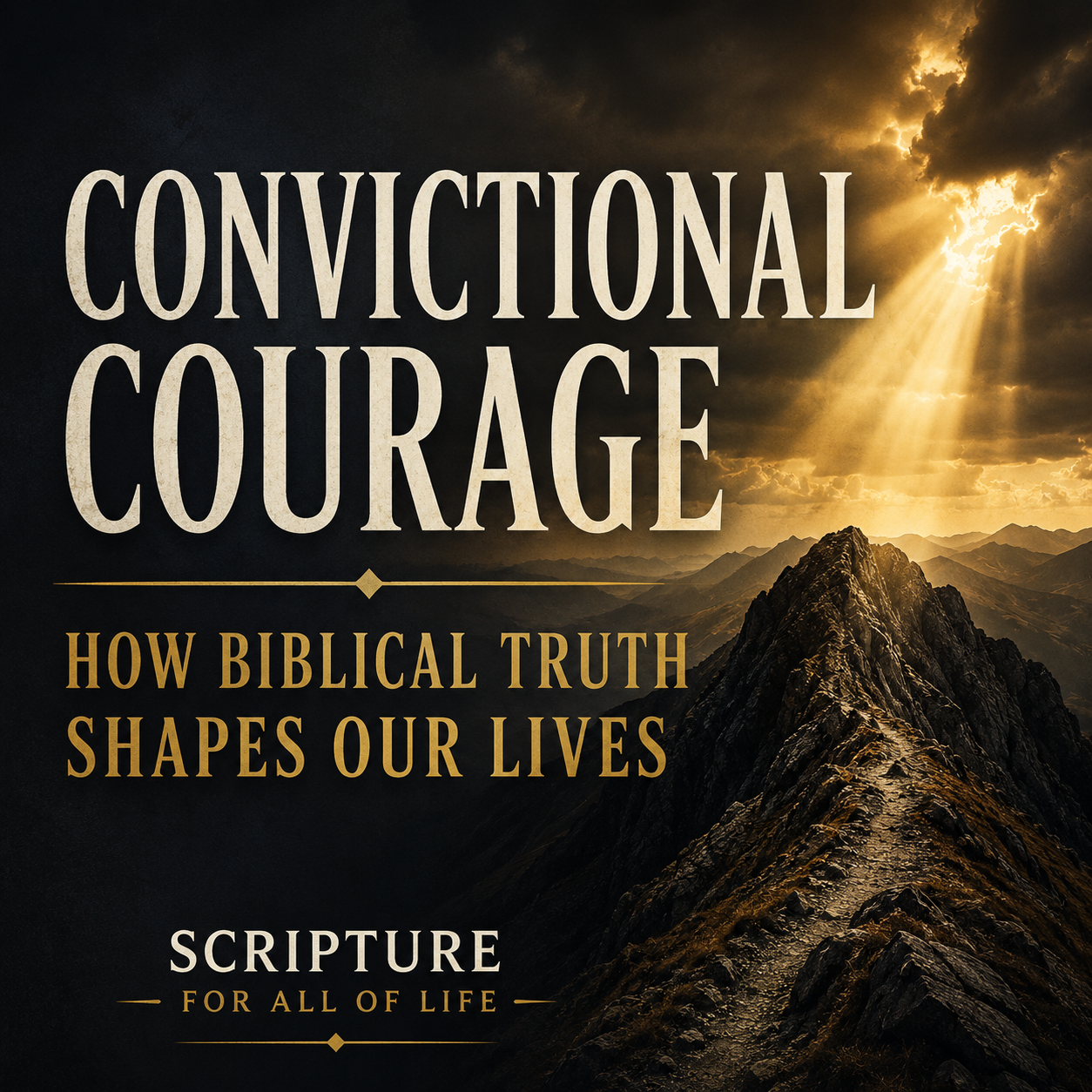
Convictional Courage: How Biblical Truth Shapes Our Lives
By Dave Jenkins
Introduction: A Moment That Demands Conviction
We live in a time when courage is applauded until it is biblical. Consider the case of Jack Phillips, a Christian baker in Colorado who has spent years in court for declining to create cakes that violate his biblical convictions. He has not been hostile, hateful, or vindictive. He has simply sought to remain faithful to Christ. Yet in our culture, conviction is often labeled divisive, truth is treated as a threat, and compassion is increasingly redefined to mean compromise.
In this climate, Christians need more than passion. We need principled courage rooted in biblical truth.
This article is part of the Scripture for All of Life series, a resource collection dedicated to applying the clarity, sufficiency, and authority of God’s Word to everyday life and discipleship. Because Scripture is sufficient for all of life, believers do not derive their convictions from culture, politics, personal experience, or public opinion. God’s Word provides the truth by which we think, live, worship, serve, and engage the world.
Biblical truth forms our convictions, our convictions shape our worldview, and our worldview fuels how we live in every stage and sphere of life.
This is not a call to be loud, angry, or reactionary. It is a call to be faithful, to stand firm, speak clearly, and live biblically. For apologists, pastors, parents, and all who disciple others, this is essential.
1. Biblical Courage Requires Biblical Conviction
Scripture repeatedly calls God’s people to stand firm in the truth. Paul exhorts believers, “Be watchful, stand firm in the faith, act like men, be strong” (1 Cor. 16:13). Biblical courage is not self-confidence but steadfast obedience to God regardless of the cost.
Many today appear bold, yet their courage is disconnected from truth. Emotional intensity is often mistaken for conviction. Courage detached from truth eventually becomes compromise.
Consider Pontius Pilate. Though convinced of Christ’s innocence, he lacked the courage to do what was right and instead yielded to the pressure of the crowd. Fear of man silenced conviction. That was not courage. It was compromise.
Daniel provides a positive example. He refused to compromise his obedience to God even when doing so threatened his position, reputation, and life. His courage flowed from settled conviction regarding the authority and faithfulness of God.
Church history is filled with similar examples. Athanasius stood contra mundum (“against the world”) to defend the deity of Christ. Martin Luther stood before emperors and councils declaring that his conscience was captive to the Word of God.
Apologists must ground confrontation in conviction. Parents must anchor their teaching in Scripture rather than cultural trends. Pastors must lead with biblical clarity rather than public approval.
2. Compassion Without Truth Is Not Love
Biblical love never abandons truth. Jesus was “full of grace and truth” (John 1:14). Grace and truth are not enemies. In Christ, they are perfectly united.
Today’s version of compassion often excuses sin in the name of peace. Yet peace without truth is not biblical peace. It is appeasement. Real compassion calls sin what it is while pointing sinners to the Savior who forgives and transforms.
Church history reminds us that love and truth are inseparable. Augustine contended for doctrinal fidelity because he cared for souls. The Reformers championed sola gratia (grace alone) while remaining firmly committed to sola Scriptura (Scripture alone).
Parents, pastors, and disciple-makers must resist the temptation to separate what God has joined together. Love without truth deceives. Truth without love wounds unnecessarily. Biblical ministry requires both.
3. Biblical Truth Forms Our Convictions
Conviction does not emerge from emotion, personal preference, or experience. It is formed through God’s Word.
Paul reminds Timothy:
“All Scripture is breathed out by God and profitable for teaching, for reproof, for correction, and for training in righteousness” (2 Tim. 3:16-17).
Scripture equips believers for every aspect of faithful living. This is why conviction must be grounded in divine revelation rather than human opinion.
The apologist must draw from Scripture, not headlines. The pastor must proclaim God’s Word faithfully. The disciple-maker must help others think biblically about every area of life.
The great creeds and confessions of church history emerged from biblical conviction. As the Westminster Confession of Faith states:
“The whole counsel of God concerning all things necessary for His own glory, man’s salvation, faith and life, is either expressly set down in Scripture, or by good and necessary consequence may be deduced from Scripture.”
Throughout church history, faithful believers have understood that conviction begins with submission to God’s Word.
4. Convictions Shape Our Worldview
Everyone possesses a worldview, whether consciously or unconsciously. What we believe about God, humanity, sin, salvation, truth, and eternity forms the lens through which we interpret reality.
The biblical worldview tells one unified story: creation, fall, redemption, and consummation.
This storyline explains who we are, why the world is broken, how God saves sinners through Christ, and where history is headed. Every competing worldview offers different answers to those questions, which is why convictions matter.
Abraham Kuyper famously declared:
“There is not a square inch in the whole domain of our human existence over which Christ, who is Sovereign over all, does not cry: ‘Mine!'”
Parents, your children are absorbing a worldview every day. Pastors, your people are constantly being discipled by competing voices. Apologists, you are not merely defending doctrine but helping people see reality through the lens of God’s truth.
5. Our Worldview Fuels How We Live
Truth is never meant to remain theoretical. It transforms life.
What we believe shapes how we speak, parent, serve, work, suffer, lead, and love. Our worldview influences how we respond to temptation, hardship, confusion, and cultural pressure.
The Christian life is lived theology.
We see this reality in faithful believers who stand for biblical truth in hostile workplaces, parents who intentionally disciple their children, and Christians who endure suffering while trusting God’s promises.
Apologists are called to speak the truth in love with gentleness and respect (1 Pet. 3:15). Pastors are called to guard sound doctrine and shepherd courageously (Titus 1:9). Parents are called to teach their children diligently (Deut. 6:6-9). Disciple-makers are called to multiply faithful followers of Christ (Matt. 28:19-20).
The early church lived distinctly because it had been transformed by Christ. Their worldview shaped their witness, and their witness impacted the world around them.
Conclusion: Be Courageous With Conviction
The Church does not need more noise. It needs courageous clarity rooted in Scripture.
We need Christians who are shaped by God’s Word rather than swayed by sentiment. We need believers who speak truth with grace and extend grace without compromising truth.
Let us reject false compassion that abandons truth. Let us pursue biblical clarity for the glory of God and the good of others. Let us stand firm, not for the sake of winning arguments, but for the sake of honoring Christ.
Ultimately, Christian courage is not rooted in our strength but in Christ’s finished work. Because Christ died for our sins, rose from the dead, and reigns as Lord, believers can stand firm with confidence. The same Savior who calls us to faithfulness also supplies the grace necessary to endure.
Will you stand? Will you open God’s Word, allow it to shape your mind and heart, and walk in obedience even when it costs you?
That is where conviction becomes courage. And where courage, by God’s grace, becomes a witness to a watching world.
For more from our latest series please visit here or at our YouTube.
For Further Study
The Word Matters by Dave Jenkins