⏱️ Estimated Reading Time: 6 min read
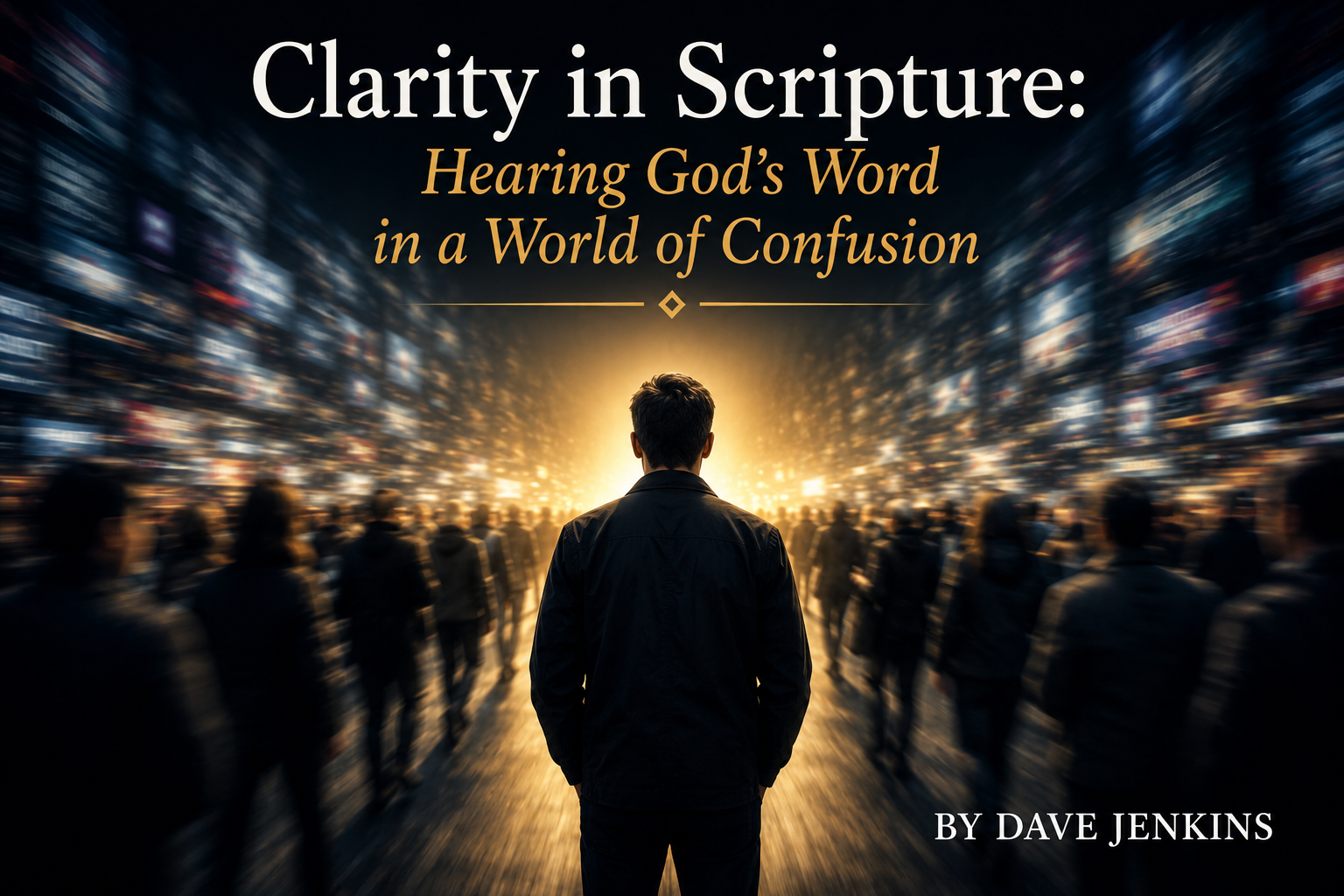
Clarity in Scripture: Hearing God’s Word in a World of Confusion
By Dave Jenkins
We are not merely living in a busy age—we are living in a confused one. Information has never been more available, yet clarity has rarely been more scarce. Voices speak constantly into our lives through screens, platforms, podcasts, and personalities. Cultural convictions shift rapidly. Moral boundaries are redrawn almost daily. Even inside the Church, many believers feel increasingly uncertain about doctrine, discernment, and spiritual direction.
Questions that once had settled biblical answers are now treated as open debates. Teachings that once stood firm are now described as “outdated” or “unloving”. Practices once grounded in Scripture are now reshaped by preference and pressure. In a moment like this, the Church does not need novelty. It needs clarity. And that clarity begins where it has always begun—with the Word of God.
This issue focuses on clarity in Scripture: the authority, clarity, and sufficiency of God’s Word, because every other form of Christian clarity flows from this source. When Scripture is trusted, understood, and applied, believers grow in stability, discernment, courage, and hope. When Scripture is neglected, reinterpreted, or sidelined, confusion inevitably follows. God has not left His people without light. He has spoken—and He has spoken clearly.
A God Who Speaks, Not a God Who Hints
The foundation of biblical faith is not a human search mission but divine revelation. Christianity does not begin with humanity reaching upward, but with God speaking downward. The book of Hebrews tells us that God has spoken at many times and in many ways, and that His revelation reaches its fullness in Jesus Christ. The God of Scripture is not silent, distant, or vague. He reveals. He declares. He makes Himself known. And He has chosen to preserve that revelation in written form.
Scripture is not a record of religious impressions. It is not a collection of spiritual guesses. It is the God-breathed Word—written through human authors, carried along by the Spirit, and preserved by divine providence. Because its source is divine, its authority is binding. Because its source is truthful, its message is trustworthy. This matters more than we often realize. If God has spoken, then His Word stands over our opinions, our experiences, our preferences, and our cultural moment. It does not bend to us; we bend to it.
The Light God Intends His Word to Give
Psalm 119 repeatedly describes God’s Word in terms of light, truth, and understanding. Scripture is not presented as a fog, but as a lamp. Not as confusion, but as illumination. When the Psalmist says that the unfolding of God’s words gives light and understanding, he is affirming something deeply helpful: God’s revelation is meant to be understood. It is given to guide, instruct, warn, comfort, and direct His people.
The historic Church has used the term clarity of Scripture (often called “perspicuity”) to describe this truth. The doctrine does not claim that every verse is equally simple or that study is unnecessary. It teaches that the central message of Scripture—especially regarding salvation and godly living—is clear enough to be understood by ordinary believers using ordinary means under the Spirit’s help. Clarity does not eliminate the need for teachers. It establishes the possibility of understanding. Clarity does not remove depth; it removes hopeless obscurity. Clarity means God is not playing games with His people.
Why Confidence in Scripture is Weakening
One of the great crises of our time is not only biblical illiteracy but biblical uncertainty. Many professing believers are unsure whether Scripture is sufficient to address modern questions. Others believe it must be supplemented by psychology, cultural theory, mystical experience, or new revelation.
We see several patterns emerging: some reinterpret Scripture through cultural frameworks, reshaping clear texts to match modern moral expectations. Others add subjective spiritual impressions and treat them as divine messages alongside Scripture. Still others reduce preaching to motivational encouragement with only passing reference to the text itself. In each case, something subtle but serious happens: Scripture is no longer functioning as the final authority. When the functional authority of Scripture is replaced, clarity disappears and confusion rushes in to fill the space.
Scripture’s Sufficiency and the Stability of the Believer
Scripture declares itself sufficient—not for technical skills or specialized trades—but for knowing God and living before Him faithfully. It equips believers for every good work. It reveals what we are to believe and how we are to live. Because Scripture is sufficient, believers do not need hidden knowledge, secret techniques, or elite interpreters to know God’s will. They need the Word rightly handled.
This sufficiency produces spiritual stability. When believers are grounded in Scripture, doctrine becomes anchored, discernment becomes sharper, worship becomes God-centered, obedience becomes clearer, and hope becomes steadier. The unstable believer is often the undernourished believer. Where the Word is thin, confusion is thick.
Clarity and the Life of the Church
Church history repeatedly shows that renewal follows the recovery of Scripture. When the Word is opened, preached, translated, studied, and sung, God’s people grow strong. The Reformation was not merely a protest—it was a recovery of biblical clarity. The Reformers insisted that Scripture was not only authoritative but understandable. They labored to put the Bible into the language of the people because they believed God speaks clearly through His Word. They did not argue that Scripture was shallow, they argued that it was accessible. We need that conviction again today—in pulpits, classrooms, homes, and personal study.
Recovering Clarity in Practice
Clarity is not recovered by slogans but by habits. Believers must return to daily Bible reading—not fragment reading, but contextual reading. Churches must return to expository preaching that explains the meaning of the text. Families must return to Scripture-shaped discipleship. Christians must support teaching by the Word rather than by charisma or popularity. We must slow down enough to read carefully. We must humble ourselves enough to be corrected. We must love truth enough to submit to it. Clarity grows where Scripture is opened consistently and handled faithfully.
The Gift and Responsibility of a Clear Word
God did not owe us revelation. That He has spoken at all is grace. That He has spoken clearly is greater grace still. We are not left to spiritual guesswork. We are not navigating by instinct. We are not dependent on private impressions. We have the written Word of God. In a confused age, this is not a small gift—it is an anchor. The question before us is not whether God has spoken clearly. The question is whether we will listen carefully. Open the Word, read it with reverence, study it with diligence, receive it with humility, obey it with courage, and pass it on with faithfulness. God’s light has not dimmed. His Word still gives understanding. Walk in His light.