
⏱️ Estimated Reading Time: 26 min read
Worship Through Suffering: Trusting God When Life Is Hard
By Dave Jenkins
Theology for Life Magazine — October 2026
Clarity in Worship: Beholding the Glory of God with Understanding
Introduction: Worship When the Heart Is Heavy
There are seasons in the Christian life when worship comes easily. We see the Lord answering prayers, providing for our needs, and encouraging us through His Word. Our hearts overflow with gratitude, and we rejoice in His goodness.
Then there are other seasons.
A loved one receives a difficult diagnosis. A family member’s health declines. Someone we love dies. A relationship becomes strained. Financial pressures increase. The responsibilities of caring for others become exhausting. We pray, but the circumstances do not change as quickly as we hoped.
During such seasons, worship can feel difficult.
We may gather with the people of God while carrying grief that others cannot see. We may sing familiar hymns while struggling to hold back tears. We may listen to the preaching of Scripture while wondering how we will endure another week.
These experiences raise important questions about the nature of Christian worship.
Is worship possible when our hearts are overwhelmed by sorrow? Can we genuinely praise God while grieving? Does faithful worship require us to feel joyful, or can we honor the Lord even when life is painful?
Scripture provides clear and compassionate answers.
The Bible never teaches that genuine worship requires the absence of suffering. In fact, some of the most profound expressions of worship recorded in Scripture come from believers experiencing extraordinary hardship.
Job worshiped after devastating loss. David prayed through seasons of fear and grief. Habakkuk rejoiced in God while anticipating national calamity. Paul and Silas sang hymns while imprisoned. Above all, Jesus Christ entrusted Himself to the Father through suffering and death.
These examples remind us that worship is not ultimately grounded in favorable circumstances or pleasant emotions.
Christian worship is grounded in the unchanging character of God and the finished work of Jesus Christ.
The Lord remains worthy of our worship when life is joyful, and He remains worthy when our hearts are breaking.
Understanding this truth is essential for learning to worship through suffering.
Worship Begins with Who God Is
One of the greatest challenges during suffering is the temptation to evaluate God’s goodness according to our circumstances.
When life is going well, we may find it easy to affirm that God is faithful.
When difficulties multiply, however, our hearts may struggle to hold fast to the same confession.
Yet Scripture teaches that God’s character does not change.
Malachi 3:6 declares, “For I the LORD do not change.”
James 1:17 describes the Father of lights as the One “with whom there is no variation or shadow due to change.”
God’s holiness, wisdom, goodness, sovereignty, mercy, and faithfulness are not dependent upon our circumstances.
He does not become less loving when we experience grief.
He does not become less sovereign when events unfold in ways we cannot understand.
He does not become less faithful when His answers to our prayers differ from our expectations.
Psalm 145:17 declares:
“The LORD is righteous in all his ways and kind in all his works.”
The Christian’s confidence rests upon the character of God as revealed in Scripture.
This is why sound theology matters so deeply during suffering.
A shallow understanding of God may provide temporary encouragement when life is comfortable, but it offers little stability when trials come.
Believers need to know the God who has revealed Himself in His Word.
They need to understand His sovereignty, His providence, His covenant faithfulness, and His saving purposes in Christ.
The more deeply God’s truth shapes our understanding, the better prepared we are to trust Him when circumstances become difficult.
Worship through suffering begins by remembering that God remains God, even when life is painful.
Job: Worship in the Midst of Devastating Loss
Few biblical accounts confront us with the reality of suffering as directly as the book of Job.
Job was a man who feared God and turned away from evil. Yet in a short period, he experienced devastating losses.
His possessions were taken.
His servants were killed.
His children died.
The magnitude of his suffering is difficult to comprehend.
Job 1:20–21 records his response:
“Then Job arose and tore his robe and shaved his head and fell on the ground and worshiped. And he said, ‘Naked I came from my mother’s womb, and naked shall I return. The LORD gave, and the LORD has taken away; blessed be the name of the LORD.'”
Notice what Scripture tells us.
Job grieved.
He tore his robe and shaved his head, outward expressions of profound sorrow.
Yet he also worshiped.
His grief and worship were not contradictory.
Job did not pretend that his losses were insignificant. Nor did he claim to understand everything God was doing.
Instead, he acknowledged the Lord’s sovereign authority over his life.
His worship rested upon the character of God rather than an explanation of his circumstances.
This does not mean Job never struggled.
As the book continues, we encounter his anguish, confusion, and difficult questions.
Job wrestled with the reality of suffering and the apparent silence of God.
Yet the Lord remained sovereign throughout his trials.
The book ultimately directs our attention away from human demands for complete explanations and toward the wisdom and greatness of God.
Job’s example teaches Christians that worship does not require emotional numbness.
We can grieve deeply and still honor the Lord.
We can acknowledge pain without accusing God of wrongdoing.
We can bring our questions before Him while remembering that His wisdom exceeds our understanding.
Faithful worship does not deny suffering.
It acknowledges God’s worthiness in the midst of it.
The Psalms Teach Us to Worship Through Lament
One of the remarkable features of the book of Psalms is its honesty about human suffering.
The Psalms do not present the life of faith as a continuous experience of happiness.
They include prayers of sorrow, confusion, fear, repentance, loneliness, and distress.
Psalm 13 begins with David crying out:
“How long, O LORD? Will you forget me forever? How long will you hide your face from me?”
These words express the anguish of a believer who feels overwhelmed by his circumstances.
David does not hide his distress.
He brings it before the Lord.
Yet the psalm concludes with a confession of trust:
“But I have trusted in your steadfast love; my heart shall rejoice in your salvation. I will sing to the LORD, because he has dealt bountifully with me” (Psalm 13:5–6).
The movement from lament to trust is significant.
David’s circumstances are not described as suddenly changing.
Instead, he remembers the steadfast love and salvation of God.
His confidence is renewed as he turns his attention toward the Lord.
Psalm 42 provides another example.
The psalmist asks:
“Why are you cast down, O my soul, and why are you in turmoil within me?”
He then instructs his own soul:
“Hope in God; for I shall again praise him, my salvation and my God” (Psalm 42:5).
Here we see an important pattern for worship through suffering.
The believer acknowledges sorrow while directing the heart toward God’s promises.
This is not the same as suppressing emotions or pretending everything is fine.
Biblical lament gives suffering Christians language for bringing their pain before the Lord.
It teaches us to pray honestly while continuing to trust Him.
Some psalms conclude without an immediate resolution to the suffering described. Psalm 88, for example, ends in darkness.
Its inclusion in Scripture reminds us that the Lord receives the prayers of His suffering people even when they cannot yet see relief.
Christians do not need to manufacture cheerful emotions before approaching God.
They may come to Him in weakness, trusting that He hears the cries of His children.
Habakkuk: Rejoicing When Everything Falls Apart
The prophet Habakkuk provides one of Scripture’s clearest examples of worship grounded in God’s character rather than favorable circumstances.
Habakkuk struggled to understand the wickedness around him and the Lord’s coming judgment.
He questioned how God would accomplish His purposes through circumstances that appeared deeply troubling.
Yet the book concludes with a remarkable confession of faith.
Habakkuk 3:17–19 declares:
“Though the fig tree should not blossom, nor fruit be on the vines, the produce of the olive fail and the fields yield no food, the flock be cut off from the fold and there be no herd in the stalls, yet I will rejoice in the LORD; I will take joy in the God of my salvation. GOD, the Lord, is my strength.”
The prophet describes the collapse of the agricultural economy upon which his society depended.
Food would be scarce.
Livelihoods would disappear.
The future would appear uncertain.
Yet Habakkuk resolves to rejoice in the Lord.
Why?
Because God Himself is the source of his salvation and strength.
The prophet’s joy is not grounded in the absence of suffering.
It is grounded in the presence and faithfulness of God.
This distinction is essential for Christian worship.
Biblical joy is not the same as constant happiness.
Happiness often fluctuates according to circumstances.
Christian joy rests upon the unchanging realities of God’s character and saving grace.
A believer may experience sorrow and joy at the same time.
Paul describes Christians as “sorrowful, yet always rejoicing” (2 Corinthians 6:10).
That statement captures an important truth about the Christian life.
Sorrow and joy are not always mutually exclusive.
We may grieve deeply while rejoicing in the salvation Christ has accomplished.
Jesus Christ: The Suffering Savior
No discussion of worship through suffering is complete without considering the Lord Jesus Christ.
The Christian faith does not present a Savior who remained distant from human suffering.
The eternal Son of God took on human flesh and entered a world marked by sin, sorrow, and death.
Isaiah 53:3 describes the suffering Servant as “a man of sorrows and acquainted with grief.”
During His earthly ministry, Jesus experienced rejection, misunderstanding, opposition, exhaustion, and sorrow.
John 11:35 records that Jesus wept at the tomb of Lazarus.
He knew that He would raise Lazarus from the dead, yet He still wept in the presence of death and grief.
This reminds us that tears are not evidence of unbelief.
Grief is a real response to the brokenness of a fallen world.
In the Garden of Gethsemane, Jesus experienced profound anguish as He approached the cross.
Matthew 26:38 records His words:
“My soul is very sorrowful, even to death.”
He prayed to the Father, submitting Himself to the divine will.
Then He went willingly to the cross.
There He bore the sins of His people and endured the judgment they deserved.
First Peter 2:24 declares:
“He himself bore our sins in his body on the tree, that we might die to sin and live to righteousness.”
Christ’s suffering was unique.
He did not merely provide an example of perseverance.
He accomplished redemption through His substitutionary death.
His sacrifice secured forgiveness and reconciliation for everyone who trusts in Him.
His resurrection demonstrates His victory over sin and death.
Because Jesus suffered, died, and rose again, Christians possess a hope that suffering cannot destroy.
Our worship is centered upon the Savior who entered suffering and conquered death.
The Sovereignty of God in Suffering
One of the most comforting truths in Scripture is that suffering does not place believers outside the sovereign care of God.
The Lord rules over all creation.
Nothing occurs beyond His knowledge or authority.
Psalm 115:3 declares:
“Our God is in the heavens; he does all that he pleases.”
Ephesians 1:11 teaches that God works all things according to the counsel of His will.
These truths do not mean that every painful event is good in itself.
Sin remains evil.
Death remains an enemy.
Suffering is a consequence of living in a fallen world.
Yet God’s sovereign purposes are never defeated by human wickedness or painful circumstances.
The clearest demonstration of this truth is the cross of Jesus Christ.
Acts 2:23 teaches that Jesus was delivered up according to God’s definite plan and foreknowledge, yet those who crucified Him remained responsible for their wicked actions.
The greatest act of human injustice became the means through which God accomplished redemption.
This does not mean Christians can always identify the particular purpose behind their suffering.
Often, we cannot.
Scripture does not promise that every painful circumstance will be explained during this life.
We must therefore resist the temptation to tell suffering Christians that we know precisely why God has allowed a particular trial.
Instead, it calls believers to trust the God whose wisdom and purposes are perfect.
Romans 8:28 declares that God works all things together for good for those who love Him and are called according to His purpose.
The following verse identifies a central aspect of that good: conformity to the image of His Son.
God is committed to making His people more like Jesus Christ.
Even suffering can serve His sanctifying purposes.
This truth does not remove the pain of hardship.
But it assures believers that their suffering is never meaningless within God’s sovereign plan.
Worship Through Suffering Requires Biblical Truth
When suffering comes, feelings can become overwhelming.
Fear may grow.
Discouragement may deepen.
Questions may multiply.
During such seasons, believers need more than encouraging slogans or vague spiritual language.
They need the Word of God.
Psalm 119:50 declares:
“This is my comfort in my affliction, that your promise gives me life.”
The psalmist finds comfort in God’s promise.
His hope rests upon divine revelation rather than changing circumstances.
The same principle applies to Christians today.
When grief overwhelms us, Scripture reminds us that Christ has conquered death.
When guilt burdens our hearts, Scripture directs us toward the sufficiency of Christ’s atonement.
When fear threatens our peace, Scripture reminds us of God’s faithful presence and care.
When suffering seems endless, Scripture points us toward the future glory promised to God’s people.
This is why biblical clarity matters in worship.
Songs, prayers, sermons, and pastoral encouragement should direct believers toward the truth of God’s Word.
A worship service built primarily around emotional experiences may offer temporary relief without providing lasting spiritual nourishment.
But worship grounded in Scripture strengthens believers because it directs them toward promises that cannot fail.
Christians need to know what God has actually said.
They need to distinguish His revealed promises from personal expectations.
They need to understand that God’s faithfulness is not measured by whether suffering ends immediately.
His faithfulness is demonstrated most clearly in Jesus Christ.
Singing Through Tears
Congregational singing can be especially meaningful during seasons of suffering.
There are times when a believer may struggle to sing.
Grief may make familiar words difficult to speak.
Yet the gathered church continues singing.
Brothers and sisters in Christ proclaim the promises of God together.
This is one of the blessings of corporate worship.
We do not worship alone.
Colossians 3:16 instructs believers to teach and admonish one another through psalms, hymns, and spiritual songs.
Congregational singing therefore has a ministry of mutual encouragement.
When one believer feels weak, the voices of others can remind that person of truths that remain certain.
A grieving Christian may struggle to sing about the resurrection.
Yet hearing the congregation proclaim Christ’s victory over death can provide meaningful encouragement.
A weary caregiver may feel overwhelmed by daily responsibilities.
Yet a hymn about God’s faithfulness can remind that believer that the Lord remains present and trustworthy.
A Christian facing uncertainty may struggle with fear.
Yet singing about God’s sovereign care can strengthen faith.
The value of congregational singing is not measured by the intensity of emotion it produces.
It is measured by its faithfulness to biblical truth and its service to God’s people.
Sometimes the most meaningful act of worship is simply confessing God’s promises while tears run down our faces.
Paul and Silas: Singing in Prison
Acts 16 provides a remarkable example of worship in difficult circumstances.
Paul and Silas had been beaten and imprisoned in Philippi.
Their feet were fastened in stocks.
They had experienced injustice and physical suffering.
Yet Acts 16:25 records:
“About midnight Paul and Silas were praying and singing hymns to God, and the prisoners were listening to them.”
Their response was extraordinary.
They did not wait until their circumstances improved before praising God.
They prayed and sang while still imprisoned.
Their worship testified to their confidence in the Lord.
Later, an earthquake opened the prison doors, and the events that followed provided an opportunity for the gospel to be proclaimed to the Philippian jailer.
Yet the significance of their worship should not be reduced to the extraordinary deliverance that followed.
The text does not teach that singing guarantees immediate rescue from suffering.
Many faithful Christians have worshiped God while enduring hardships that continued for years.
The lesson is that God remains worthy of praise even when His people suffer.
Paul and Silas demonstrated that their hope rested in the Lord rather than their immediate circumstances.
Christians today can learn from their example.
We do not need to deny suffering before we can worship.
We need to remember the God who remains faithful in the midst of it.
The Local Church as a Place of Comfort and Encouragement
God has not designed Christians to endure suffering in isolation.
The local church is a community of believers united to Jesus Christ and called to care for one another.
Galatians 6:2 instructs Christians:
“Bear one another’s burdens, and so fulfill the law of Christ.”
Romans 12:15 commands believers to rejoice with those who rejoice and weep with those who weep.
These instructions remind us that Christian fellowship includes entering into the joys and sorrows of others.
When a church member experiences grief, the congregation should respond with compassion.
When someone faces illness, believers should pray and offer practical assistance.
When a family is overwhelmed by caregiving responsibilities, fellow Christians should look for ways to serve.
When a believer struggles with discouragement, the church should provide biblical encouragement.
The ministry of presence matters.
Sometimes suffering Christians do not need lengthy explanations.
They need someone to listen, pray, and walk alongside them.
The friends of Job initially sat with him in silence because his suffering was very great (Job 2:13).
Their later attempts to explain his suffering often added to his distress.
This should caution Christians against offering simplistic answers to complicated pain.
We must speak truth, but we should do so with tenderness.
The church should be a place where suffering believers are encouraged to trust Christ without feeling pressured to pretend that everything is fine.
This is one reason the gathered worship of the church matters so deeply during suffering. When believers are too weary to find words, they hear the congregation confess the truths of Scripture. When their strength is limited, they receive the ministry of the preached Word. When sorrow weighs heavily upon them, they are reminded through prayer, singing, and the ordinances that Jesus Christ remains faithful to His people. The ordinary means of grace are not reserved for seasons of spiritual strength. They are gifts through which the Lord sustains His people in weakness.
The Danger of a Theology That Promises Freedom from Suffering
One reason Christians may struggle to worship during hardship is that they have been taught an unbiblical understanding of the Christian life.
Some teachings suggest that sufficient faith will produce consistent health, prosperity, success, or freedom from hardship.
When suffering comes, believers influenced by these ideas may assume that God has failed them or that their faith is inadequate.
Scripture teaches something very different.
Jesus told His disciples in John 16:33:
“In the world you will have tribulation. But take heart; I have overcome the world.”
Paul and Barnabas encouraged believers by teaching that through many tribulations we must enter the kingdom of God (Acts 14:22).
Second Timothy 3:12 declares that all who desire to live a godly life in Christ Jesus will be persecuted.
Although not every hardship is persecution for righteousness, Scripture teaches that suffering in various forms is part of life in a fallen world, and following Christ does not exempt believers from it.
These passages do not portray suffering as an unusual interruption of the Christian life.
They teach that hardship is part of following Christ in a fallen world.
This does not mean Christians should seek suffering or refuse to pray for relief.
Scripture encourages believers to bring their needs before God.
It also calls the church to care for those who are hurting.
But we must never promise what God has not promised.
The Lord has not guaranteed that every believer will experience physical healing, financial prosperity, or immediate deliverance from hardship during this life.
He has promised to remain faithful to His people.
He has promised to sustain them by His grace.
He has promised to complete the saving work He began.
And He has promised eternal life through Jesus Christ.
These promises provide a far stronger foundation for worship than any message that makes God’s goodness dependent upon earthly comfort.
God’s Grace Is Sufficient in Weakness
In 2 Corinthians 12, Paul describes a thorn in the flesh that caused him significant distress.
He pleaded with the Lord three times that it should leave him.
Yet the Lord answered:
“My grace is sufficient for you, for my power is made perfect in weakness” (2 Corinthians 12:9).
Paul did not receive the removal of his affliction that he had requested.
Instead, he received the assurance of God’s sufficient grace.
His response was to boast all the more gladly of his weaknesses so that the power of Christ might rest upon him.
This passage provides an important lesson about worship through suffering.
Sometimes God delivers His people from difficult circumstances.
At other times, He sustains them through circumstances that remain unchanged.
His grace is sufficient in either case.
The Christian life is not sustained by human strength.
It is sustained by the grace of Jesus Christ.
Believers may feel weak, exhausted, and overwhelmed.
Yet their weakness does not place them beyond the care of God.
The Lord knows their needs.
He understands their limitations.
He remains faithful.
This truth should produce humility and dependence.
We do not worship because we possess extraordinary strength.
We worship because Christ is sufficient.
Grief, Death, and the Hope of the Resurrection
Few experiences confront believers with the brokenness of the world as directly as the death of someone they love.
Grief can affect every part of life.
Ordinary routines become reminders of absence.
Memories bring both gratitude and sorrow.
The future may look different from what we expected.
Christians should never minimize the pain of such loss.
Death is an enemy.
First Corinthians 15:26 identifies death as the last enemy to be destroyed.
Yet believers do not grieve without hope.
Paul writes in 1 Thessalonians 4:13–14 that Christians should not grieve as others do who have no hope, because Jesus died and rose again.
Notice that Paul does not command believers to stop grieving.
He distinguishes Christian grief from hopeless grief.
Our sorrow is real.
But it is accompanied by the hope of resurrection.
Jesus declared in John 11:25:
“I am the resurrection and the life. Whoever believes in me, though he die, yet shall he live.”
These words provide lasting comfort.
The believer’s hope does not rest upon sentimental memories or vague ideas about the afterlife.
It rests upon the risen Christ.
Because Jesus conquered death, those who belong to Him will also be raised.
This hope does not erase the pain of separation.
But it assures Christians that death will not have the final word.
Worship through grief means bringing our sorrow before the Lord while holding fast to His promises.
We can weep and still trust Him.
We can miss those we love and still rejoice in the resurrection.
We can acknowledge the pain of the present while looking forward to the glory that awaits God’s people.
The Hope of Future Glory
Romans 8:18 declares:
“For I consider that the sufferings of this present time are not worth comparing with the glory that is to be revealed to us.”
Paul does not minimize suffering.
He knew hardship personally.
He experienced persecution, imprisonment, physical affliction, and opposition.
Yet he understood that the future glory promised to believers far exceeds the suffering of this present age.
Second Corinthians 4:16–18 similarly directs Christians toward the eternal realities secured through Christ.
Paul reminds believers that their present afflictions are preparing for them an eternal weight of glory beyond comparison.
He then calls them to look not to the things that are seen but to the things that are unseen.
The things that are seen are transient.
The things that are unseen are eternal.
This eternal perspective is essential for worship through suffering.
Christians are not promised a life free from hardship before the return of Jesus Christ.
But they are promised a future in which suffering will finally end.
Revelation 21:4 declares:
“He will wipe away every tear from their eyes, and death shall be no more, neither shall there be mourning, nor crying, nor pain anymore, for the former things have passed away.”
What a glorious promise.
The Lord will bring His people into a new creation where sin, death, sorrow, and suffering will no longer exist.
The Christian’s future is not uncertain.
It has been secured through the death and resurrection of Jesus Christ.
This hope strengthens worship in the present.
We praise God because His promises are true.
We trust Him because His purposes will be accomplished.
And we persevere because the glory awaiting His people will far exceed the hardships of this life.
Practical Ways to Worship Through Suffering
Understanding the biblical theology of suffering is essential, but Christians also need practical encouragement for applying these truths.
First, remain in the Word of God.
During difficult seasons, Scripture provides the truth our hearts desperately need. Even when concentration is difficult, reading and meditating upon a portion of God’s Word can help redirect our attention toward His character and promises.
Second, continue in prayer.
Prayer does not require polished language or emotional composure. The Psalms demonstrate that believers may bring their grief, fears, questions, and needs honestly before the Lord.
Third, remain connected to the local church.
Suffering often creates a temptation to withdraw from others. While there may be legitimate seasons when illness, caregiving responsibilities, or other limitations affect participation, believers should seek the encouragement and fellowship of God’s people as circumstances allow.
Fourth, sing biblical truth.
Faithful hymns and worship songs can help Christians remember the promises of God. Singing may be difficult during grief, but the truths proclaimed remain valuable even when emotions are unsettled.
Fifth, receive help from others.
Christians are not called to carry every burden alone. Receiving practical assistance, prayer, and pastoral care is not a sign of spiritual weakness.
Sixth, remember the gospel.
The cross and resurrection of Jesus Christ provide the foundation for Christian hope. Whatever circumstances we face, our salvation remains secure in Him.
Finally, look toward eternity.
The present world is not our final home. Christ will return, and the Lord will bring His people into the fullness of His promised glory.
These practices do not guarantee immediate relief from suffering.
But they help believers remain anchored in the truth of God’s Word.
Worship Is an Act of Faith
One of the most important lessons Christians can learn is that worship is not always accompanied by strong feelings of joy.
Sometimes worship is an act of faith.
We pray because God has commanded us to pray and promised to hear His people.
We gather with the church because Christ has united us to His body.
We sing because the Lord is worthy of praise.
We give thanks because His character remains good.
We trust Him because His promises cannot fail.
Faith does not require us to understand every circumstance.
Hebrews 11 reminds us that God’s people have often trusted Him while facing uncertainty, hardship, and suffering.
Some experienced remarkable deliverance.
Others endured persecution, imprisonment, and death.
Yet they were commended for their faith.
The Christian’s confidence is not in the certainty of immediate relief.
It is in the faithfulness of God.
Worship through suffering expresses that confidence.
It declares that the Lord remains worthy even when our circumstances are painful.
It confesses that Christ is sufficient even when our strength is small.
And it looks forward to the day when faith will give way to sight.
Conclusion: Worshiping the God Who Holds Us Fast
Christian, there will be seasons when life is difficult.
You may experience grief that feels overwhelming.
You may face responsibilities that leave you exhausted.
You may walk through uncertainty without knowing what tomorrow will bring.
You may pray for circumstances to change and find yourself waiting longer than expected.
During those seasons, remember that the Lord has not abandoned you.
His character has not changed.
His promises remain true.
His grace is sufficient.
And His Son has accomplished everything necessary for your salvation.
You do not need to pretend that suffering is easy.
You do not need to suppress your grief or manufacture feelings of happiness.
You may bring your sorrow honestly before the Lord.
You may ask Him for help.
You may lean upon the encouragement of your local church.
And you may continue worshiping Him because He remains worthy.
Job worshiped through devastating loss.
David prayed through seasons of anguish.
Habakkuk rejoiced when circumstances appeared hopeless.
Paul and Silas sang while imprisoned.
And Jesus Christ endured the cross to accomplish the redemption of His people.
The Savior who suffered for us is now risen and reigning.
He understands our weakness.
He intercedes for His people.
And He will one day bring every believer safely into His presence.
Until that day, let us worship through suffering with hearts anchored in the truth of God’s Word.
Let us sing even when our voices tremble.
Let us pray even when words are difficult to find.
Let us trust the Lord even when His providence is hard to understand.
And let us remember that our hope is not found in a life without suffering, but in the Savior who has conquered sin and death.
The God who calls us to worship in suffering is the same God who holds us fast through suffering.
As the Apostle Paul declares in Romans 8:38–39:
“For I am sure that neither death nor life, nor angels nor rulers, nor things present nor things to come, nor powers, nor height nor depth, nor anything else in all creation, will be able to separate us from the love of God in Christ Jesus our Lord.”
That is the hope of every Christian.
And that is why, even through suffering, we can continue to worship the Lord with reverence, gratitude, and confidence in His unfailing grace.
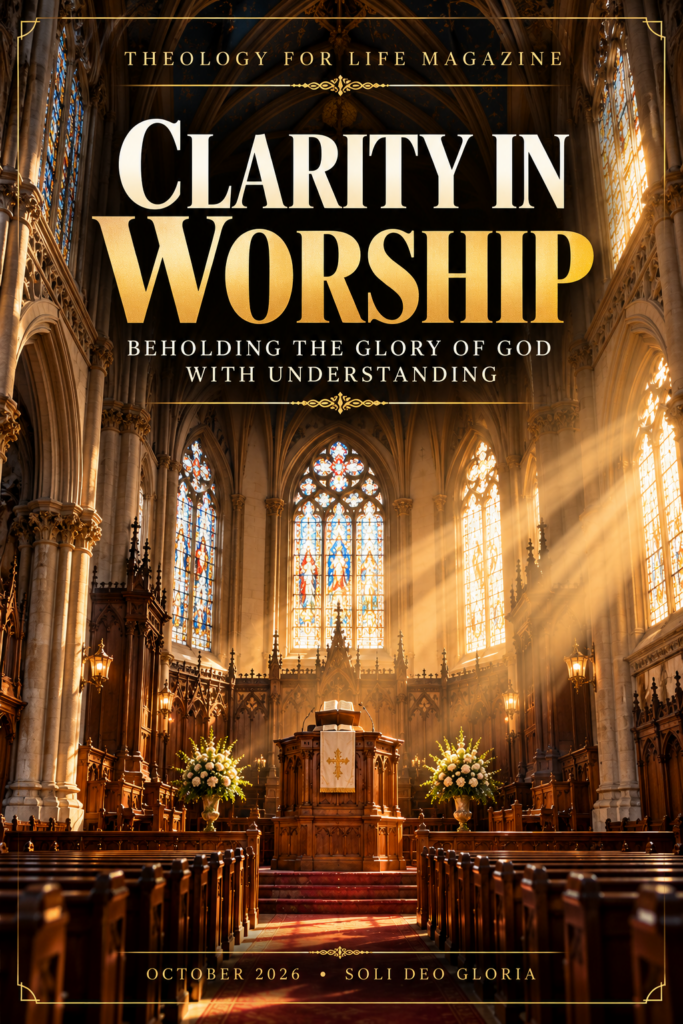
Clarity in Worship: Beholding the Glory of God with Understanding

Dave Jenkins is happily married to his wife, Sarah, and lives in beautiful Southern Oregon. He is a writer, editor, and speaker who loves Christ, His people, the Church, and sound theology.
Dave serves as the Executive Director of Servants of Grace Ministries and the Executive Editor of Theology for Life Magazine. He is the Host and Producer of the Equipping You in Grace Podcast and a contributor to and producer of Contending for the Word.
He is the author of The War of Worldviews: Truth, Lies, and the Battle for the Christian Mind (Theology for Life, 2026), Contentment: The Journey of a Lifetime (Theology for Life, 2024), The Word Matters: Defending Biblical Authority Against the Spirit of the Age and The Word Explored: The Problem of Biblical Illiteracy and What To Do About It (House to House, 2021).
You can connect with Dave on Facebook, X (Twitter), Instagram, YouTube, or subscribe to his newsletter.
When he is not engaged in ministry work, Dave enjoys spending time with his wife, going to movies, sharing a meal at a favorite restaurant, or playing a round of golf with friends. He is also a voracious reader, particularly of Reformed theology and the Puritans, and is often found working through a stack of new books from a wide range of Christian publishers.
Dave earned his M.A.R. and M.Div. from Liberty Baptist Theological Seminary.