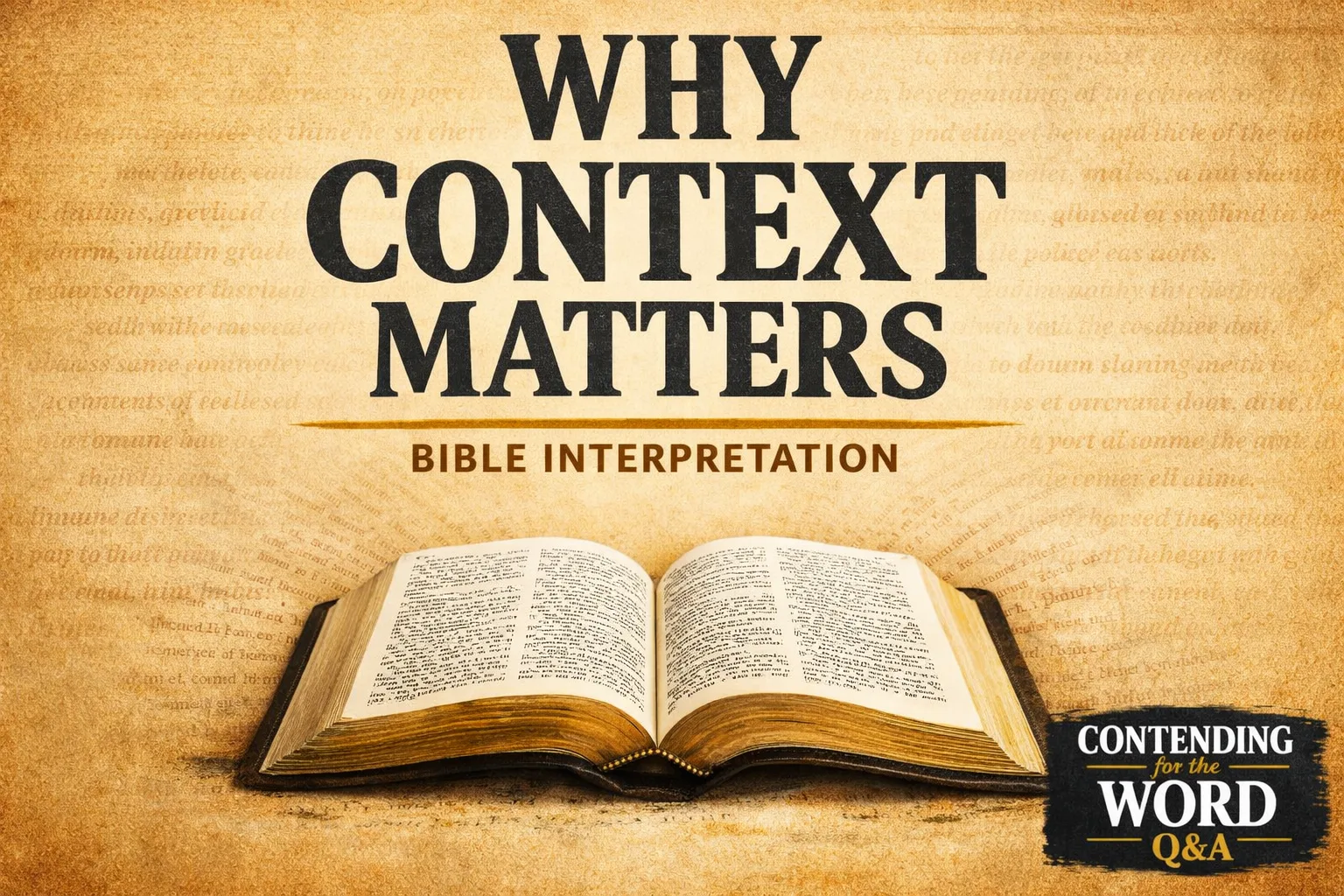
Why Context Matters When Reading the Bible
Scripture is not meant to be guessed at or reshaped. It is meant to be understood as God has given it.
Author: Dave Jenkins
Show: Contending for the Word Q&A
Date: April 3, 2026
Show Summary
Why is understanding context essential for interpreting Scripture faithfully and applying it wisely?
In this episode of Contending for the Word Q&A, Dave Jenkins explains why context matters when reading the Bible and how paying attention to historical, literary, and redemptive context helps Christians handle God’s Word faithfully. Looking at passages such as Jeremiah 29:10–13, Luke 10:25–37, and 2 Timothy 3:16–17, this episode shows how context protects believers from misusing Scripture, clarifies the author’s intent, shapes faithful application, and keeps Christ at the center of Bible reading.
Audio Player
Video Player
Key Scriptures
- Jeremiah 29:10–13
- Luke 10:25–37
- 2 Timothy 3:16–17
Episode Highlights
- Context protects us from misusing the Word of God.
- Context helps us understand the author’s intent.
- Context shapes faithful application.
- Context keeps Christ at the center.
- Careful Bible reading leads to clarity, confidence, and obedience.
Full Article
As we continue our Scripture Questions month, we are addressing an issue that sits at the heart of many misunderstandings of the Word of God: context.
Many verses are quoted, shared, and applied every day, often with sincerity, but sometimes without regard for their original meaning. When Scripture is taken out of context, even well-known passages can be misunderstood or misused. That is why this is such an important question: Why is understanding context essential for interpreting Scripture faithfully and applying it wisely?
Our anchor texts help us answer that question clearly. Jeremiah 29:10–13 reminds us that God’s promises must be understood in their covenant and historical setting. Luke 10:25–37 shows us that the meaning of the Good Samaritan is tied to the question Jesus was answering and the assumptions He was confronting. And 2 Timothy 3:16–17 reminds us that all Scripture is breathed out by God and given for the instruction and maturity of the people of God.
Together, these passages show that God’s Word is clear, purposeful, and meant to be understood as He has spoken it. Because Scripture is clear, believers are not left to guess its meaning, but are called to understand it faithfully. Context matters because God’s Word has a specific meaning rooted in its historical, literary, and redemptive setting. Understanding that context protects us from misunderstanding and misapplication.
Context Protects Us from Misusing the Word of God
Jeremiah 29:11 is often quoted as a personal promise detached from its setting: “For I know the plans I have for you, declares the Lord.” But in context, this promise was given to Israel in exile. It spoke to God’s covenant faithfulness over time, not to an immediate guarantee of personal prosperity or comfort.
Understanding context does not weaken Scripture. It strengthens our understanding of it. It helps us honor what God actually said rather than shaping Scripture to fit our own desires. When we ignore context, we risk turning God’s Word into a collection of inspirational slogans instead of receiving it as divine revelation.
Context Helps Us Understand the Author’s Intent
Every passage of Scripture was written by a human author under the inspiration of the Holy Spirit. Context helps us understand what the author was addressing, why the passage was written, and how the original audience would have understood it.
In Luke 10, the parable of the Good Samaritan makes sense only when we understand the question Jesus was answering. A lawyer asked, “Who is my neighbor?” and sought to justify himself. Jesus answered in a way that exposed the man’s heart and shattered his assumptions about righteousness, mercy, and love. Without context, we may miss the force of the passage altogether.
Context Shapes Faithful Application
Application flows from meaning. Before we ask, “What does this text mean for me?” we must first ask, “What did this text mean in its original setting, and how should it be rightly understood?” Context helps us apply Scripture faithfully by drawing principles that are rooted in the meaning of the text rather than forcing applications that God never intended.
This guards us from two dangers. On the one hand, it keeps us from legalism, where we impose burdens the text does not require. On the other hand, it keeps us from careless interpretation, where we make Scripture mean whatever we want it to mean. Faithful application begins with faithful interpretation.
Context Keeps Christ at the Center
Every passage of Scripture fits within the larger storyline of redemption. Context includes not only the immediate setting of a verse, but also its place within the whole counsel of God. Reading Scripture in context helps us see how individual passages point to God’s redemptive work in Christ rather than isolating texts from the gospel.
When we read the Bible this way, we see that God’s Word is unified, purposeful, and centered on His saving plan. Context helps us read individual texts as part of the grand story of creation, fall, redemption, and restoration fulfilled in Jesus Christ.
How to Read Scripture with Context in Mind
How, then, do we read Scripture with context in mind?
- Read more than a single verse.
- Pay attention to the surrounding chapter and the flow of the book.
- Ask who wrote the passage, why it was written, and to whom it was addressed.
- Consider the historical setting and literary form.
- Interpret each text in light of the whole Bible.
Context requires patience, but it leads to clarity, confidence, and faithful obedience.
Takeaways / Reflection Questions
- Why is it dangerous to quote or apply Scripture without considering its context?
- How does understanding the original audience and purpose of a passage help interpretation?
- Have you ever misunderstood a verse because you read it in isolation?
- How does reading Scripture in context help keep Christ at the center?
- What practical steps can you take to become a more careful reader of God’s Word?
Call to Action
If this episode helped you think more clearly about God’s Word, please subscribe to the Contending for the Word Q&A page at Servants of Grace or on YouTube, share it with a friend, and visit Servants of Grace for more biblical teaching, theology, and discernment resources.