Why Adding or Taking Away from God’s Word Is Spiritually Dangerous

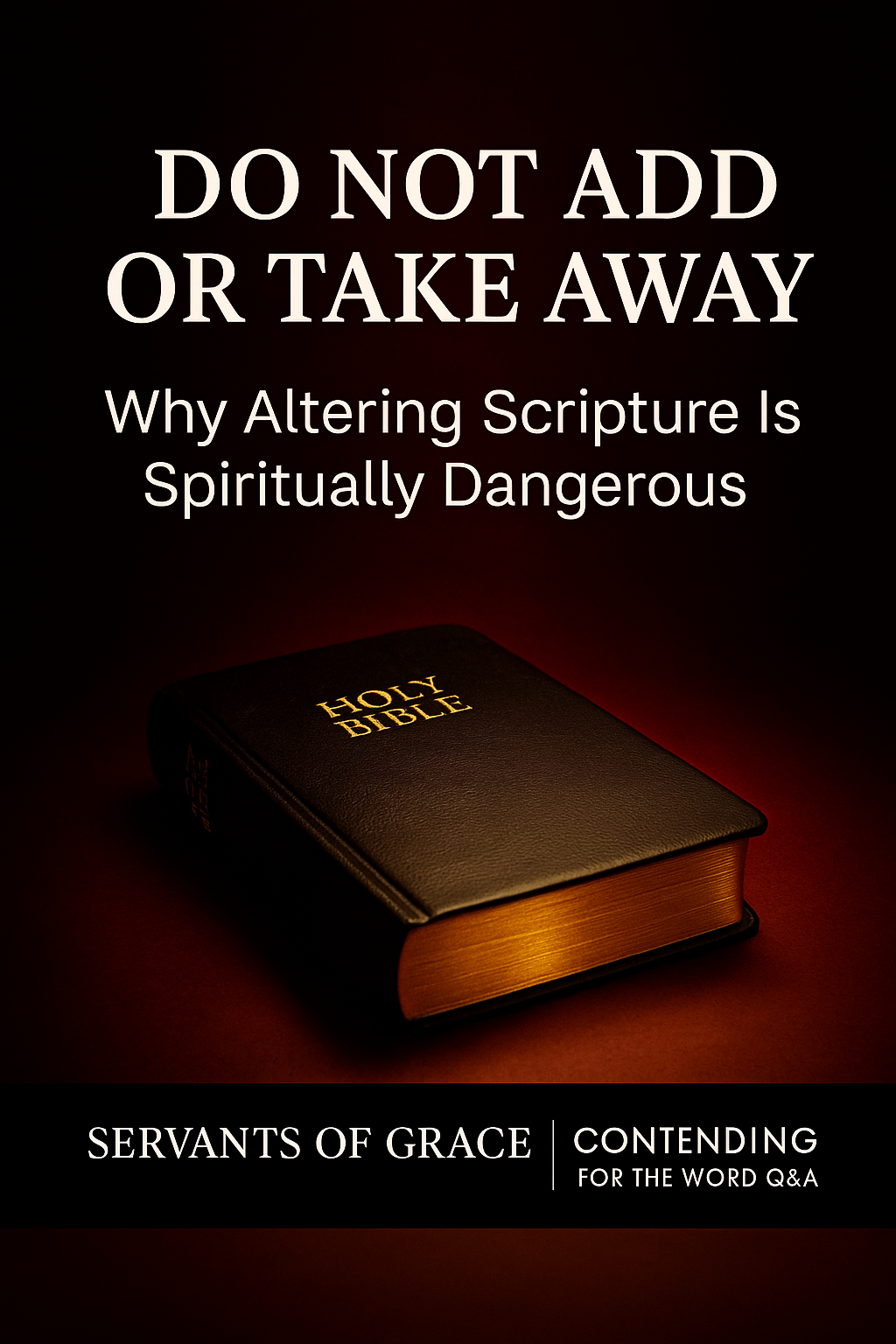
A closed Holy Bible rests on a dark red background, glowing with warm golden light, with bold text above reading ‘Do Not Add or Take Away’ and the subtitle ‘Why Altering Scripture Is Spiritually Dangerous,’ and a black brand bar at the bottom displaying ‘Servants of Grace | Contending for the Word Q&A.

⏱️ Estimated Reading Time: 6 min read

Do Not Add or Take Away, Why Altering Scripture Is Spiritually Dangerous

Show: Contending for the Word Q&A with Dave Jenkins Host: Dave Jenkins Category: Biblical Authority, Discernment

Show Summary

Today’s Question: Why is it dangerous to add or take away from the Word of God?From the Garden of Eden to the final words of Revelation, God warns His people not to alter His Word. Every false religion, spiritual deception, and major doctrinal error begins by questioning, twisting, or replacing what God has said. In this Contending for the Word Q&A episode, Dave Jenkins explains why it is spiritually dangerous to add to or take away from Scripture and how Christians can stand firm on the sufficiency and finality of God’s Word in a confused age.

Listen to the Episode

Watch the Episode

Key Scriptures

  • Deuteronomy 4:2
  • Revelation 22:18–19
  • 2 Timothy 3:16–17
  • Psalm 19:7
  • Genesis 3
  • Hebrews 1:1–3
  • Jude 3

Episode Highlights

  • Every false religion and spiritual deception begins with altering the Word of God.
  • To add to Scripture is to claim that God has not spoken enough, to take away is to claim He has spoken too much.
  • Scripture is God-breathed, perfect, sufficient, and final in its authority.
  • Questioning and revising God’s Word, as in Genesis 3, opens the door to confusion and ruin.
  • God has spoken fully and finally in His Son; there is no new authoritative revelation today.
  • Christians must test experiences, feelings, and teachings by the Word of God, not above it.
  • Faithfulness to Christ means loving, believing, and obeying the whole counsel of God.

Full Article

Why It Is Dangerous to Add or Take Away from God’s Word

From the very beginning of Scripture to its closing chapter, the Lord warns His people not to tamper with His Word. Deuteronomy 4:2 commands, “You shall not add to the word that I command you, nor take from it,” and Revelation 22:18–19 declares God’s solemn judgment on those who add to or take away from the words of the prophecy.Every false religion and every serious doctrinal error begins with a distortion of God’s revelation. The moment we add to Scripture or subtract from it, we place ourselves above God, acting as if we can edit His speech. To add to Scripture is to say that God has not spoken enough. To take away from Scripture is to say that He has spoken too much. Both are acts of rebellion against His authority.

1. God Alone Has Authority to Speak for Himself

Scripture is “God-breathed” (2 Timothy 3:16–17). The Bible is not a collection of human opinions about God; it is the very Word of God written. No human tradition, spiritual impression, or religious authority can stand beside or above what God has revealed in Scripture.When we alter Scripture, we are not merely adjusting a text, we are usurping God’s throne and claiming His authority. Only God has the right to declare His will. Our calling is not to improve His revelation but to listen, believe, and obey.

2. Scripture Is Perfect and Sufficient

Psalm 19:7 says, “The law of the Lord is perfect.” God’s Word lacks nothing. It is sufficient to make us wise for salvation, to equip us for every good work, and to guide us in a life of godliness. We do not need modern revelations, mystical experiences, or cultural updates to complete what God has spoken.When we suggest that Scripture is outdated, incomplete, or unclear, we are, in effect, saying that God’s wisdom is lacking. The Bible is perfectly suited to every generation because it is the Word of the eternal, unchanging God.

3. Altering Scripture Opens the Door to Deception

The first sin in human history began when God’s Word was questioned and revised. In Genesis 3, the serpent said, “Did God actually say…?” and then twisted the Lord’s clear command. That pattern has repeated throughout history. Every false religion, cult, and major theological error traces back to adding to or subtracting from God’s Word.When Scripture is compromised, truth collapses. Once we give ourselves permission to change or ignore what God has said, there is no firm standard left to guard us from deception. We drift from the anchor of God’s revelation into the shifting winds of human opinion.

4. Scripture Is God’s Final Revelation in Christ

Hebrews 1:1–3 tells us that God, who formerly spoke through the prophets, “has in these last days spoken to us by his Son.” Jesus Christ is the full and final revelation of God, and the apostolic witness to Christ has been recorded for us in the pages of the New Testament.There is no new authoritative revelation coming today. The canon of Scripture is complete, sufficient, and final. Christ is enough, and His Word is enough. Claims of fresh, binding revelation stand in direct opposition to the sufficiency of Scripture.

Putting This Into Practice Today

First, we must refuse to elevate personal experience, feelings, or emotions above the Word of God. Our experiences must be tested by Scripture, not the other way around. Second, we must reject teaching and movements that claim new revelation from God, especially when those claims revise or contradict what God has already spoken.Third, we are called to submit our beliefs, our consciences, and our decisions to the authority of God’s Word alone. A helpful question to ask in conversation is, “How do you know that is true?” That question invites people to reveal their authority, and from there we can gently point them to what God has said in His written Word.Finally, we must love and obey the whole counsel of God, not just the parts that are comfortable for us. Faithfulness to Christ means being faithful to His Word. It is dangerous to add to or take away from Scripture because God alone defines truth, and His Word is final, sufficient, and authoritative. To change Scripture is to oppose God. To obey Scripture is to honor Him and walk in truth. Remember, God’s Word is true, and God’s Word is enough.

Takeaways and Reflection Questions

  • Do I treat Scripture as the final authority over my beliefs, decisions, and conscience?
  • Are there areas where cultural pressure or personal preference leads me to ignore or soften what God has clearly said?
  • Am I willing to test every teaching, movement, and claim of “revelation” by the written Word of God?
  • How can I grow in confidence in the sufficiency and clarity of Scripture in my daily life?

Stay Connected

If this episode strengthened your confidence in the authority of God’s Word, please share it with a friend, subscribe to the Contending for the Word Q&A podcast, and consider exploring more resources at Contending for the Word Q&A page at Servants of Grace or at our YouTube.
Facebook
X
LinkedIn
Pinterest
Email
Print