⏱️ Estimated Reading Time: 11 min read
The Rod in a Shepherd’s Hand: Recovering Church Discipline as a Grace
Always Reforming: Fidelity to God’s Word in Every Generation
By Drew Von Neida
Church discipline is among the most misunderstood responsibilities Christ has entrusted to His church. In some congregations, it has almost disappeared. Public and destructive sin seems to continue without meaningful correction because confronting it is thought to be unloving. Other churches fall into the opposite error. Discipline is practiced, yes. But it functions less like the care of a shepherd and more like the authority of a court. It becomes punitive, controlling, or protective of the institution and its leaders. One error neglects discipline in the name of love; the other practices discipline in a manner that has forgotten what Christian love requires.
Scripture presents us with something different. Church discipline is an exercise of authority given by Christ for the recovery of sinners, the purity of the church, and the honor of His name. It may be painful, and at times it must be severe, but severity and cruelty are not the same thing. This is an important distinction. Biblical discipline is a grace because it refuses to watch quietly while a professing Christian makes peace with the very sin destroying him.
Recovering church discipline belongs to the ongoing work of reforming the church according to Scripture, bringing both our reluctance to confront sin and our exercise of authority beneath the commands of Christ.
Going After the Wandering Sheep
The setting of Matthew 18 should shape the way we understand church discipline. Immediately before Christ instructs His disciples about confronting a sinning brother, He speaks of a sheep that has gone astray and of the shepherd who goes after it. Then He says, “If your brother sins against you, go and tell him his fault, between you and him alone” (Matthew 18:15). If the brother listens, Christ says, “you have gained your brother.”
This language is important. The aim is to gain a brother, not to defeat an opponent.
This does not make the process less serious. If private confrontation is rejected, others are brought into the matter. If their appeals are refused, the matter eventually comes before the church. If the sinner remains stubbornly unrepentant, Christ commands the church to regard him “as a Gentile and a tax collector” (Matthew 18:17). There comes a point when a church can no longer affirm a profession of faith that is being openly contradicted by persistent and unrepentant sin.
Excommunication, then, is not ecclesiastical revenge. It is the solemn recognition that someone has wandered, resisted repeated calls to return, and now lives in such a way that the church can no longer assure him that his profession is consistent with belonging to Christ. The severity of that judgment should never cause us to forget why the church went after him in the first place: it desired to gain its brother.
The Painful Mercy of Discipline
Calling discipline a grace does not mean pretending that it is pleasant. Hebrews 12 speaks directly of God’s fatherly discipline of His children. Although church discipline is a distinct responsibility, this passage helps us understand why loving correction can be painful without being cruel.
Hebrews tells us, “For the moment all discipline seems painful rather than pleasant” (Hebrews 12:11). The same passage, however, reminds us that “the Lord disciplines the one he loves” (Hebrews 12:6). Scripture therefore refuses to place love and discipline against one another.
There is a tenderness that fears causing unnecessary pain, and there is another kind of tenderness that is unwilling to cause any pain at all. The latter may appear compassionate, but it can leave a sinner undisturbed in the very thing that is ruining him. A physician does not hate his patient because the treatment hurts. Sometimes love must be willing to wound in order to heal.
Paul’s instructions to the Corinthians demonstrate this seriousness. In 1 Corinthians 5, he commands the church to remove a man living openly in sexual immorality. Allowing that man to continue in rebellion while enjoying the affirmation of the church would not have been grace. Faithful discipline refuses to offer such a false comfort. Its wound may be severe, but it wounds in the hope of repentance.
The Aim Is Restoration
Galatians 6:1 gives us both the purpose and the spirit of Christian correction: “Brothers, if anyone is caught in any transgression, you who are spiritual should restore him in a spirit of gentleness.” Restoration is not incidental to the passage. It is the work being commanded. Not suggested, but commanded.
That word should govern the heart of those involved in discipline. The goal is not humiliation, public embarrassment, or an opportunity for leaders to demonstrate their authority. Something has gone wrong in the life of a brother or sister, and the church desires to see what sin has disordered brought again beneath the gracious rule of Christ.
Paul immediately warns those doing the restoring, “Keep watch on yourself, lest you too be tempted.” The Christian confronting another person’s sin stands there as a fellow sinner who is himself dependent upon preserving grace. There should therefore be no triumph in another person’s exposure and no pleasure in possessing authority over someone who has fallen. An elder who remembers his own weakness will approach a wandering sheep differently from one who sees the occasion as an opportunity to exercise power. He is dealing with Christ’s sheep, not his own property.
When Discipline Becomes a Weapon
Because Christ has entrusted real authority to His church, that authority can be abused. A pastor may describe disagreement with his leadership as rebellion. Legitimate questions may be labeled as divisive. Concerns about leadership may be treated as threats to church unity, while protecting the reputation of leaders or the institution becomes more important than patiently establishing the truth. The vocabulary of biblical discipline may remain while its character has been lost.
Christ has given authority to His church, but He has not given unlimited authority to church leaders. Their authority is ministerial and must remain bounded by His Word. Elders may declare what Christ has spoken, but they do not possess the right to manufacture sins He has not named. They are to shepherd consciences through Scripture. An elder’s preference does not become God’s commandment because the elder possesses an office.
Church discipline must never be used to silence someone reporting abuse, shield wrongdoing from lawful investigation, or pressure those harmed to abandon appropriate safeguards.
One of the clearest signs that discipline has become punitive is when restoration is continually spoken of but no meaningful path toward restoration exists. The sinner might confess, repent, seek forgiveness, and submit to the appropriate consequences, yet the requirements continue to change. When repentance can never satisfy those administering discipline, we should ask whether the desire to restore and gain a brother is truly governing the process.
This does not mean repentance erases every consequence. Trust that has been destroyed may take considerable time to rebuild, and some consequences may remain permanently. For example, a pastor who has disqualified himself from the office is not automatically qualified again because he has repented. A disqualified pastor can no longer hold that office though he can be restored to fellowship. Restoration to fellowship and restoration to office are not the same thing. Nevertheless, repentance must mean something. When genuine repentance is treated as though nothing has changed, discipline has begun to resemble punishment for punishment’s sake.
When Discipline Has Accomplished Its Proper End
Second Corinthians gives us a needed picture of how the church should respond when discipline and sorrow have accomplished their proper end. Paul writes concerning a disciplined man, “This punishment by the majority is enough,” and then instructs the church to “forgive and comfort him, or he may be overwhelmed by excessive sorrow” (2 Corinthians 2:6–7). He then urges them to “reaffirm your love for him.”
The church must know when to apply the rod, but it must also know when to put the rod away.
Paul was concerned that sorrow, once useful in producing repentance, could become excessive. The church that had been required to act firmly was now required to forgive, comfort, and reaffirm its love. Discipline had not given them permanent possession of the sinner’s shame.
A repentant believer should not be formally forgiven while continuing to be treated as though his worst moment has become his permanent identity. The disposition of the church toward genuine repentance should be unmistakable. We are not waiting for an opportunity to remind the brother of what he was. We are rejoicing that the Lord has brought him back.
Discipline Is Grace to the Whole Church
Restoration of the sinner is central to church discipline, but it is not its only purpose. Paul warns the Corinthians that “a little leaven leavens the whole lump” (1 Corinthians 5:6). Sin openly tolerated among those who profess Christ does not remain a private matter. It begins to teach the congregation that holiness is negotiable and that membership in Christ’s church carries little responsibility beyond having one’s name on a roll.
Faithful discipline teaches something different. It reminds the church that Christ takes sin seriously, that repentance belongs to the Christian life, and that belonging to the visible church means submitting together to the Word of God. It protects weaker believers from the corrupting influence of tolerated sin and guards the church’s public witness from the contradiction of professing a holy Christ while refusing to address open wickedness among His people.
In this sense, discipline is an act of love toward the whole flock. A church that practices it biblically is making a quiet promise to its members: if you wander, we will not easily let you go. We will pray for you, plead with you, confront you when necessary, and seek to bring you home.
The Rod Must Remain in a Shepherd’s Hand
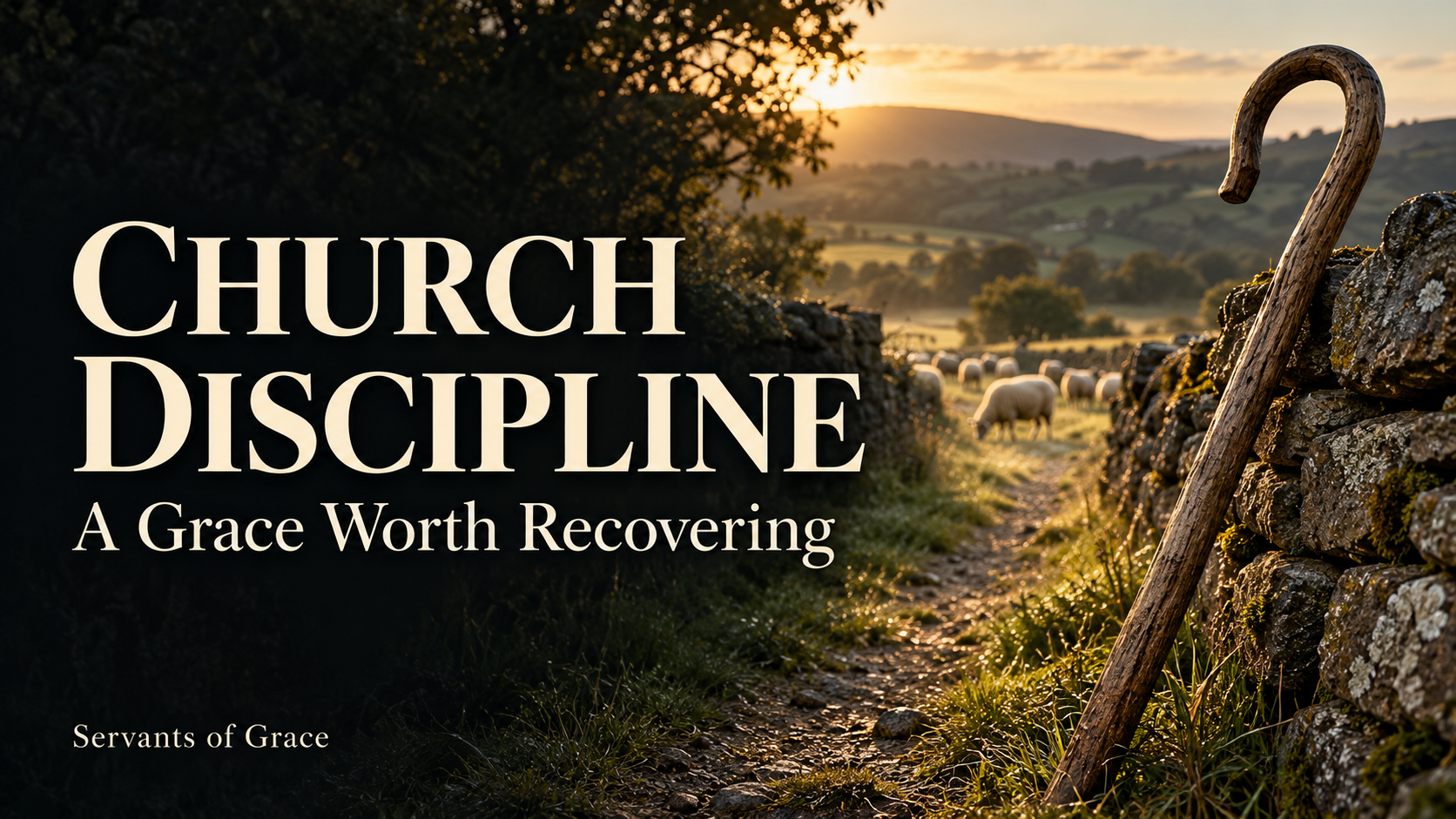
Scripture repeatedly describes church leaders as shepherds, and that image guards us from both neglect and abuse. A shepherd possesses a rod, but the rod does not define his relationship to the sheep. He feeds them, leads them, watches over them, searches for those who wander, and protects them from what would destroy them. The rod belongs within that larger work of shepherding.
An elder exercising discipline should therefore do so with trembling. The person before him ultimately belongs to Christ. Whether that person proves to be a wandering believer or someone whose profession cannot finally be affirmed, he is not an object upon which ecclesiastical authority may be displayed. He is a soul standing before eternity.
A Grace Worth Recovering
The church does not need less discipline. It needs discipline that more closely resembles the heart and commands of Christ. We should reject the sentimentalism that considers confrontation inherently unloving, because there is nothing loving about watching a professing Christian walk deeper into sin because we are unwilling to endure the discomfort of confronting him. We must also reject an authoritarian vision of discipline that turns the authority of Christ into a means of controlling His people. The same Christ who commands His church to discipline also determines the boundaries within which that authority may be exercised.
There is something beautiful about a congregation that loves holiness enough to confront sin and loves sinners enough to forgive them when they repent. Such a church understands that the rod was never given for the satisfaction of striking the sheep. It was placed in the hand of the shepherd because the sheep will wander, wolves will threaten, sin always destroys, and Christ loves His flock.
Church discipline is severe at times because sin is severe. But when practiced according to Scripture, its severity serves mercy. It is one of the ways Christ guards His church, calls wandering sinners home, and teaches His people that the grace which forgives our sin is also a grace that will not leave us comfortably within it.
For more from our latest series, visit Always Reforming: Fidelity to God’s Word in Every Generation. You can also find more biblical teaching on the Servants of Grace YouTube channel.