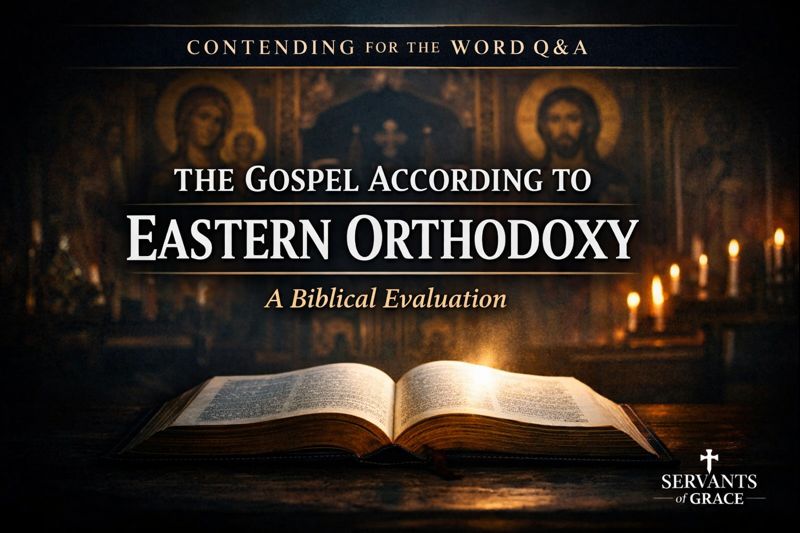
The Gospel According to Eastern Orthodoxy: A Biblical Evaluation
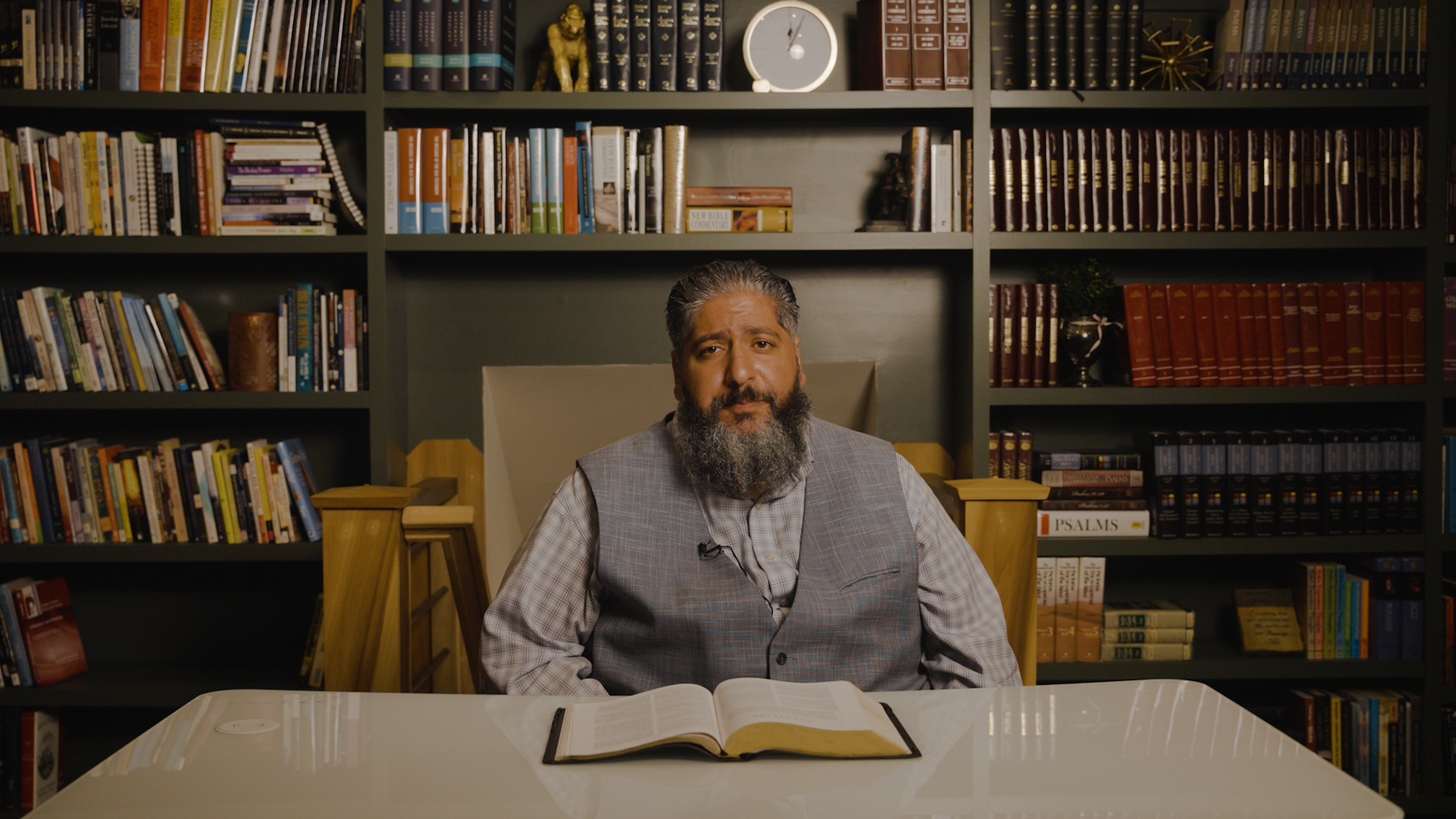
Host: Samuel Farag
Show: Contending for the Word Q&A
Date: January 15, 2026
Show Summary
Since the pandemic, Eastern Orthodoxy has seen a noticeable rise in interest—especially among young men—often driven by online influencers and a desire for stability and tradition. In this episode, Samuel Farag evaluates whether the official teachings of the Eastern Orthodox Church align with the biblical gospel by comparing key doctrines to the clear teaching of Scripture.
Audio Player
Video Player
Key Scriptures
- Galatians 1:8–9
- Ephesians 2:8–9
- Romans 3:21–28
- 2 Timothy 3:16–17
- Exodus 20:4–6
Full Article
Does the Eastern Orthodox Church Teach the Gospel?
By Samuel Farag
Does the Eastern Orthodox Church Teach the Gospel?
By Samuel Farag
The Rise in Popularity of the Eastern Orthodox Church
Since the pandemic, there has been a growing trend of individuals, especially young men, who have been flirting with and flocking to the Eastern Orthodox Church. In fact, parishes in the Eastern Orthodox Church have seen a 78% increase in converts in 2022, according to the Orthodox Studies Institute’s 2024 survey by The Saint Constantine College. This is a dramatic increase from the pre-pandemic levels that were recorded in 2019. One of the largest factors for this drastic increase is due to the impact of Eastern Orthodox influencers and YouTubers. As the 2025 article in The Telegraph says, “Priests are now planning to open new parishes to accommodate the ‘tsunami’ of young men who have converted since the pandemic. They say that most of the new converts found the Orthodox church by watching YouTube videos or listening to podcasts.”[i]
But why the gravitation towards Eastern Orthodoxy? Why are young men the main ones who seem to be the most attracted to this organization? And more importantly, is Eastern Orthodoxy just another Christian denomination that we as Bible-believing Christians should see as fellow brothers and sisters in Christ? Are their claims of being an apostolic church accurate, or are they truly an apostate church? Today, we will explore those questions and more through the evaluation of the official teachings of the Eastern Orthodox Church and compare them to the truth found in Scripture.
The Appeal of Eastern Orthodoxy
Before we get to official doctrines and what the Word of God has to say, it is important to understand the appeal of the Eastern Orthodox Church. According to popular Eastern Orthodox priest Josiah Trenham, a desire to find a “masculine” church has been one of the largest factors in this new trend. He said in a 2024 New York Post article titled, Young Men Leaving Traditional Churches for ‘Masculine’ Orthodox Christianity in Droves, that “The last four to five years have been a massive uptick. It’s showing no sign of tapering off. If anything, it’s increasing still…It’s happening massively in untold numbers all over the country…The feminization of non-Orthodox forms of Christianity in America has been in high gear for decades.”[1]
Another factor is a desire for stability. Recent Eastern Orthodox follower Bailey Mullins said, “People want something that is historic and not going to change. They want something that’s stable and sound and is not built on sand.”[ii] That may seem like some good reasons to some to enter the Eastern Orthodox Church. However, is the Eastern Orthodox Church the “masculine” alternative to the progressive and liberal churches claiming to be Christian but rejecting the truths found in Scripture? In Eastern Orthodoxy, do we really find a church that is stable and not built on sand? The only way to faithfully answer these claims is to turn to the Scriptures and hold the teachings of the Eastern Orthodox Church to the standard of God’s Word and see if they truly stand up to the inerrant and infallible text inspired by the Holy Spirit.
The Official Teachings of the Eastern Orthodox Church
One of the most essential and distinct doctrines of the Eastern Orthodox Church is found in its practice of icon veneration. One can’t think of Eastern Orthodoxy without thinking of icons. Just walk into any Eastern Orthodox Church, and you are immediately hit with icons all over the church building. However, this is not just for decoration. These icons are venerated, which means that they receive incense, are bowed down to, are kissed, and are seen as windows to the actual representative in the image (saints, angels, Mary, and/or Christ). Veneration of icons is also not an optional practice. The Eastern Orthodox Church has made this man-made practice (it is found nowhere in Scripture) a requirement and, for all intents and purposes, salvific.
Here is just a sampling of the anathemas from the Seventh Ecumenical Council, which is also known as Second Nicaea (which is seen as just as infallible and inerrant as the Bible to the Eastern Orthodox Church), and took place in 787 AD. “To those who apply to the sacred images the sayings in divine Scripture against idols, anathema! To those who do not kiss the holy and venerable images, anathema! To those who call the sacred images idols, anathema! To those who say that Christians have recourse to the images as to gods, anathema! To those who knowingly communicate with those who insult and dishonor the sacred images, anathema!”[iii]
By making the idolatrous and unbiblical practice of icon veneration a mandatory requirement, they prove that they peddle a different gospel. For as Paul said in Galatians, “But even if we or an angel from heaven should preach to you a gospel contrary to the one we preached to you, let him be accursed. As we have said before, so now I say again: If anyone is preaching to you a gospel contrary to the one you received, let him be accursed” (Galatians 1:8-9). We are not talking about our Christian brothers and siters from the East when we are talking about the Eastern Orthodox Church. We are talking about an apostate church that adds requirements to the gospel, just like the Judaizers in Paul’s day, with their requirement of circumcision and other practices.
That is not all. The veneration of Mary is downright blasphemous in the Eastern Orthodox Church. Just take a look with me at The Akathist Hymn to the Most Holy Theotokos, which calls Mary the “propitiation of the whole world”[iv] and the “restoration of men.”[v] She is said to be the “forgiveness for many who have stumbled.”[vi] It also says that she “taketh away the filth of sin,”[vii] and the congregation of the Orthodox church proclaims that she is the “salvation of my soul.”[viii] These words do not honor Mary. They dishonor her and insult Christ. Hymns in Eastern Orthodoxy are considered just as inspired as Scripture. So, this hymn is treated just like the Word of God, and this unbiblical attitude of Mary is found in Eastern Orthodox prayers and homilies, which reveal that this is not just “poetic” language, as some Eastern Orthodox apologists claim when they are confronted with this inappropriate language towards Mary.
On top of that, the Eastern Orthodox worldview rejects the biblical doctrine of justification by faith alone. This is shown in The Confession of Dositheus, an official and binding document, which says this in Decree Thirteen, “We believe a man to be not simply justified through faith alone, but through faith which works through love, that is to say, through faith and works…We regard works not as witnesses certifying our calling, but as being fruits in themselves, through which faith becomes efficacious, and as in themselves meriting.”[ix]
All of this stems from the Eastern Orthodox Church’s low view of the Scriptures. As stated in The Confession of Dositheus, Question One, “Should the Divine Scriptures be read in the [common language] by all Christians? No…The [Eastern Orthodox] Church, knowing by experience the damage that can cause, forbids them to read [Scripture]…To read some parts of the Scriptures, and especially of the Old [Testament], is forbidden…For it is the same thing to prohibit undisciplined persons from reading all the Sacred Scriptures, as to require infants to abstain from strong meats.”[x]
So, based on just these points, and there are a whole lot more (see my 10-part teaching series on American Gospel TV (AGTV) that is currently being released, entitled Eastern Orthodoxy: Through the Lens of Scripture), the Eastern Orthodox Church does in fact teach another gospel that clearly conflicts with the Word of God. Genuine born-again believers need to be discerning and avoid the sales pitch being sold by the Eastern Orthodox Church as being the one true church, and stick to the sufficient and perfect truth found exclusively in the Bible.
To God be all the glory!
References
[i] Susie Coen, “Young, Single Men are Leaving Traditional Churches. They Found a More ‘Masculine’ Alternative,” The Telegraph, January 4, 2025, https://www.telegraph.co.uk/us/news/2025/01/04/the-young-men-leaving-traditional-churches-for-orthodox/.
[ii] Schlott, “Young Men Leaving Traditional Churches.”
[iii] Richard Price, The Acts of the Second Council of Nicaea (787) (Liverpool, L69 7ZU: Liverpool University Press, 2020), 111-112.
[iv] Orthodox Christian Prayers, ed. John Mikitish and Hieromonk Herman (South Canaan, PA: St. Tikhon’s Monastery Press, 2019), 207.
[v] Orthodox Christian Prayers, ed. Mikitish and Herman, 210.
[vi] Orthodox Christian Prayers, ed. Mikitish and Herman, 211.
[vii] Orthodox Christian Prayers, ed. Mikitish and Herman, 215.
[viii] Orthodox Christian Prayers, ed. Mikitish and Herman, 216.
[ix] Holy Standards, The: The Creeds, Confessions, and Catechisms of the Eastern Orthodox Church, ed. Joshua Schooping (Olyphant, PA: St. Theophan the Recluse Press, 2020), 48-49.
[x] Holy Standards, ed. Schooping, 68-69.
Subscribe and Stay Connected
If this episode helped you grow in biblical discernment, please consider subscribing to Contending for the Word Q&A. New episodes are released regularly to help you think biblically, contend for the faith, and stand firm on the sufficiency of God’s Word.
If you were encouraged, please share this episode with a friend and help others grow in gospel clarity.