Testing the Spirits: Why Contemplative Spirituality Is an Unbiblical Path to Spiritual Growth

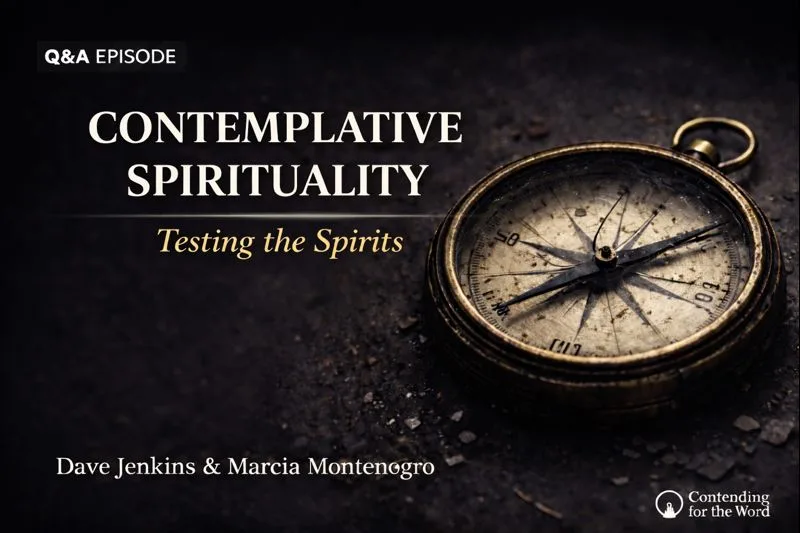
Broken compass on a dark, gritty surface symbolizing false spiritual direction, with the text ‘Contemplative Spirituality – Testing the Spirits,’ a Q&A episode with Dave Jenkins and Marcia Montenegro from Contending for the Word.

⏱️ Estimated Reading Time: 3 min read

Contending for the Word • Q&A

Testing the Spirits: Contemplative Spirituality Q&A

Host: Dave Jenkins • Guest: Marcia Montenegro • Show: Contending for the Word

Show Summary

In this Contending for the Word Q&A episode, Dave Jenkins and Marcia Montenegro examine contemplative spirituality and explain why Scripture commands believers to test the spirits rather than adopt experience-driven and unbiblical methods of spiritual growth. They answer listener questions and contrast contemplative and mystical practices with the sufficiency of Scripture, the nature of biblical meditation, and Word-centered discipleship.

Audio Player

Video Player

Key Scriptures

  • 1 John 4:1–6 — Testing the spirits
  • Acts 17:11 — Examining the Scriptures
  • 2 Timothy 3:16–17 — Sufficiency of Scripture
  • Colossians 2:8–10 — Warning against hollow philosophy
  • Psalm 1:1–2 — Biblical meditation

Episode Highlights

  • What contemplative spirituality teaches and why it appeals
  • Why spiritual “methods” are not theologically neutral
  • How to distinguish biblical meditation from mystical techniques
  • Common doctrinal errors tied to contemplative practices
  • Practical counsel for churches and ministry leaders

Full Article

What is contemplative spirituality?

Contemplative spirituality is often presented as a deeper path to God through interior techniques such as silence, centering practices, altered states, or wordless prayer. While it may use Christian language, its assumptions often shift authority away from God’s Word and toward inner experience or mystical encounter.

Why Christians must test it

Scripture commands believers to test the spirits (1 John 4:1). The test is doctrinal truth measured by Scripture — not emotional resonance or spiritual aesthetics. Any approach to growth that minimizes the Word or redefines prayer and meditation should be examined carefully.

Biblical meditation vs. mystical methods

Biblical meditation is Word-centered — reflecting on God’s truth, applying it, and praying it back to Him (Psalm 1:2). Mystical methods often aim at mental emptying or inner states. Scripture forms communion with God through truth, not technique.

Biblical counsel

If you encounter contemplative practices, ask careful questions about Scripture, Christ, prayer, and sanctification. Bring the answers under God’s Word and pursue growth through the ordinary means of grace — Scripture, prayer, fellowship, and faithful preaching.

Takeaways & Reflection Questions

  • Does this practice elevate Scripture or replace it with experience?
  • Does it define prayer as communion with God or a spiritual technique?
  • What does it teach about Christ and the gospel?
  • Is the local church central or optional?
  • How can you deepen Word-centered prayer this week?

Call to Action

For more from Contending for the Word visit our podcast page or our YouTube playlist.

Explore the full contemplative spirituality series: Series Page.

Facebook
X
LinkedIn
Pinterest
Email
Print