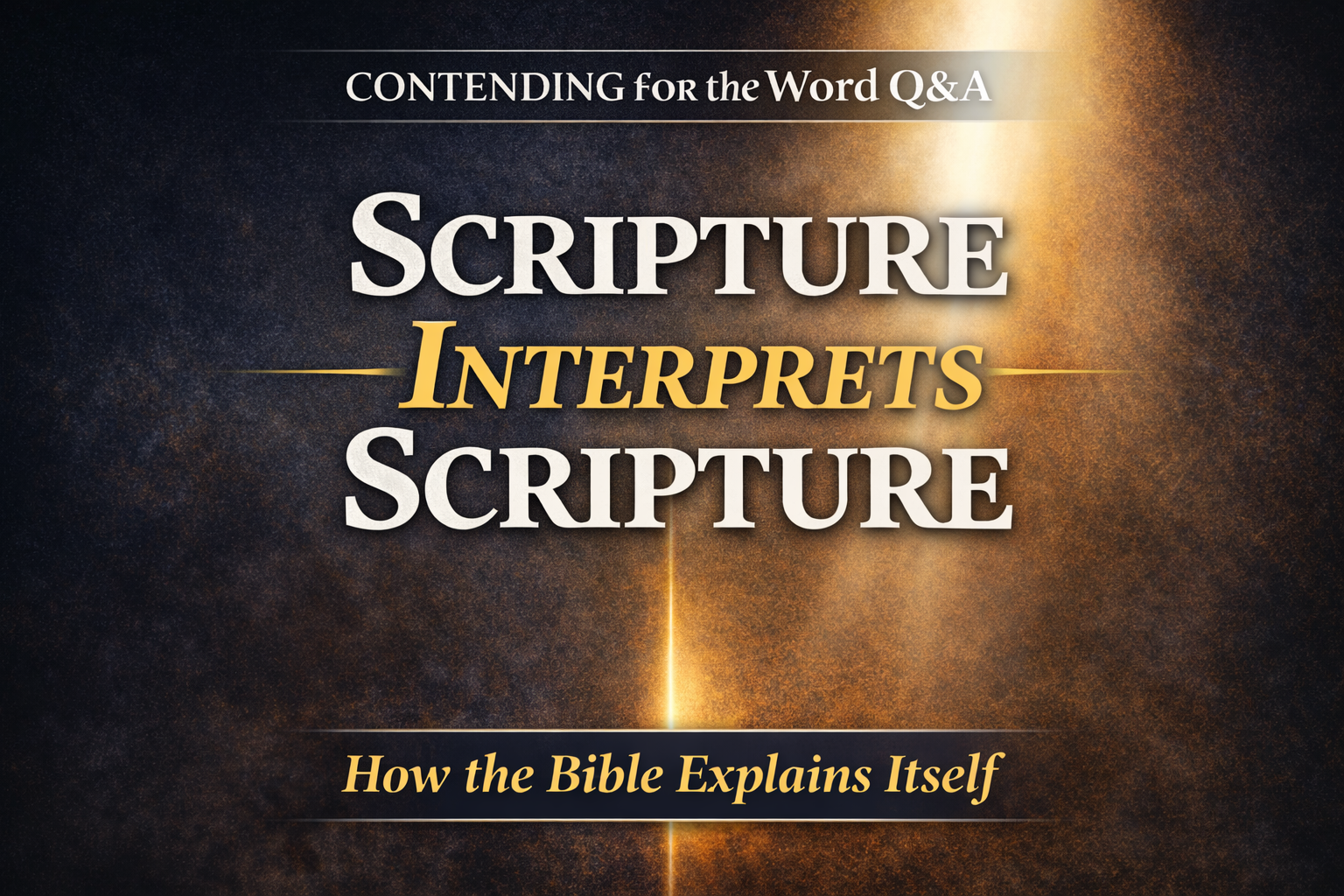
Scripture Interprets Scripture: How the Bible Explains Itself
Author: Dave Jenkins
Series: Contending for the Word Q&A
Date: April 7, 2026
Show Summary
Scripture interprets Scripture is one of the most important principles for understanding the Bible rightly.
In this episode of Contending for the Word Q&A, Dave Jenkins answers an essential question for faithful Bible reading: What does it mean that Scripture interprets Scripture?
Many misunderstandings of the Bible arise when verses are read in isolation from the rest of God’s Word. But the Bible is not a collection of disconnected writings. It is a unified revelation from one divine Author. Because God inspired the whole of Scripture, the Bible is consistent, trustworthy, and interprets itself.
This principle reflects both the unity and clarity of God’s Word. Clear passages help explain difficult ones, and no verse should be understood apart from the whole counsel of God.
Listen to the Audio
Watch the Video
Key Scriptures
- Luke 24:44–45
- 2 Peter 3:15–16
Episode Highlights
- Scripture has one divine author
- Clear passages explain less clear passages
- The Bible must be read in its redemptive context
- Ignoring this principle often leads to doctrinal error
- Christ is the center of the whole story of Scripture
Full Article
One of the most important principles of biblical interpretation is the truth that Scripture interprets Scripture. Because the Bible ultimately has one divine Author, it is unified, consistent, and trustworthy.
While Scripture was written by many human authors across centuries, it comes from the inspiration of the Holy Spirit. This means the Bible does not contradict itself. Differences in style, genre, and emphasis enrich Scripture rather than undermine it. Because God speaks truthfully and consistently, we can allow one passage of Scripture to help clarify another.
Jesus affirmed the unity of the Bible in Luke 24:44–45, explaining that everything written in the Law of Moses, the Prophets, and the Psalms pointed to Him. Then He opened the disciples’ minds to understand the Scriptures. This shows that the Bible is not only unified doctrinally but also redemptively, pointing ultimately to Christ.
The apostle Peter warns that some passages of Scripture are difficult to understand and can be twisted by the ignorant and unstable (2 Peter 3:15–16). This is why Christians must interpret difficult passages in light of clearer teaching throughout the rest of the Bible.
When we read Scripture this way, we avoid building doctrine on obscure passages. Instead, we allow the consistent teaching of God’s Word to guide our understanding. Clear passages illuminate difficult ones, and the whole counsel of God shapes our interpretation.
This principle also guards us from false teaching. Many doctrinal errors arise when verses are isolated from their context or interpreted apart from the rest of Scripture. False teachers often quote the Bible, but they do so selectively and inconsistently.
Allowing Scripture to interpret Scripture protects believers from these errors and helps them remain grounded in truth.
Practically, this means we read the Bible widely rather than narrowly. We compare passages rather than isolating them. We interpret difficult texts in light of clearer teaching, and we keep Christ at the center of our reading.
God has not given His Word to confuse His people but to guide them. As believers read the Bible faithfully and allow Scripture to interpret Scripture, they grow in clarity, confidence, and discernment.
Takeaways
- The Bible has one ultimate author: God.
- Scripture is unified and consistent.
- Clear passages help interpret difficult ones.
- Christ is the center of the entire Bible.
- Faithful interpretation requires reading Scripture in light of the whole counsel of God.
Reflection Questions
- Why is it dangerous to interpret Bible verses in isolation?
- How does the unity of Scripture strengthen our confidence in the Bible?
- How can comparing passages help us understand difficult texts?
- How does keeping Christ at the center shape our Bible reading?
Call to Action
If this episode helped you grow in understanding Scripture, consider sharing it with a friend or someone in your church. For more from Contending for the Word Q&A, visit our page at Servants of Grace or our YouTube playlist.