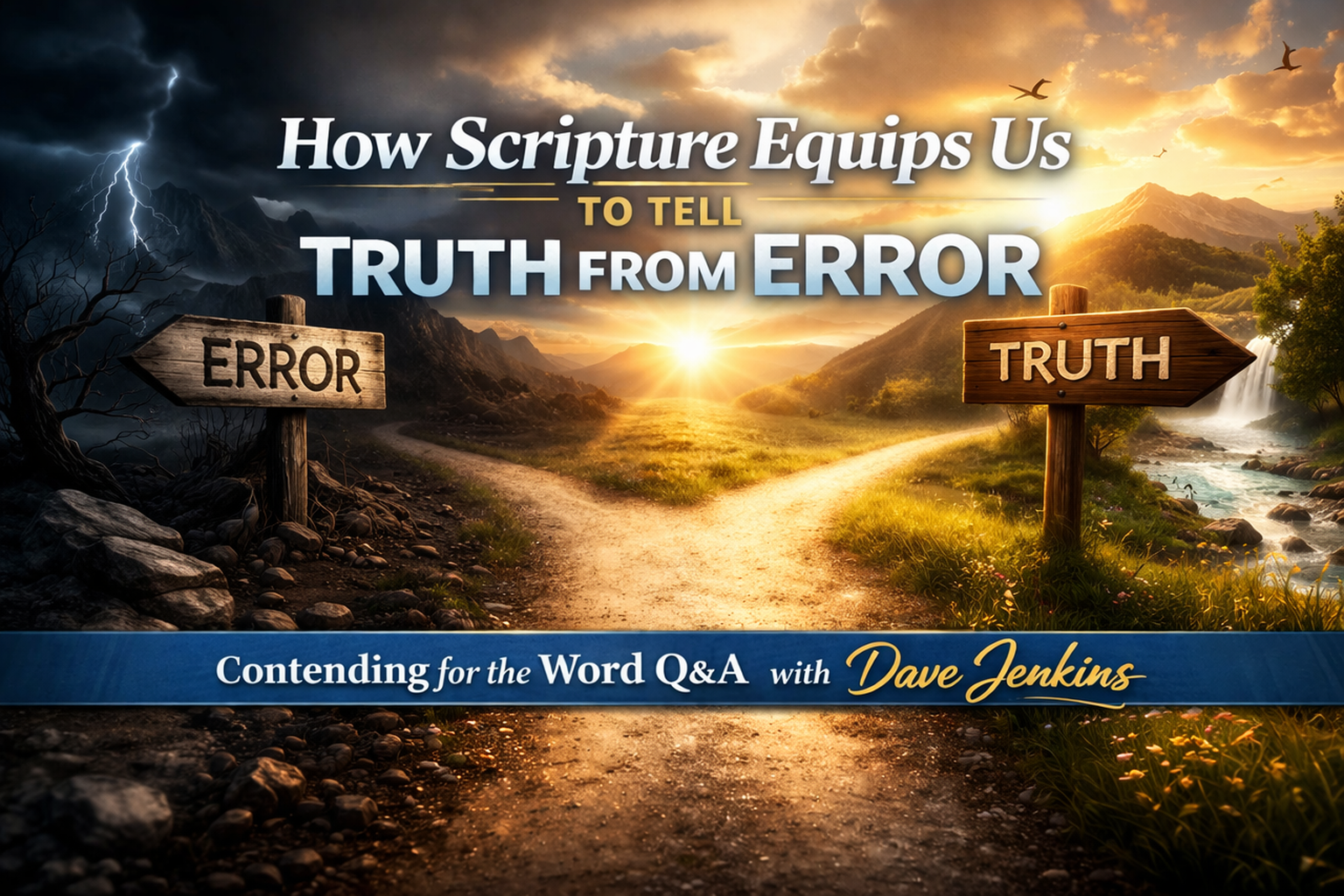
How Scripture Equips Us to Tell Truth from Error | Biblical Discernment Explained
Author: Dave Jenkins
Show: Contending for the Word Q&A
Date: March 2, 2026
Show Summary
Today’s Question: How does Scripture equip us to tell truth from error?
In a world filled with persuasive messages, spiritual counterfeits, and competing truth claims, Christians need more than instinct or emotion—we need minds shaped by the Word of God. In this episode, Dave Jenkins explains how Scripture reveals truth, exposes deception, renews the mind, and trains believers to walk with clarity and conviction.
Audio
Video
Key Scriptures
- 2 Timothy 3:16–17
- Psalm 119:105
- Hebrews 4:12
- Romans 12:2
- James 1:22–25
- Proverbs 2:6–12
Episode Highlights
- Discernment is formed through Scripture, not intuition.
- God’s Word teaches truth and exposes deception.
- Renewing the mind produces spiritual clarity.
- Biblical discernment shapes everyday decisions.
- Scripture equips believers to stand firm in a confused age.
Full Article
How Scripture Equips Us to Tell Truth from Error
Each day we face a world filled with ideas, messages, and influences competing for our attention and shaping how we think. Some messages align with the Word of God. Others openly contradict it. Still others mix truth and error in ways that sound persuasive, compassionate, or even spiritual while quietly drifting away from biblical truth.
Because of this reality, discernment is not optional for the Christian life—it is essential. If believers do not understand how Scripture trains us to think, judge, and evaluate ideas, we will inevitably become vulnerable to confusion and deception.
God has not left His people to navigate life blindly. He has given His Word as our authority—true, sufficient, clear, and binding—so that our minds are formed, our hearts steadied, and our convictions anchored in truth.
So how does Scripture equip believers to tell truth from error?
Scripture Is God-Breathed and Sufficient
Paul answers this question directly in 2 Timothy 3:16–17:
In these two verses, Paul explains both the origin and the purpose of Scripture. The Bible is not merely human reflection or religious opinion—it is breathed out by God Himself. Because Scripture comes from God, it carries divine authority and complete reliability. It is sufficient for shaping the believer’s life and equipping God’s people for faithful living.
Paul also shows how God uses His Word. Scripture teaches what is true, reproves what is false, corrects what is wrong, and trains believers in righteousness. Together, these functions form the foundation of biblical discernment. God equips His people through His Word so they can see clearly and walk faithfully.
Discernment, therefore, is not instinct, personality, or intuition. Discernment is the result of a mind shaped by Scripture.
Scripture Reveals God’s Character and Truth
Biblical discernment begins with knowing who God is. Every theological error ultimately flows from a distorted view of God or a diminished view of His Word. Scripture corrects this by revealing God’s holiness, righteousness, justice, mercy, and unchanging nature.
Psalm 119:105 declares, “Your word is a lamp to my feet and a light to my path.” God’s Word illuminates reality because it reveals the character of God Himself. The clearer our understanding of God becomes, the clearer our discernment grows.
Discernment does not begin by analyzing culture—it begins by beholding God through His Word. When we know who God truly is, deception loses much of its power.
Scripture Exposes Lies and False Teaching
Scripture does not merely present truth; it also exposes error. Hebrews 4:12 teaches that the Word of God is living and active, piercing to the division of soul and spirit and discerning the thoughts and intentions of the heart.
Error rarely appears obviously dangerous. More often, it arrives wrapped in partial truths, emotional appeals, or spiritual language. False teaching frequently sounds compassionate, reasonable, or culturally appealing. That is precisely why deception is dangerous.
But when ideas, teachings, or experiences are tested against Scripture, disguises fall away. The Word of God clarifies what human wisdom often clouds. Without Scripture, lies sound convincing. With Scripture, lies stand exposed.
Scripture Renews the Mind
Discernment is learned and developed over time. Romans 12:2 teaches that believers are transformed by the renewing of their minds. As Scripture reshapes our thinking, our ability to evaluate truth grows stronger.
A mind saturated with God’s Word becomes stable, clear, and wise. In contrast, a mind shaped primarily by the world becomes reactive, confused, and easily swayed by changing ideas.
This is why daily engagement with Scripture matters so deeply. Bible reading is not merely about gaining information; it is about transformation. God uses His Word to form convictions, strengthen judgment, and sharpen our ability to recognize what honors Him and what does not.
Scripture Trains Believers to Walk in Wisdom
Discernment is never purely theoretical. Scripture not only helps believers identify truth; it equips us to live truthfully. Proverbs teaches that wisdom guards and guides the path of the righteous, while James describes Scripture as a mirror that reveals our true condition and directs our obedience.
This means discernment is not primarily about spotting error in others—it is about pursuing godliness in our own lives. Scripture equips believers to make wise decisions, resist sin, pursue holiness, and walk faithfully in relationships, trials, speech, and conduct.
A discerning life is ultimately a Scripture-shaped life.
What This Means for Us Today
Discernment grows wherever Scripture is treasured, trusted, and obeyed. If we desire clarity in a confused age, stability in uncertain times, and wisdom that resists deception, we must anchor our lives in the Word of God.
- Read Scripture not as a checklist but as a lifeline.
- Allow God’s Word to confront and correct you with humility.
- Evaluate teachings, ideas, experiences, and emotions through Scripture.
- Pursue wisdom, not merely information.
God’s Word is sufficient for His people. It is clear enough to guide us, strong enough to steady us, and powerful enough to keep us from drifting into confusion.
So how does Scripture equip us to tell truth from error? It reveals who God is. It exposes deception. It renews our minds. And it trains us to walk in wisdom.
Closing Encouragement
God has not left His people directionless. He has given us His Word—clear, trustworthy, and sufficient—so that we may stand firm in a world filled with shifting ideas and spiritual counterfeits.
Christian, build your life on the Word of God. Let Scripture shape your thinking, strengthen your convictions, and steady your heart. Discernment grows wherever the Bible is read, believed, and obeyed.
For more from Contending for the Word Q&A, visit our Contending for the Word Q&A page or watch episodes on our
YouTube playlist.