⏱️ Estimated Reading Time: 10 min read
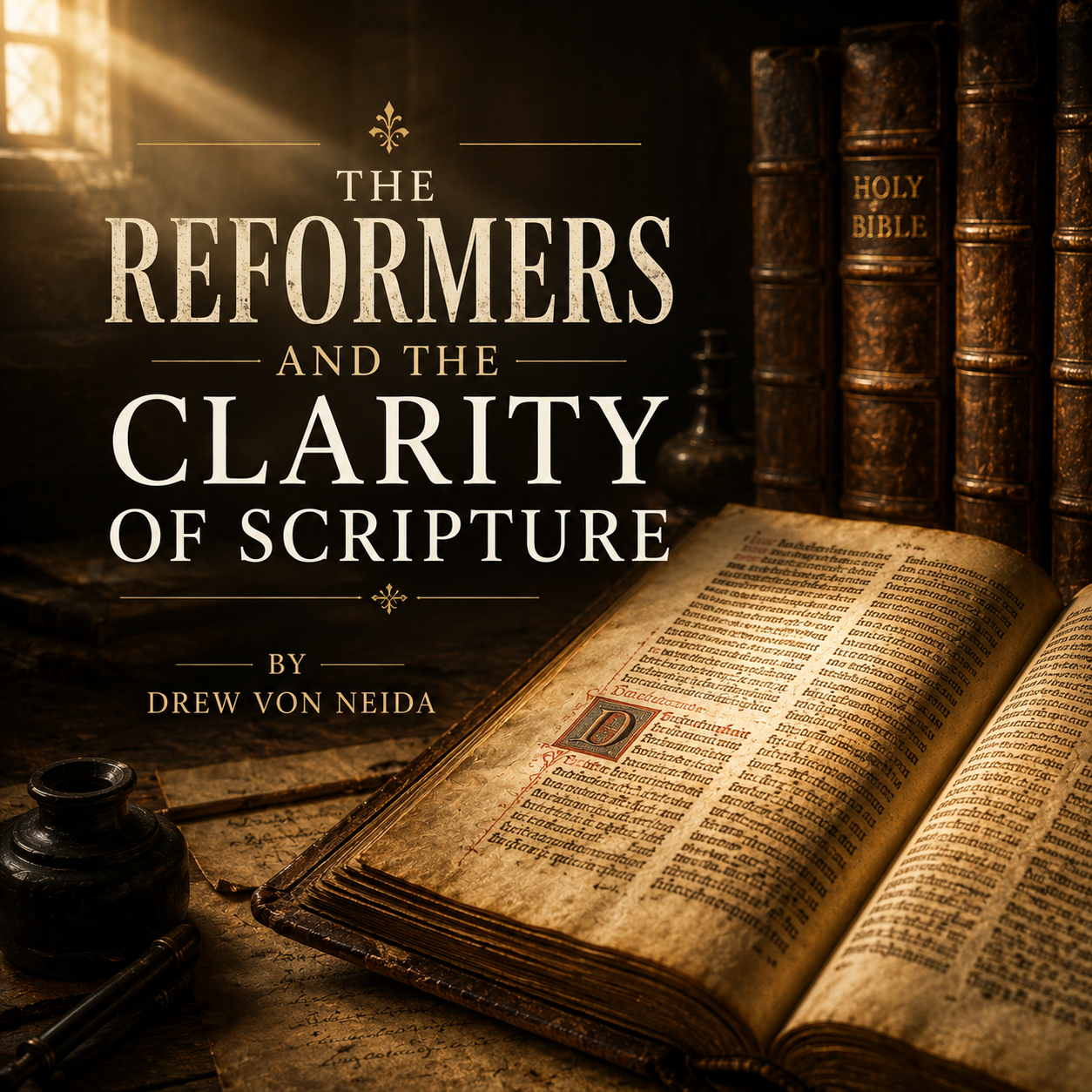
The Reformers and the Clarity of Scripture
By Drew Von Neida
In the centuries preceding the sixteenth-century Reformation, a thick ecclesiastical veil had gradually settled over the pages of Holy Scripture. The Bible itself was not denied, nor was its authority rejected. Yet in practice it was increasingly being treated as a book whose true meaning could only be safely known through the mediation of the Church’s priesthood and its accumulated traditions. The Word of God, which the Psalmist calls “a lamp unto my feet and a light unto my path” (Psalm 119:105), was often handled as though it were a light too distant for the common believer to approach directly. The ordinary Christian was encouraged to trust the Church’s interpretation rather than the clarity of the text itself.
The Reformation was, in many ways, the lifting of this veil. It was the rediscovery of the doctrine of the Perspicuity of Scripture. That is, the Scripture is clear in its content and in its saving message. To the Reformers this was no minor point of theological speculation. It was a matter of spiritual freedom. If the King of Heaven has spoken to His people, He has not spoken in riddles. He has spoken clearly. The God who commands all men to repent and believe the gospel has also revealed that gospel plainly enough to be known.
The Historical Landscape: A Book Bound in Chains
To understand the Reformers’ passion for the clarity of Scripture, we must first understand the interpretive climate they inherited.
The Fourfold Sense
Medieval interpretation often relied on what was known as the Quadriga, the fourfold sense of Scripture. According to this method, every passage could possess four layers of meaning: the literal, the allegorical, the moral, and the anagogical (or heavenly) sense. In theory, medieval theologians affirmed that the literal sense was foundational. However, in practice, allegorical readings frequently overshadowed the plain meaning of the text. Scripture could become a canvas upon which spiritual meanings were painted rather than a message to be plainly heard. For example, a word such as Jerusalem might simultaneously represent a historical city, the institutional Church, the human soul, and the heavenly Kingdom. While such interpretations often sounded devout, they could leave the ordinary reader dependent upon learned authorities to determine what Scripture truly meant.
The Shackled Word
Compounding this difficulty was the language barrier. By the late medieval period the Scriptures were largely confined to the Latin Vulgate. Latin was the language of academia and the clergy, but it was not the language of the plowman. In this environment, many came to believe that clarity belonged not to Scripture itself but to the institutional Church that interpreted it.
Without the guidance of tradition and magisterial authority, it was feared that the Bible might become what critics called a nasus cereus, a “nose of wax”, easily bent to any interpretation. It was in this atmosphere that the Reformers spoke with renewed confidence with the clarity of God’s Word.
The Reformers’ Defense: God Has Spoken Plainly
The Reformers did not deny that some passages of Scripture require careful study. They did, however, insist that the message necessary for salvation shines with unmistakable clarity.
Martin Luther and the Light of the Word
The clearest defense of this conviction came in 1525 when Martin Luther answered the humanist scholar, Erasmus, in his work, The Bondage of the Will. Erasmus argued that Scripture was too obscure to settle many theological questions. Luther replied with characteristic boldness in The Bondage of the Will, writing, “If the words are obscure in one place, yet they are clear in another… The subject matter of the Scriptures, therefore, is all in the light, though some of the words are still obscure. It is wretched of you to say that the Scriptures are obscure… for who will ever be sure of anything, if the Scriptures are obscure?”
Luther distinguished between what he called the external clarity of Scripture and the internal clarity granted by the Holy Spirit. Externally, the Scriptures speak plainly. Their words possess a real and intelligible meaning. Internally, however, the sinner’s heart must be opened by the Spirit of God in order to receive that truth with faith. This means any obscurity with a text lies not in God’s revelation but in the blindness of the human heart.
John Calvin and the Father Who Stoops to Speak
John Calvin approached the clarity of Scripture from the tenderness of God’s fatherly character. In the Institutes of the Christian Religion, section 1.13.1, he described the way God graciously accommodates Himself to human weakness: “For who even of slight understanding does not perceive that God, as it were, lisps with us as nurses are wont to do with little children?”
God, Calvin argued, stoops to our frailty. Like a loving Father bending down to address a child, He communicates His truth in ways we may grasp. Calvin also emphasized that true understanding requires the illumination of the Holy Spirit. The same Spirit who inspired the Scriptures must also open the eyes of those who read them. Without the Spirit, the clearest truth remains unseen. With the Spirit, the humble believer perceives the wisdom of God shining through the written Word.
Ulrich Zwingli and the Word that Interprets Itself
The Swiss Reformer, Ulrich Zwingli, likewise emphasized the inherent clarity and authority of Scripture. In his 1522 treatise, titled, Of the Clarity and Certainty of the Word of God, he wrote:
The Word of God is so sure and strong that if God wills, all things are done the moment He speaks… It is certain, and cannot fail. It is clear, and will not leave us to wander in darkness. It teaches itself, it explains itself, and it brings the light of salvation to the soul.[i]
Zwingli insisted that the Word of God carries within itself the power to reveal its meaning. Scripture is not dependent upon ecclesiastical authority to grant it clarity. Rather, the Word itself shines with divine light.
The Theological Anchor: The 1689 London Baptist Confession
This conviction reached mature expression in the confessions of the seventeenth century. The London Baptist Confession of Faith (1689) summarizes the doctrine with remarkable balance:
All things in Scripture are not alike plain in themselves, nor alike clear unto all; yet those things which are necessary to be known, believed and observed for salvation are so clearly propounded and opened in some place of Scripture or other, that not only the learned, but the unlearned, in a due use of ordinary means, may attain to a sufficient understanding of them.[ii]
This statement guards two vital truths: first, Scripture contains depths that require diligence, study, and humility. Second, the saving message of Christ is so plainly revealed that even the unlearned may understand the way of salvation. God has not hidden the door of mercy behind riddles.
The Biblical Foundation for Clarity
The Reformers did not invent the doctrine of the Perspicuity of Scripture. They discovered it within Scripture itself. Moses told Israel: “For this commandment which I am commanding you today is not too difficult for you, nor is it far from you” (Deuteronomy 30:11). The Psalmist declares: “The unfolding of Your words give light; It gives understanding to the simple” (Psalm 119:130). Even the Apostle Peter, while acknowledging that some things in Paul’s writings are difficult (2 Peter 3:16), still treats the Scriptures as a clear and binding authority for the whole Church. The Bible repeatedly presents itself as a light given for the guidance of ordinary believers.
Why it Mattered Then: The Birth of a New World
The doctrine of the clarity of Scripture reshaped the Christian world.
The Priesthood of All Believers
If Scripture speaks clearly, then every believer may hear the voice of God within its pages. Christians are not dependent upon an elite class of interpreters to access divine truth. Pastors teach and guide the Church, but every believer may test that teaching against the Word of God.
The Vernacular Revolution
If Scripture is clear, it must also be accessible. This very conviction drove men like William Tyndale to translate the Bible into the language of the people. Tyndale famously declared that if God spared his life, the boy who drives the plow would one day know more of the Scriptures than the learned clergy who opposed him.
Assurance of Salvation
Clarity of the Scriptures also brought comfort to troubled souls. The believer no longer had to search for hidden meanings to discover the way of salvation. The promises of Christ speak plainly: “Truly, truly, I say to you, he who believes has eternal life” (John 6:47).
Why it Matters Today: Responding to the Modern Fog
The doctrine of clarity remains just as necessary today.
Interpretive Pluralism
Skeptics often argue that the existence of many denominations proves the Bible is unclear. But Scripture itself warns that misunderstanding often arises from human pride or distortion. As Peter writes: “Which the untaught and unstable distort, as they do also the rest of the Scriptures, to their own destruction” (2 Peter 3:16). The problem is not the light of Scripture, but the unwillingness of fallen hearts to walk in that light.
The Rise of a New Magisterium
Modern Christians sometimes feel that without advanced degrees or specialized scholarship they cannot understand the Bible. While historical study is valuable, Scripture was not written only for academics. It is a public book for the Church of Christ. The same Word that instructs scholars also instructs shepherds, laborers, mothers, and children.
Moral Obscurity
In many contemporary ethical debates, Scripture is often declared “unclear” on matters that previous generations of Christians regarded as settled. The claim of obscurity is frequently a refuge for disobedience. The clarity of Scripture calls us not merely to interpret God’s Word, but to submit to it.
Devotional Application: Treasuring the Accessible Word
To believe in the clarity of Scripture is to believe in a God who graciously speaks to His people. When you open your Bible, you are not entering a labyrinth of divine riddles. You are hearing the voice of your Shepherd. Christ said: “My sheep hear my voice, and I know them, and they follow me” (John 10:27).
Use the Ordinary Means
The Reformers spoke of the “due use of ordinary means.” These can also be referred to as the ordinary means of grace. These are given by God as the way He ordinarily grows and nourishes His people. These means involve prayer, the Word of God, and the ordinances (baptism and the Lord’s Supper). For the believer, understanding Scripture involves prayer, careful reading, and participation in the life of the Church. We compare Scripture with Scripture, allowing the clearer passages to illuminate those that are more difficult. The goal of clarity is not mere knowledge but to grow in holiness. God’s Word is clear in order that our lives may be conformed to Christ. It is not merely a lamp to admire, but a lamp by which we walk.
The Legacy of the Open Book
In many medieval paintings the Bible appears closed, held reverently by saints or angels. In the imagery of the Reformation the Bible is almost always open. This open book symbolizes the recovered truth that God has clearly spoken.
We live in an age where faithful translations of Scripture are widely available. However, the great danger of our generation is not that the Bible is hidden from us, but that it remains unopened. Let us, therefore, treasure the clarity of God’s Word. In its pages the light of Christ shines forth. It is the voice of the God who once said, “Let there be light,” and who now shines in our hearts to give the light of the knowledge of the glory of God in the face of Jesus Christ.
[i] https://www.e-rara.ch/zuz/content/zoom/278863
[ii] 1689 London Baptist Confession, 1.7
Clarity in Scripture: The Authority, Clarity, and Sufficiency of God’s Word

Drew is a regular writer at Servants of Grace and is a regular contributor to the Warriors of Grace podcast. He holds a Bachelor of Science in theological and biblical studies and a Master of Arts in Biblical exposition, both from Liberty University. He lives in Taylorsville, Georgia with his wife Brandy and their three children.