⏱️ Estimated Reading Time: 14 min read
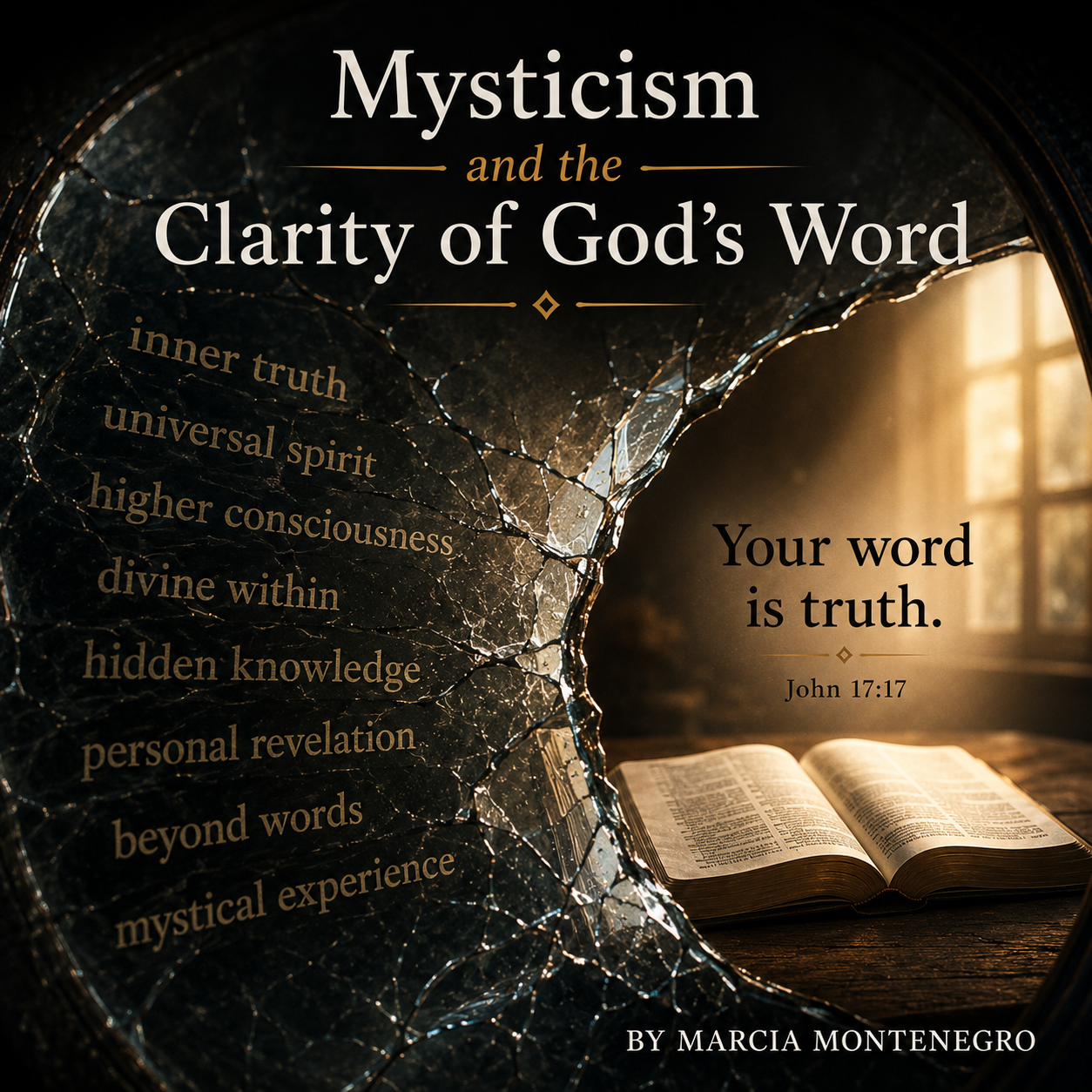
Mysticism and the Clarity of God’s Word
By Marcia Montenegro
Introduction
To appreciate the clarity of God’s Word, it helps to see how it contrasts with something less clear. The clarity of God’s word can be obscured or temporarily forgotten if feelings and experiences bring someone into what appears to be a spiritual experience. Experiences are powerful and able to offer what feels like a God-experience.
The purpose of this article is to explain where we are seeing mysticism in the church and how it undermines the clarity of God’s Word by examining current trends that cloud that clarity and hijack God’s Word for its own ends. A biblical assessment and response are given as well.
What is Mysticism?
Defining Mysticism
Mysticism has been defined as an unmediated contact with the Divine (or whatever a sacred source or being might be called). It is primarily experiential and the methods taught to achieve this involve going inward. As one source[i] describes mysticism:
- “the belief that direct knowledge of God, spiritual truth, or ultimate reality can be attained through subjective experience (as intuition or insight)
- a theory postulating the possibility of direct and intuitive acquisition of ineffable knowledge or power.
- belief in the existence of realities beyond perceptual or intellectual apprehension that are directly accessible by subjective experience.”
Note the word “ineffable” in the second example. This is a key to understanding the Contemplative mindset, which is that silence is superior to words. Words are negatively linked to the mind or intellect by Contemplatives and viewed as inferior to what Contemplatives call the “heart” or “inner being.”
However, this is self-refuting since they must use words to convey this. They also neglect that in the Bible, the word translated as “heart” means the whole self – mind, will, spirit, and emotions. Also seemingly overlooked is the fact that God’s revelation, the 66 books of the canon, are in words.
The Components of Mysticism
Subjective
The components of mysticism include an experience of subjective knowledge and ineffable knowledge. Subjective knowledge is knowing something merely through an inner experience and ineffable knowledge is knowing something that cannot be communicated in words or by ordinary means.
The subjective knowledge gained through mysticism is not from information perceived by the senses, the intellect, through reasoning, or via normal introspection. So, it cannot be based on any objective evidence or truth. Such knowledge is not teachable nor verifiable, so its assertions cannot be evaluated by objective truth. This seemingly protects Contemplative teachings from criticism since the defense is that one must have the experience to really understand it.
It Is Ineffable
Additionally, this mystical knowledge or experience is viewed as superior to knowledge based on facts, tested principles, reasoning, logic, and superior to anything that can be clearly articulated. Words are deemed inadequate to express the experience or knowledge. This is also a self-protective stance which rejects reasoning or logic as shallow or unable to comprehend the Contemplative experience. This is because reasoning and logic would expose the fallacies. So, experience is appealed to in these cases, not Scripture.
It Is Esoteric
Mysticism is by nature esoteric. That is, it is secretive and not able to be communicated with the mind or words, but must be sought inwardly, usually through certain practices. As this Christian article which supports such ideas, states:
“Esotericism, by contrast, offers a more structured and selective path. It involves the study of mystical texts, sacred correspondences, ritual practice, and symbolic systems. The seeker often progresses through initiatory grades, each unveiling deeper layers of insight. Esotericism asks, ‘What is the hidden order behind the visible world? And how can I align with it?’[ii]
The above quote describes the view about the “truths” allegedly hidden behind the visible world that this writer had for many years while in the New Age. So, I am quite familiar with this thinking. What is perceived with the mind and senses is either false or insufficient. This includes knowledge about God from Scripture.
Biblical Response: Mysticism and its esoteric spirituality are by nature contrary to God and his revelation. God’s word is offered to all, is meant to be read in a normal fashion (not looking for codes or hidden messages) and reflects God’s character. God as revealed in Scripture does not hide behind enigmas, nor is he a cipher challenging us to unlock secret codes that lead to him.
Furthermore, God certainly knows man’s limitations but being God, he is more than able to communicate what he wants humans to know. Jesus continually quoted to and referred to the Old Testament scriptures, and stated in his priestly prayer, “Sanctify them in the truth; Your word is truth” (John 17:17). God has given his written Word so that we can know who God and Christ are and understand how to live the Christian life (2 Tim. 3:16; Rom. 4:23-24, 15:4; 2 Peter 1:20-21).
Christians are told to “test all things” (1 Thess. 5:21) and are warned throughout the New Testament of false teachings. One must test teachings in the light of God’s word; God has commanded this (Is. 8:20; Gal. 1:8-9; 1 John 4:1, Acts 17:11, 2 John 1:7-10).
Where Do We See It Now?
In the past two decades, there has been a growing movement of mysticism in the church sometimes called Contemplative Spirituality. It also goes under names such as Spiritual Disciplines, Spiritual Practices, and Spiritual Formation (these terms can be used in a biblical way but, in most cases, they are connected to Contemplative teachings). This includes but is not limited to forms of meditation that put the mind in neutral; repeating words; centering/contemplative prayer; sacred reading (Lectio Divina); practicing solitude and silence; the Prayer of Examen (or Ignatian Prayer); Lectio Visio; and imaginary and guided prayer. Each section below will describe some of these practices followed by how these practices blur and misuse Scripture, with a biblical response.
Prayer Redefined
Prayer is redefined and presented as a meditative state one enters in silence. “Wordless prayer” is promoted; this does not mean silent prayer, which is biblical. It means non-verbal in speech or thought. Contemplative or Centering prayer methods usually involve certain ways of breathing, being still, and entering a state of silence which is believed to be a way to be in God’s presence and hear from him and/or feel his love.
This state of silence, if done with certain breathing or other techniques, is actually a form of self-induced hypnosis in which critical thinking is suspended and the mind is in neutral, receptive to any idea or influence that may enter. It is similar to the methods of Hindu and Buddhist meditation.
In fact, the modern Contemplative Prayer movement deliberately adopted some methods from Hindu and Eastern. A video with Thomas Keating, Basil Pennington, and John Menninger, the three Trappist monks who founded this movement, shows the discussion about incorporating Eastern meditation.[iii] Keating hosted Buddhist monks and a former monk turned Transcendental Meditation teacher at his abbey to teach and meditate with the Trappist monks.
Additionally, Keating and his cohorts drew from the 14th century work, The Cloud of Unknowing, a mystical book thought to have been written by an anonymous monk. Reason and intellect are to be set aside. The Cloud of Forgetting is to forget everything below the cloud so that the Cloud of Unknowing can be pierced by love in order to know God. This theme is a common false dichotomy found in Contemplative Spirituality, that of head (knowledge) versus heart (love).
The book also teaches repetition of a word “to anchor the mind” so that the seeker may be free of thought. The book is esoteric and inward-oriented.
Biblical Response: Prayer as demonstrated in God’s word is starkly different from Contemplative and mystical forms of prayer. Prayer is verbal (whether silent or spoke aloud); it is never a suppression of thoughts or words.
Contemplative Prayer substitutes an esoteric form of meditation for prayer, so it is not really prayer. What is offered is a bait-and-switch. There are no biblical examples that one should cultivate a silent, wordless state or that silence is superior to verbal communication, as the Contemplatives teach.
Scriptures cited by Contemplatives using the word “silent” or “silence” actually reveal that the silence comes about from one of these situations: it is in awe of God’s majesty or something he has done; it is remorse due to having sinned and therefore having nothing to say to God; or silence is a contrast to foolish words.
Jesus himself, when asked by his disciples how to pray, taught the words in Matthew 6:9-13 (also Luke 11:2-4). Is not the pattern for prayer taught by Jesus superior to anything else, especially a prayer based on mystical methods?
Lectio Divina
A method found in some evangelical churches, promoted on Bible apps, and taught in women’s ministries, is Lectio Divina, which means “sacred reading.” This way of reading the Bible is done without taking the context nor the meaning of words into account.
Directions are to read a passage slowly several times, noticing if a word or phrase stands out, and then to meditate on those words. In some cases, the person is to ponder those words for a day or a week, believing them to be a personal message from God.
Biblical Response: Reading the Bible should be done the way one normally reads and understand words, with the mind. If God expected man to read differently, he would have indicated it or not given his revelation in words. The mind and reason are necessary to read words.
Pondering and reading over passages is chewing on the word, which is what the Hebrew word translated as meditation means. It can also mean saying the words aloud, which may have been done for memorization since people did not have Bibles to carry around. This is the kind of meditation God means when that word is used.
Imaginative Prayer, the Prayer of Examen, and Guided Prayer
Imaginative prayer and the Prayer of Examen are connected to Ignatius of Loyola (1491-1556), the founder of the Society of Jesus, known as the Jesuits. He compiled his teachings on methods for spiritual formation in 1548 into a book, Spiritual Exercises. It is noteworthy that Ignatius and the Jesuits were instrumental in fighting the Reformation as part of the Roman Catholic Counter-Reformation.
Imaginative Prayer is also known as Ignatian Contemplation. Most instructions for Imaginative Prayer tell the person to put themselves in the scene of a Bible passage and notice what they feel or think. Some may suggest seeing Jesus do or say something that is not in the text.
Many videos on this practice state that we connect to God and/or know Jesus through our imagination. They urge the viewers to let their imagination unfold to see where they are in a biblical account.
The Ignatian Prayer of Examen and Imaginative Prayer have spread into churches. Jared Boyd, a Vineyard pastor, has taught and written on Imaginative Prayer for children. He writes in the introduction:
“Perhaps in pretending to be with Jesus they might experience what it’s like to see him bring the kingdom.”
So, pretense here is equated with reality. Seeing a “pretend Jesus” in the imagination is not encountering the real Jesus of Scripture. Man’s imagination has not been redeemed (using imagination is also taught by Dallas Willard, Richard Foster, and Peter Greig). The mind and imagination are being conformed to the image of Christ in the process of sanctification, but this is an ongoing, lifelong process. If our minds were totally redeemed and sanctified, we would never have a bad thought.
Pete Greig acknowledges in a video in his Lectio course[iv] that the imagination is “broken,” but he claims that if God spoke through Balaam’s donkey and the burning bush, then God can speak through a ‘broken” imagination.
There are also Bible apps and other Christian apps that offer imaginative prayer and guided visualizations using Scripture, and numerous online videos demonstrating these methods.
Closely related is Guided Prayer. Guided prayer is not the prayer you pray as someone else leads in prayer. It is when someone leads you through a prayer suggesting what to think or visualize. This is often done for healing and found in Inner Healing (also called healing of memories). Inner healing is used in Theophostic prayer, deliverance ministries, some forms of healing prayer, and in some counseling practices. Many who do this do not use the term “inner healing.”
Guided Prayer involves, as in imaginative prayer, somebody directing the person what to see or imagine, and it often involves Jesus since he is used as the instrument of healing (but fallaciously in this case).
One is told to put Jesus into a past traumatic scene and to perhaps hear what Jesus might say in that situation; or one is told that Jesus was there and did say something, so what did he say or do? Again, this is a misuse of imagination. Using imagination is not wrong but it should not be misused in a way that ushers in a pretend Jesus.
Biblical response: For imaginative prayer, it may be a fine line because it is not wrong to spontaneously imagine a scenario with Jesus as you read the Bible. In fact, it is quite normal. It is when one imagines Jesus saying or doing something not in Scripture, especially when directed by another person (found on some Bible apps or in conjunction with Contemplative practices), that it is problematic. In those cases, one may imagine Jesus speaking words not only that he never said, but that he never would say.
However, we don’t evoke the real Jesus with our imagination; encounters with Jesus are through God’s word and in prayer, two of the methods that God has clearly given as the way to know and follow him.
As for examples of the burning bush and Balaam’s donkey, God chose those methods according to his will. Neither Moses nor Balaam were using a bush or a donkey to hear from God. Moreover, God (the text also indicates the “Angel of Yahweh”) did not speak through the bush; God called to Moses from “the midst of the bush” (Ex. 3:4).
The same problems go for Guided Prayer and Inner Healing. These methods conjure a fake Jesus. It is even possible in some cases, if the person is not saved, that it could introduce that person to a spirit guide (fallen angel).
Biblical Truths Vs. Contemplative Practices
Biblical truths are clearly laid out in God’s word. God in his omniscience knows how to communicate what man needs to know in order to know the Trinitarian doctrine, to know who Christ is, how salvation is obtained, and how to live the Chrisitan life. God also gives patterns for prayer in Scripture, especially the prayer Jesus taught his disciples, and the meaning of terms are clear through context.
It is impossible for an omniscient, sovereign God to leave out important information in the Word that he has given. Insufficient revelation would indicate a faulty or negligent God, which is not the God revealed in the Bible, and is contradicted by Second Timothy 3:16.
The Contemplative practices have been demonstrated to be at odds with Scripture and are based on mysticism about how to be close to God. Compared to the clarity of God’s Word, the mysticism of Contemplative practices falls short since it is subjective, murky, and experience-oriented, and lacks the foundation of God’s Word.
References
[i] https://uumystics.org/what-is-mysticism/
[ii] https://www.contemplation.info/spirituality-and-esotericism
[iii] https://www.youtube.com/watch?v=I1VFKlpbol8
[iv] https://www.24-7prayer.com/podcast/meditate-hearing-the-holy-spirit-in-our-thoughts/
Sola Fide: The Heart of the Gospel: Why Faith Alone Still Matters in a Confused Age

Marcia Montenegro was a professional astrologer who believed and practiced many New Age/Eastern beliefs before receiving Christ as her personal Savior. She began a website called Christian Answers for the New Age to help Christians better understand the dangers of New Age/Eastern beliefs and how they are making inroads into the church and Christian community.