⏱️ Estimated Reading Time: 6 min read
Marriage Vows Before God: What Christian Wedding Vows Really Mean
By Michael Schultz
Love, Marriage, and the Christian Life
Ed Ames wrote a song decades ago that included the following verse:
Side by side two people stand,
Together vowing, hand-in-hand
That love’s imbedded in their hearts
But soon, an empty feeling starts
To overwhelm their hollow lives
And when they seek the how’s and why’s
Who will answer?
That song haunts me, because so many people are living without God, and bereft of Him they will never find the answers to their how’s and why’s when empty feelings start to overwhelm their hollow lives. How are Christian couples different though? They are also subject to the pain that comes from those hard questions.
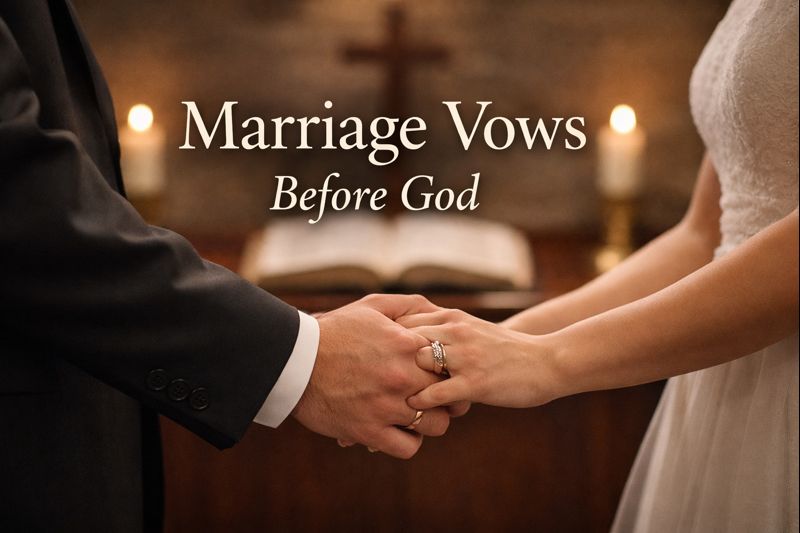
In some sense, one would expect these questions to be anticipated by Christians who get married, but frequently they go unconsidered by newlyweds who have failed to truly consider what it is they are saying when they stand at the altar “together vowing, hand-in-hand.” We must consider these vows very seriously.
What Are Vows Anyway?
Before looking at them directly, it should be noted that while many traditions eschew vowing or taking oaths and covenants, doing so is a Biblical thing to do. Jeremiah 4:1–2 says God will bless those who swear vows and keep them. However, it is always to be done with caution (Leviticus 19:12; Exodus 20:7).
The very word vow comes from the Latin votum which means “a promise to God.” So, one should understand that when we take vows, we are not promising these things to our spouse—we are promising them to God. Breaking these vows, then, is not simply betraying the commitment made to our spouse, but betraying the commitment made to God.
Further, we are commended in 2 Chronicles 6:22–23 to have witnesses present to hold us accountable to the vows we make. Ecclesiastes 5:4–5 tells us that we should fulfill our vows as soon as we can. Numbers 30:2 tells us that if we make a vow, we are expected to fulfill everything we committed to do—not just most of it and not just the “most important” parts.
What Do Christians Say and Mean When We Take Wedding Vows?
While the vows of other faith traditions greatly differ, the vows taken by Christians (including those at my own wedding), are usually very close to this:
“I ______ take you ______, to be my lawfully wedded wife/husband, to have and to hold, for better or worse, for richer or poorer, in sickness and in health, forsaking all others, till death do us part.”
Lawfully Wedded
It goes without saying that a marriage that is performed outside the bounds of what God has prescribed is not a marriage. While the nation one lives in may provide further and helpful provisions for what constitutes a “lawful” marriage (such as age of consent), the ultimate law designating what is a legitimate marriage is always God’s Word as recorded in the Holy Scriptures of the Old and New Testaments.
To save space, I would encourage readers to find the parameters of a Biblically lawful marriage in a historical confession, such as the Westminster or the London Baptist Confession of Faith.
The central premise underlying this part of the vow is:
The couple marrying promise God that they are both fit to marry according to God’s Law.
To Have and to Hold
These words seem to come from the Biblical prescription given to men that he should “hold fast to his wife” (Matthew 19:5; Genesis 2:24). The Biblical term denotes “stickiness” and implies that the married couples are to grasp one another so tightly that two things are true: they cannot drift apart, and nothing can come between them.
The central premise underlying this part of the vow is:
The couple marrying promise God that they will not be pulled or pushed apart, either by others or themselves.
For Better or Worse, For Richer or Poorer
Perhaps the most unfathomable element in the marriage vow is this element, which is often present even in marriages between non-Christians. Imagine the extent of this statement: “I will stay with you no matter how our lives go.”
Many couples divorce today because one or both members has “fallen out of love.” Others separate and divorce over financial hardship, while still others divide over even more frivolous issues.
As a pastor, I always want to ask these couples, “If you have fallen out of love with your spouse, would you describe your life as better or worse?” Or, “If you are experiencing financial turmoil, would you say you are richer or poorer?”
The central premise underlying this part of the vow is:
The couple marrying promise God that they will stay with one another regardless of their life circumstances.
In Sickness and Health
I have had the great privilege in my ministry of sitting in the room with husbands and wives as their spouse took their last breath. In that moment, I have witnessed a bond that is simply incomparable in human relations.
The central premise underlying this part of the vow is:
The couple marrying promise God that they will not allow the transitory nature of health and sickness to separate them.
Forsaking All Others
It has been said that when a man marries a woman, he is simultaneously saying “yes” to her and “no” to everybody else.
The central premise underlying this part of the vow is:
The couple marrying promise God that they will keep their eyes, mind, and body for their spouse alone.
Till Death Do Us Part
Why this lone provision for separation? Because it leaves the end of this marriage union in the hands of the one who ordained it.
The central premise underlying this part of the vow is:
The couple marrying promise God that they will let Him decide when it is time for their marriage to come to His chosen end.
In trusting God with the beginning, middle, and end of marriage, Christian couples find not only obligation, but grace sufficient for every season.
For more from our latest series please visit here or at our YouTube.

H. Michael Shultz Jr. serves as Senior Pastor of Antioch Baptist Church in Lewisburg, KY. He also serves as an Associate Professor of Church History at Forge Theological Seminary. He is married to the love of his life and spends his leisure time on daddy-daughter dates with his little girls.