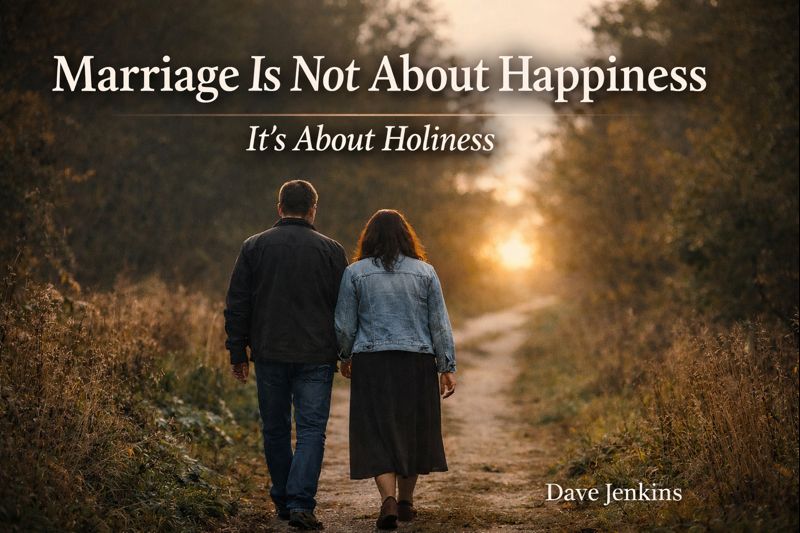
Marriage Is Not About Happiness: It’s About Holiness
By Dave Jenkins
Love, Marriage, and the Christian Life
Our culture treats marriage like a tool for personal fulfillment. The goal is often framed as happiness, compatibility, and the constant meeting of emotional needs. When those feelings fade, many assume something is broken. Even in the church, it can be tempting to talk about marriage in ways that mirror the world just with Bible verses sprinkled on top. But Scripture gives us a more durable, God-centered vision. Marriage is not first about your happiness. It is about God’s glory and your holiness. That might sound severe at first, but it is actually freeing. If happiness is the aim, then suffering feels like failure and conflict feels like disqualification. But if holiness is the aim, then God is at work even in the hard places using marriage as a means of grace to shape you into the likeness of Christ.
Marriage Is a Covenant, Not a Contract
One of the most damaging assumptions we can bring into marriage is that it functions like a contract. A contract says, “I will stay as long as you meet my expectations.” A covenant says, “I will be faithful because God is faithful.” Marriage is a public, lifelong covenant before God that calls a husband and wife to love, serve, and endure in ways the world does not understand. This covenantal commitment matters because it anchors marriage in something deeper than feelings. Feelings rise and fall. Seasons change. Trials come. But covenant faithfulness does not depend on ease or comfort. It depends on the character of God and the calling He places on husband and wife.
Why “Happiness” Makes a Fragile Foundation
Happiness is not evil. Joy is a gift from God. But happiness is a terrible master. If happiness becomes the main goal of marriage, then your spouse becomes the means to an end. Instead of receiving your husband or wife as a gift from God, you begin to evaluate them as a product: “Do they satisfy me? Do they meet my needs? Do they make me feel the way I want to feel?” When happiness is the goal, conflict becomes a threat rather than an opportunity for sanctification. Repentance feels unnecessary because the problem is assumed to be the other person. Endurance becomes optional because the relationship is built on emotional momentum rather than biblical conviction. Scripture calls Christians to something sturdier than constant comfort. God’s purposes are deeper than short-term satisfaction. He is not only interested in your circumstances; He is committed to shaping your character. And one of His chosen tools for that work is marriage.
Holiness Means God Uses Marriage to Expose and Refine
Marriage has a way of bringing your sin into the light. Your spouse will see your impatience, your selfishness, your pride, your harsh words, your avoidance, your anger, your fear, your desire to control. In dating, you can hide many things. In marriage, you cannot. This is not a design flaw. It is part of God’s sanctifying plan. God uses ordinary, daily life in marriage to reveal what needs to be put to death and what needs to be cultivated by His grace. He uses pressure to expose the heart, and He uses repentance and forgiveness to grow love. That means conflict is not automatically a sign you married the wrong person. Conflict is often a sign that two sinners are living closely together and that God is working to make them more like Christ. The question is not whether you will have conflict. The question is whether you will respond in the flesh or in faith.
The Cross Belongs at the Center of Marriage
Christian marriage only makes sense when the cross is at the center. Jesus did not love His people because it was easy. He loved at great cost. He served, suffered, and laid down His life. And the apostle Paul teaches that husbands are to love their wives “as Christ loved the church and gave himself up for her” (Ephesians 5:25). That is not sentimental language. It is cruciform language. It calls husbands to die to selfishness, to lead with humility, to protect, provide, and serve with Christlike strength. And it calls wives to walk in faith, to honor God, to resist bitterness, and to pursue godliness with courage and clarity. When marriage is centered on the cross, love is not reduced to a feeling. Love becomes action. Love becomes repentance. Love becomes patience. Love becomes the willingness to forgive and to pursue reconciliation. Love becomes endurance when life is heavy and the road is long.
What This Means for Real Life
If marriage is about holiness, then you stop interpreting every hardship as a sign that something is doomed. You begin to ask better questions. Instead of asking, “Why isn’t this making me happy?” you ask, “What is God teaching me?” Instead of asking, “How can I change my spouse?” you ask, “How must I repent?” Instead of asking, “How can I escape?” you ask, “How can I be faithful?” This does not minimize the reality of serious sin or real harm. Scripture addresses abuse, unrepentant adultery, and abandonment with sober clarity. But in many marriages, the most common threats are not dramatic scandals they are slow-growing sins: resentment, harshness, neglect, selfishness, prayerlessness, and spiritual laziness. Holiness in marriage means fighting those sins with the means of grace God has provided: the Word, prayer, the local church, wise counsel, repentance, accountability, and patient obedience.
Hope for Struggling Couples
Holiness does not mean misery. In fact, the path of holiness is often the path that leads to the deepest joy. Joy is not produced by chasing happiness. Joy grows as a fruit of obedience and trust. When a husband and wife learn to repent quickly, forgive freely, and pursue Christ faithfully, God often grants a sweeter unity over time. If your marriage feels hard right now, that does not mean God is absent. It may mean He is working. He is committed to completing what He began in His people. And He is able to strengthen the weary, humble the proud, soften the bitter, restore the broken, and help husbands and wives walk in newness of life.
A Better Goal Than Happiness
Happiness rises and falls. Holiness lasts. God is more committed to your holiness than your comfort, and that is good news. He is not wasting your trials, your conflicts, or your tears. He is forming Christ in you. So do not settle for the world’s thin vision of marriage. Fight for covenant faithfulness. Pursue holiness. Keep the cross at the center. And trust that the God who joins husband and wife together is able to sustain them by His grace.
For more from our latest series visit here or at our YouTube.