NAR to Christ
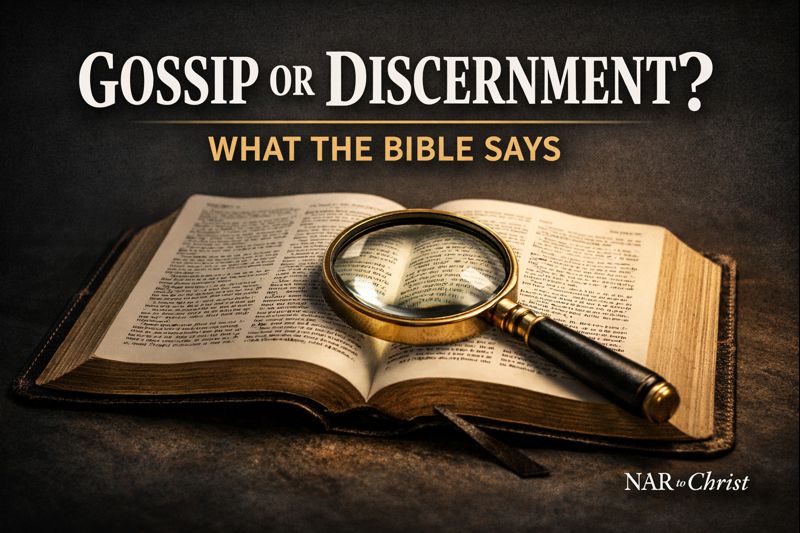
Gossip vs. Discernment: What the Bible Says About Testing Public Teaching
Show: NAR to Christ with Dawn Hill
Author: Dawn Hill
Date: 2/12/2026
Show Summary
What does the Bible actually mean by gossip and slander and is examining public sermons, books, videos, and “prophetic” claims the same thing as gossip? In this episode, we clarify biblical definitions, explain why testing public teaching is a Christian duty, and offer guardrails for speaking truthfully and carefully without crossing into sinful speech.
Listen (Audio)
Watch (Video)
Episode Focus: Distinguishing private rumor-spreading from biblical discernment, and clarifying how Christians should evaluate public teaching with integrity, charity, and Scripture.
Key Scriptures
- Romans 1:28–30
- Proverbs 11:13
- Proverbs 20:19
- Proverbs 26:20
- Matthew 18:15–17
- Ephesians 5:11
- Romans 16:17
- 1 Peter 2:1
Episode Highlights
- What gossip is (and is not) in biblical categories.
- What slander is (and is not) and why accuracy matters.
- Why testing public teaching is not “gossip,” but an act of obedience.
- How labels get weaponized to silence scrutiny.
- Practical guardrails: evidence, context, charity, and restraint.
Full Article
1) Why this conversation matters
In a noisy online age, serious biblical critique is often dismissed with loaded terms—“gossip,” “slander,” or “heresy hunter.” But Scripture does not leave believers guessing. God condemns sinful speech, and God also commands believers to test claims and teaching. The issue is not whether words matter—they do. The issue is whether we are using the Bible’s categories faithfully.
2) What the Bible means by gossip
Biblically, gossip commonly involves repeating information that should not be repeated—often private, unverified, or shared with people who do not need to know—resulting in needless harm and division (see Proverbs 11:13; Proverbs 20:19; Proverbs 26:20). Even “true” information can become gossip when it violates wisdom, charity, and rightful boundaries.
3) What the Bible means by slander
Slander involves false charges, misrepresentation, or speech intended to defame and damage someone’s reputation. It thrives on exaggeration, motive-assigning, and careless claims. Scripture warns that slander belongs to the old life and must be put away (Romans 1:28–30; 1 Peter 2:1).
4) Why testing public teaching is not gossip
When someone publishes sermons, posts videos, sells books, claims divine revelation, or teaches publicly in Christ’s name, that teaching is no longer private. Scripture commands believers to evaluate claims, test what is said, and expose works of darkness (Ephesians 5:11). Discernment is not rumor-spreading—it is measuring public teaching by the public standard of God’s Word.
5) Guardrails for faithful discernment
- Stick to what is public: books, sermons, videos, posts—avoid private claims you cannot prove.
- Quote accurately: represent what was said in context, not as a caricature.
- Avoid motive-assigning: deal with doctrine and claims; do not speculate about hidden intent.
- Keep your tone accountable: no name-calling; no mockery; no exaggeration.
- Aim at protection, not popularity: clarity for the church, not clicks.
Takeaways & Reflection Questions
- Am I using biblical definitions—or online slogans—to judge speech and discernment?
- Do I evaluate public teaching by Scripture, or by personality and platform size?
- Have I repeated unverified information that didn’t need to be repeated?
- When I critique error, do I do so truthfully, carefully, and without slander?
Call to Action
If this episode helped you, please share it with someone who needs biblical clarity. Subscribe for more content that equips believers to think biblically, test all things, and hold fast to what is true. If you enjoyed this episode please visit Dawn’s page at Servants of Grace or at our YouTube.