⏱️ Estimated Reading Time: 9 min read
Following Christ in Humble Service
By Dave Jenkins
Following Christ is not about building a platform, protecting our reputation, or insisting that others recognize our importance. It is a call to follow the Savior who “came not to be served but to serve, and to give his life as a ransom for many” (Mark 10:45).
Humility is not a personality trait reserved for naturally quiet people. It is the fruit of seeing God rightly, seeing ourselves truthfully, and gladly placing the good of others before our own preferences. Christian humility does not deny that God gives gifts, responsibilities, opportunities, or convictions. It receives them with gratitude and uses them for the glory of God and the good of His people.
In a world that teaches us to promote ourselves, defend ourselves, and demand our rights, Christ calls His people to a radically different way of life. He calls us to humble service.
The Pattern of Christ’s Humility
Philippians 2:3–8 gives one of Scripture’s clearest descriptions of the mind believers are to have:
“Do nothing from selfish ambition or conceit, but in humility count others more significant than yourselves. Let each of you look not only to his own interests, but also to the interests of others. Have this mind among yourselves, which is yours in Christ Jesus” (Philippians 2:3–5).
Paul does not ground this command in mere moral improvement. He points us to Jesus. Though Christ is eternally God, He took on human flesh, became a servant, and humbled Himself in obedience to the point of death on a cross.
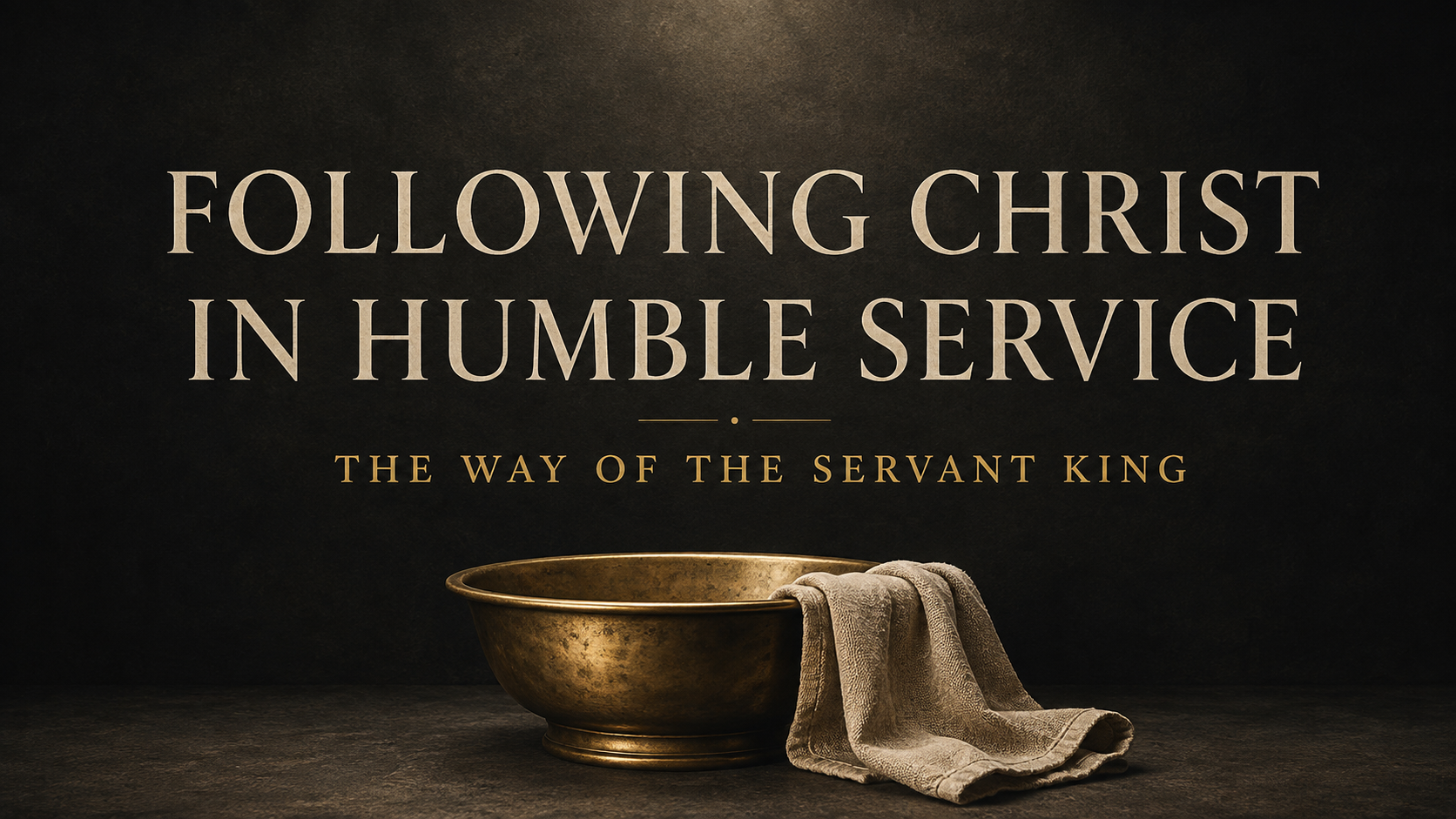
The humility of Jesus was not weakness. It was not uncertainty about who He was. Jesus knew that He had come from the Father and was returning to the Father. Yet, knowing His identity and authority, He washed His disciples’ feet (John 13:3–5). The King stooped low. The Lord of glory served sinful, needy, often-confused men.
This is the pattern for Christian discipleship. We do not serve others to earn God’s favor. We serve because, in Christ, we have already received mercy beyond measure. The gospel frees us from the exhausting need to make much of ourselves. We belong to Christ. We are accepted in Him. We can therefore spend our lives seeking the good of others.
Humility Begins with the Fear of the Lord
Pride places the self at the center. It treats personal preferences, personal comfort, personal success, and personal recognition as ultimate concerns. Humility begins when we remember that God is God and we are His creatures and servants.
Proverbs 11:2 says, “When pride comes, then comes disgrace, but with the humble is wisdom.” Pride blinds us. It makes us quick to speak, slow to listen, resistant to correction, and eager to find fault in others. It is possible to use right words, defend true doctrine, and even engage in ministry while being driven by a proud heart.
The fear of the Lord brings us back to reality. Everything we have is a gift from God. Our salvation is a gift of grace. Our abilities are gifts. Every open door, every relationship, every opportunity to serve, and every measure of strength comes from the hand of the Lord.
Paul asks in 1 Corinthians 4:7, “What do you have that you did not receive?” That question exposes the foolishness of boasting. Christians have no room for self-congratulation, because every spiritual blessing is found in Christ and comes to us by grace.
Humility does not mean pretending that sin is not sin or refusing to speak with biblical conviction. It means submitting every conviction, every gift, and every ambition to the lordship of Christ. The humble Christian seeks to be faithful, not impressive.
Humble Service Looks for the Good of Others
Jesus teaches His disciples that greatness in His kingdom is unlike greatness in the world. When the disciples argued about prominence, Jesus said, “Whoever would be great among you must be your servant” (Mark 10:43).
This does not mean that every Christian will have the same role in the church or the same opportunities in life. God gives different gifts and assignments to His people. But every believer is called to use what he has received in love.
Humble service often appears in ordinary ways. It is the husband who sacrifices his comfort to care for his wife. It is the wife who faithfully serves her family with joy and strength. It is the church member who notices someone sitting alone and welcomes them. It is the mature believer who makes time to encourage a younger Christian. It is the person who serves without needing public recognition.
Much of Christian service will never be seen by crowds. It may be a prayer offered in private, a meal prepared for a grieving family, a word of encouragement sent at the right time, or a faithful act of obedience when no one is watching.
The Lord sees what others do not. Hebrews 6:10 reminds us that God “is not unjust so as to overlook your work and the love that you have shown for his name in serving the saints.” Faithful service is never wasted when it is offered unto Christ.
Humility Receives Correction
One of the clearest tests of humility is how we respond when we are corrected. Pride immediately becomes defensive. It explains, excuses, shifts blame, and looks for the failures of others. Humility listens carefully.
This does not mean that every criticism is true or wise. Christians are called to exercise discernment. But the humble person is willing to ask, “Is there something here I need to hear?” He is willing to examine himself in light of Scripture. He is willing to repent when he has sinned.
Proverbs 9:8–9 says, “Reprove a wise man, and he will love you. Give instruction to a wise man, and he will be still wiser.” A believer who desires to follow Christ should want to grow in grace. That growth requires a teachable heart.
God often uses fellow believers to expose blind spots in our lives. The local church is one of His gracious means of helping us mature. We need brothers and sisters who will speak the truth in love, pray for us, and point us back to Christ when we wander.
A humble Christian does not view correction as an attack on his identity. His identity is secure in Christ. He can acknowledge failure because the gospel assures him that Jesus died for sinners and that His grace is sufficient for those who repent and believe.
Humility Serves Without Keeping Score
Pride keeps a record. It remembers every sacrifice, every inconvenience, every time someone failed to say thank you, and every moment when another person received credit. It serves as long as it receives something in return.
Christ calls us to a better way.
In Luke 6:35, Jesus says, “Love your enemies, and do good, and lend, expecting nothing in return.” This is not natural to us. We are often tempted to serve people only when they are grateful, helpful, or likely to repay us. But Christian love flows from the grace we have received from God.
Jesus served those who misunderstood Him. He loved those who opposed Him. He washed the feet of Judas, knowing that Judas would betray Him. His love was not controlled by the response of others. It was rooted in His obedience to the Father and His purpose to save His people.
When we serve Christ, we can entrust recognition and outcomes to Him. We do not need to keep score because our reward is not ultimately found in the approval of people. The Lord knows. The Lord sees. The Lord will bring every faithful act into the light.
Serving in the Strength Christ Supplies
Humble service does not mean attempting to carry every burden in our own strength. It is possible to be busy in ministry while neglecting communion with the Lord. It is possible to serve others outwardly while becoming spiritually weary, resentful, or self-reliant inwardly.
Peter reminds believers that they are to serve “by the strength that God supplies—in order that in everything God may be glorified through Jesus Christ” (1 Peter 4:11). Christian service is sustained by grace. We need the Word of God, prayer, fellowship, rest, and the regular reminder that Christ is the One building His church.
The goal is not to become indispensable. No servant of Christ is. The goal is to be faithful. God does not need us, yet in His grace He uses us. That should make us both diligent and humble.
As we follow Christ, we must remember that He is not asking us to create a life of self-made spiritual greatness. He calls us to abide in Him, obey His Word, love His people, and serve in the strength He provides.
Following the Servant King
The Christian life is a life of following the Servant King. Jesus did not come to exalt Himself through the praise of men. He came to obey the Father, seek and save the lost, bear the sin of His people, and rise in victory over death.
His humility led to the cross, and the cross is the foundation of our hope. Because Christ humbled Himself for us, believers are forgiven, reconciled to God, and given new hearts. We are no longer enslaved to the endless pursuit of self.
So let us follow Christ in humble service. Let us put away selfish ambition. Let us welcome correction, seek the good of others, and serve without demanding recognition. Let us use what God has given us for His glory, trusting that the Lord sees every quiet act of faithfulness.
The way of Christ is not the way of self-exaltation. It is the way of humble obedience, sacrificial love, and joyful service to the One who gave Himself for us.
For more from our latest series visit here or at our YouTube.

Dave Jenkins is happily married to his wife, Sarah, and lives in beautiful Southern Oregon. He is a writer, editor, and speaker who loves Christ, His people, the Church, and sound theology.
Dave serves as the Executive Director of Servants of Grace Ministries and the Executive Editor of Theology for Life Magazine. He is the Host and Producer of the Equipping You in Grace Podcast and a contributor to and producer of Contending for the Word.
He is the author of The War of Worldviews: Truth, Lies, and the Battle for the Christian Mind (Theology for Life, 2026), Contentment: The Journey of a Lifetime (Theology for Life, 2024), The Word Matters: Defending Biblical Authority Against the Spirit of the Age and The Word Explored: The Problem of Biblical Illiteracy and What To Do About It (House to House, 2021).
You can connect with Dave on Facebook, X (Twitter), Instagram, YouTube, or subscribe to his newsletter.
When he is not engaged in ministry work, Dave enjoys spending time with his wife, going to movies, sharing a meal at a favorite restaurant, or playing a round of golf with friends. He is also a voracious reader, particularly of Reformed theology and the Puritans, and is often found working through a stack of new books from a wide range of Christian publishers.
Dave earned his M.A.R. and M.Div. from Liberty Baptist Theological Seminary.