⏱️ Estimated Reading Time: 8 min read
From Dry Bones to Disciples: How God’s Word and Spirit Make Disciples
James Williams
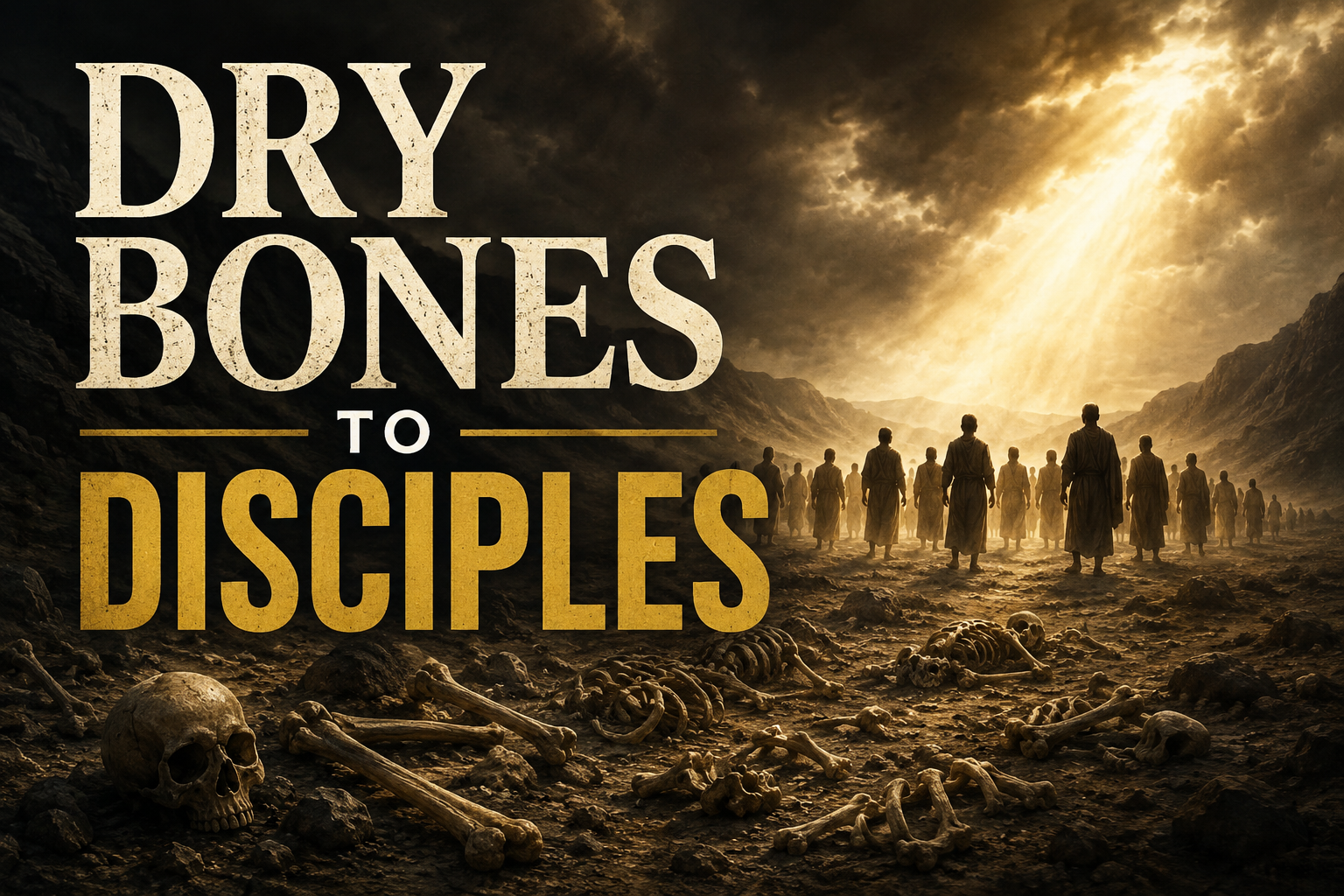
As Ezekiel was led through a parched valley, he wondered how many lives had been lost. Everywhere he looked, there seemed to be endless piles of bones without any sign of life.
A violent battle had taken place, leaving many corpses behind, but decomposition and wild animals had taken their toll so that only dry bones remained.
“Can these bones live?” the Lord asked Ezekiel.
Preaching to the Dead
No doubt, this was a difficult question to answer. To say “no” would be to doubt the very power of God. But to say “yes” wasn’t easy considering the bleak sight all around him. Perhaps Ezekiel had heard stories of dead people being resuscitated.
However, the valley wasn’t filled with recently deceased bodies; these were merely bones. There was no skin, no organs, nothing besides disconnected skeletons, and they were so dry they surely had been there a while.
“O Lord God, you know,” Ezekiel humbly replies.
“Prophesy over these bones,” commands the Lord.
Humanly speaking, this is a rather strange request. I’ve preached to some seemingly lifeless audiences, but I’ve never preached to bones. What good is it to declare the Word of the Lord to those who are dead?
However strange it may have been, Ezekiel obeys. As he preaches, the bones begin to shake. They come together to form fully connected skeletons. Tendons and muscles start to form and are finally covered with skin. Instead of bones, there are now full human bodies.
But there is still no life in them.
The Lord tells Ezekiel once again to prophesy, this time to the breath. Ezekiel obeys another strange request, and breath begins to enter these lifeless bodies, resulting in this pile of bones becoming a mighty army.
Hope for Dead Transgressors
Ezekiel 37:11–14 provides the interpretation of this vision. In short, God’s people had disobeyed the covenant and pursued other gods. The people had repeatedly experienced God’s grace, yet they had become presumptuous about their sin. They didn’t think God would ever destroy Jerusalem.
However, they failed to remember the covenant curse for disobedience as described in Deuteronomy 28:25–26: “The Lord will cause you to be defeated before your enemies. . . . And your dead body shall be food for all birds of the air and for the beasts of the earth” (a repeated warning also appears in Jeremiah 34:17–20).
The bones scattered abroad in the valley in Ezekiel’s vision are a picture of those who received the covenant curse through the Babylonian defeat and also lacked a proper burial for the slain.
The people have experienced judgment for their sins, but God has not completely abandoned them. Despite the grim effects of their disobedience, the vision ends with hope. God promises to restore His covenant people from the death-like judgment of exile. The imagery is nothing less than resurrection and re-creation, accomplished through His Word and Spirit.
God’s judgment would not overturn His redemptive purposes. He would preserve and restore His people, ultimately fulfilling His covenant promises through Abraham’s offspring, Jesus Christ, through whom blessing would come to the nations (Genesis 22:15–18).
The Power to Make Disciples
We’re all likely familiar with the Great Commission in Matthew 28:19–20:
“Go therefore and make disciples of all nations, baptizing them in the name of the Father and of the Son and of the Holy Spirit, teaching them to observe all that I have commanded you. And behold, I am with you always, to the end of the age.”
As believers, we’re all commanded to make disciples. The command to make disciples includes proclaiming the gospel to the lost, baptizing those who believe in the name of the Triune God, and teaching Christ’s disciples to obey everything He has commanded.
This disciple-making work ordinarily takes place in and through the local church, where believers are baptized, taught the Word of God, encouraged by fellow Christians, and equipped to follow Christ faithfully.
But where does the power for discipleship come from? We can’t convert anybody, and we certainly can’t cause someone to grow in spiritual maturity. As a result of the curse of sin, an unbeliever is spiritually dead with no ability to revive himself. How are we to obey the command to make disciples amid apparent hopelessness?
This is where Ezekiel’s vision of the valley of dry bones illustrates Scripture’s teaching about the power of God’s Word and Spirit. Making disciples is as miraculous as a pile of bones putting on flesh and coming to life. In salvation and sanctification, the powerful work of the Word and Spirit is our only hope of seeing dry bones live.
The Word and Spirit in Salvation
Hoping to see spiritually dead people come to life through the proclamation of the Word of God sounds foolish, but I’m sure Ezekiel felt just as foolish being asked to preach to dry bones.
However, God has said that through the proclamation of His Word, He will bring the dead to life. Consider these words from Romans 10:
“For everyone who calls on the name of the Lord will be saved. How then will they call on Him whom they have not believed? And how are they to believe in Him of whom they have never heard? And how are they to hear without someone preaching? . . . So faith comes from hearing, and hearing through the word of Christ” (Romans 10:13–14, 17).
Faith comes by hearing the Word of God proclaimed by someone who has been sent.
How will your co-workers hear unless you proclaim the Word to them? How will your family believe unless someone shares the gospel with them? How will your friends hear without someone declaring the good news of Christ? How will people from every tribe, tongue, and nation call upon Christ unless the gospel is proclaimed?
The Word must be proclaimed, but the Spirit must also come and bring life to the spiritually dead. Jesus teaches in John 3 that a person must undergo a change so radical that it is like being born again. Only the Spirit can bring such a dramatic change. Unless He regenerates the sinner, no one will respond to the gospel with saving faith.
We need God’s Spirit to work through the proclamation of God’s Word in order to see the dead come to life. We proclaim Christ faithfully, trusting the Spirit of God to do what no preacher, evangelist, parent, friend, or discipler can accomplish.
The Word and Spirit in Sanctification
Once God saves a person, the lifelong process of sanctification begins. As believers, we are commanded to help others grow in spiritual maturity. Jesus said in Matthew 28:20, “[Teach] them to observe all that I have commanded.” We commonly refer to this as discipleship. But what is the power in discipleship and sanctification?
Again, the power is in the Spirit of God working through the Word of God.
Jesus prays, “Sanctify them in the truth; your word is truth” (John 17:17). God’s Word is truth and is the means by which He sanctifies His people. We see a similar teaching in Ephesians 5:25–26: “Husbands, love your wives, as Christ loved the church and gave Himself up for her, that He might sanctify her, having cleansed her by the washing of water with the word.”
While this passage is speaking to husbands, it also reveals that Christ sanctifies His bride through the washing of water with the Word.
We also see the Spirit of God at work in sanctification in passages such as 1 Corinthians 6:11: “But you were washed, you were sanctified, you were justified in the name of the Lord Jesus Christ and by the Spirit of our God.”
The Spirit of God works through the Word of God to sanctify the child of God.
“It is God who does it, but he does it by giving us the truth, and by giving us the Holy Spirit who enables us to understand the truth and apply it. The work of the Spirit is to bring us into this relationship to the truth by opening our eyes to it, by giving us a desire to practice it and by enabling us to do so; but he sanctifies us through the truth.”
— Martyn Lloyd-Jones
From Dry Bones to a Mighty Army
The command to make disciples is just as impossible as telling dry bones to live. God told Ezekiel to proclaim the Word to the bones and then gave them life by the Spirit. Similarly, the ultimate power to see any fruit in disciple-making comes as we proclaim the Word of God in dependence upon the power of the Holy Spirit.
Christ has not called us to manufacture spiritual life. He has called us to proclaim His gospel, teach His Word, and make disciples while trusting the Spirit to accomplish what only God can do.
Let us read the Word, study the Word, memorize the Word, and proclaim the Word. Let us plead with God for a work of His Spirit. May we live lives that do not quench or grieve Him. Let us go out and make disciples, trusting God to turn valleys of dry bones into mighty armies of men and women who follow Jesus Christ.
Check out the rest of our series on Discipleship and our YouTube channel for more great content.
James serves as an Associate Pastor at FBC Atlanta, TX. He is married to Jenny and they have three children and are actively involved in foster care. He’s currently working on his PhD in Systematic Theology. His hobbies include: fishing, reading, writing, and running.