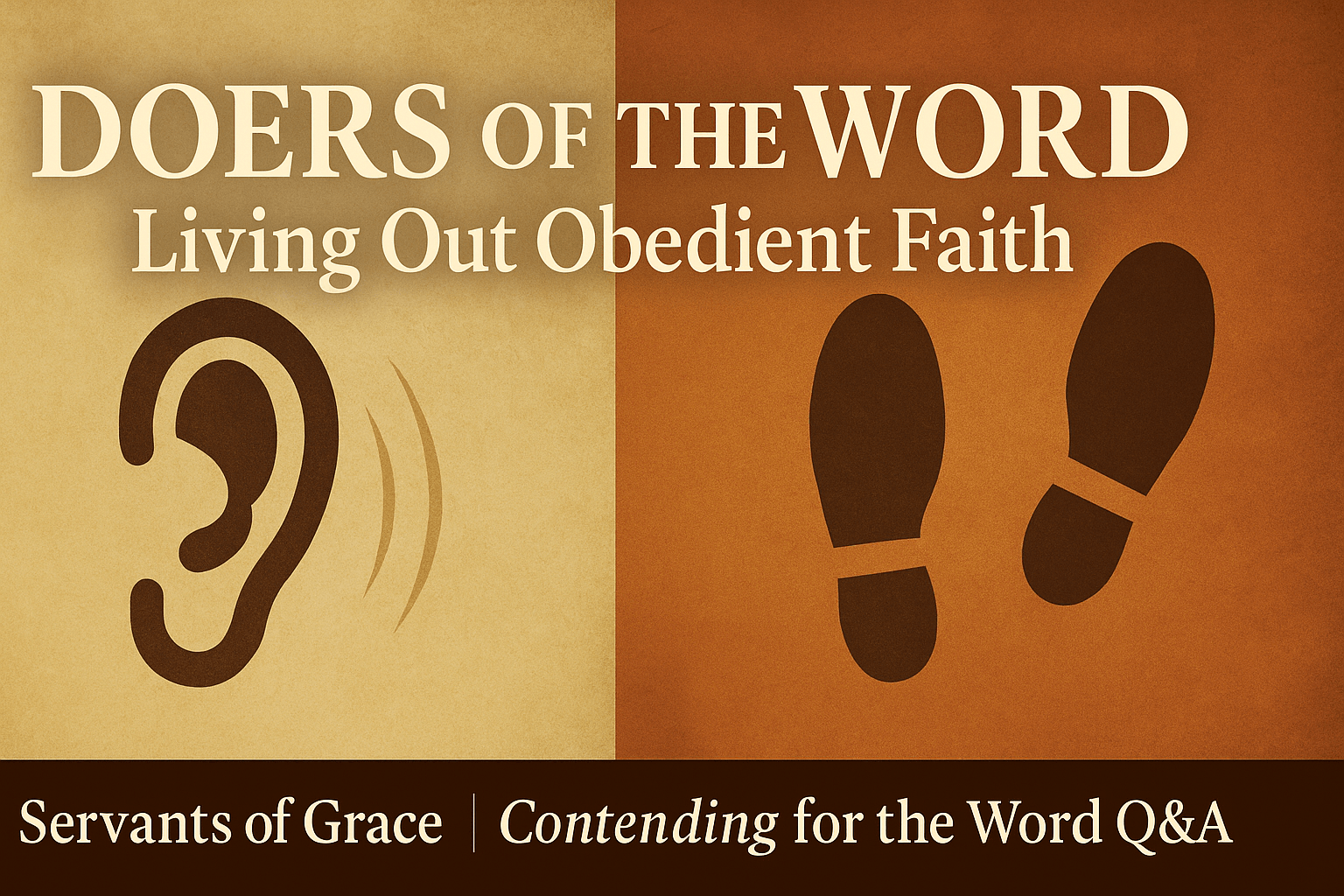
Doers of the Word, Living Out Obedient Faith in a Noisy World
Show: Contending for the Word Q&A with Dave Jenkins
Date: December 4, 2025
Show Summary
Today we tackle a foundational question for Christian living: What does it mean to be a doer of the Word of God?
In a world filled with information and constant content, Scripture warns us that true faith is not in hearing alone
but in practicing the truth we receive.
🎧 Audio Player
🎥 Video Player
Key Scriptures
- James 1:22–25
- John 14:15
- Psalm 119
Episode Highlights
- Hearing without obedience leads to spiritual deception.
- True obedience flows from humble submission to God’s authority.
- Self-examination through Scripture fuels repentance and assurance.
- The Holy Spirit empowers Christian obedience.
- Faith is active, lived out daily in practical obedience.
Full Article
In a world filled with information, podcasts, sermons, and constant content, it is possible to hear the truth and yet not live it. Many believers today sit under good teaching, read good books, and listen to faithful preaching yet still remain unchanged because they stop at hearing. Scripture warns us that spiritual deception does not only come from false teaching. It can also come from hearing the truth without practicing the truth.
James is crystal clear: “But be doers of the word, and not hearers only, deceiving yourselves” (James 1:22). In other words, there is a kind of hearing that produces self-deception. We can assume we are spiritually healthy simply because we know the right things, agree with the right things, and listen to the right things while our lives remain resistant to repentance and obedience. So, what does it mean to be a doer of the Word of God? It means we respond to Scripture with humble submission, Spirit-empowered obedience, and a faith that is lived out in everyday life.
1. Doers of the Word Hear with Humble Submission
To be a doer of the Word begins with how we approach the Bible. We do not come to Scripture as consumers looking for inspiration, or as critics deciding what we will accept. We come to Scripture as God’s people under God’s authority. The Word of God is not a suggestion. It is the living and abiding Word of the King. This means that when we open the Bible, we come ready to obey not to negotiate, not to redefine God’s commands on our own terms, and not to evaluate Scripture as if we stand above it. We test everything we hear, read, and see by and with the Word of God. A doer of the Word does not merely ask, “Do I like this?” but “Is this true, and will I submit to it?”
2. Doers of the Word Practice What They Learn
Jesus teaches that obedience is the evidence of love: “If you love me, you will keep my commandments” (John 14:15). The goal of biblical learning is not information for its own sake. The goal is transformation truth believed becoming truth lived. That means when Scripture commands us to love our neighbor, we pursue love. When it commands us to forgive, we forgive. When it warns us about the tongue, we guard our speech. When it calls us to holiness, we put sin to death. When it calls us to serve the body of Christ, we move toward faithful membership, generosity, and sacrifice. Christian growth is not measured merely by what we know, but by whether what we know is shaping our affections, choices, and patterns of life.
3. Doers of the Word Examine Themselves in the Mirror of Scripture
James gives us a memorable picture: the Word of God is like a mirror (James 1:23–25). A hearer looks into the mirror and walks away unchanged. A doer looks into the mirror and responds. Scripture reveals what is true about God and what is true about us. It exposes our sin, our idols, our excuses, and our blind spots, and it calls us to repentance and faith. Biblical self-examination is not meant to produce despair or endless introspection. It is meant to lead us to repentance, renewed faith, and deeper assurance. When we see sin, we confess it. When we see weakness, we seek help. When we see God’s promises, we rest in them. The Word does not merely diagnose; it directs us to Christ.
4. Doers of the Word Rely on the Holy Spirit, Not Self-Effort
To be a doer of the Word is not a call to self-sufficiency. Christian obedience is not self-salvation. It is not moralism. It is Spirit-empowered living that flows from union with Christ. If you are a Christian, you are united to Christ by faith, and you obey Him by the power of the Holy Spirit. This matters because some people hear “obedience” and assume it means trying harder in their own strength. But the gospel teaches us that the same grace that saves us also trains us to live godly lives. We do not obey in order to earn God’s love. We obey because we have been loved in Christ. We do not obey to become children of God. We obey because we already are.
5. Doers of the Word Live Their Faith Daily, Not Only on Sundays
One of the great dangers in our day is compartmentalized Christianity where faith is something we practice at church, but not at home, not at work, not in our relationships, and not in our private decisions. But Scripture calls us to a living faith. True faith is active. It shows itself in everyday obedience. That means we connect hearing with doing. We apply what we’ve read. We respond to what we’ve heard. We examine our lives regularly in the light of God’s Word. We rely on the Holy Spirit. And we pursue obedience in the ordinary places of life—our habits, our speech, our entertainment, our thought life, our relationships, and our service in the local church.
Why This Matters
The point is simple: the blessed life is not found in merely hearing the Word of God, but in living the Word of God. James says the one who looks into the perfect law and perseveres—being not a forgetful hearer but a doer who acts—“will be blessed in his doing” (James 1:25). To be a doer of the Word is to embrace God’s truth with humility and respond in obedience and faith. And as we submit to Christ and His Word, God conforms us to the image of His Son, strengthens our faith, and equips us to serve Him faithfully.
If this episode challenged or encouraged you, please share it and invite someone to listen with you. Subscribe to the Contending for the Word podcast wherever you get podcasts, and for more resources to help you grow in biblical faithfulness, please visit ServantsOfGrace.org.
And remember: hearing God’s Word is a blessing. Obeying it is life.
Takeaways & Reflection Questions
- Where do you struggle to connect hearing with doing?
- How does God’s Word shape your daily choices?
- Are there commands of Scripture you need to submit to today?
Call to Action
If this episode encouraged you, please share it and subscribe on YouTube or your favorite podcast app.
For more biblically faithful resources, visit Contending for the Word Q&A page at Servants of Grace or at our YouTube.