⏱️ Estimated Reading Time: 10 min read
Doctrinal Questions Christians Are Afraid to Ask
By Dave Jenkins
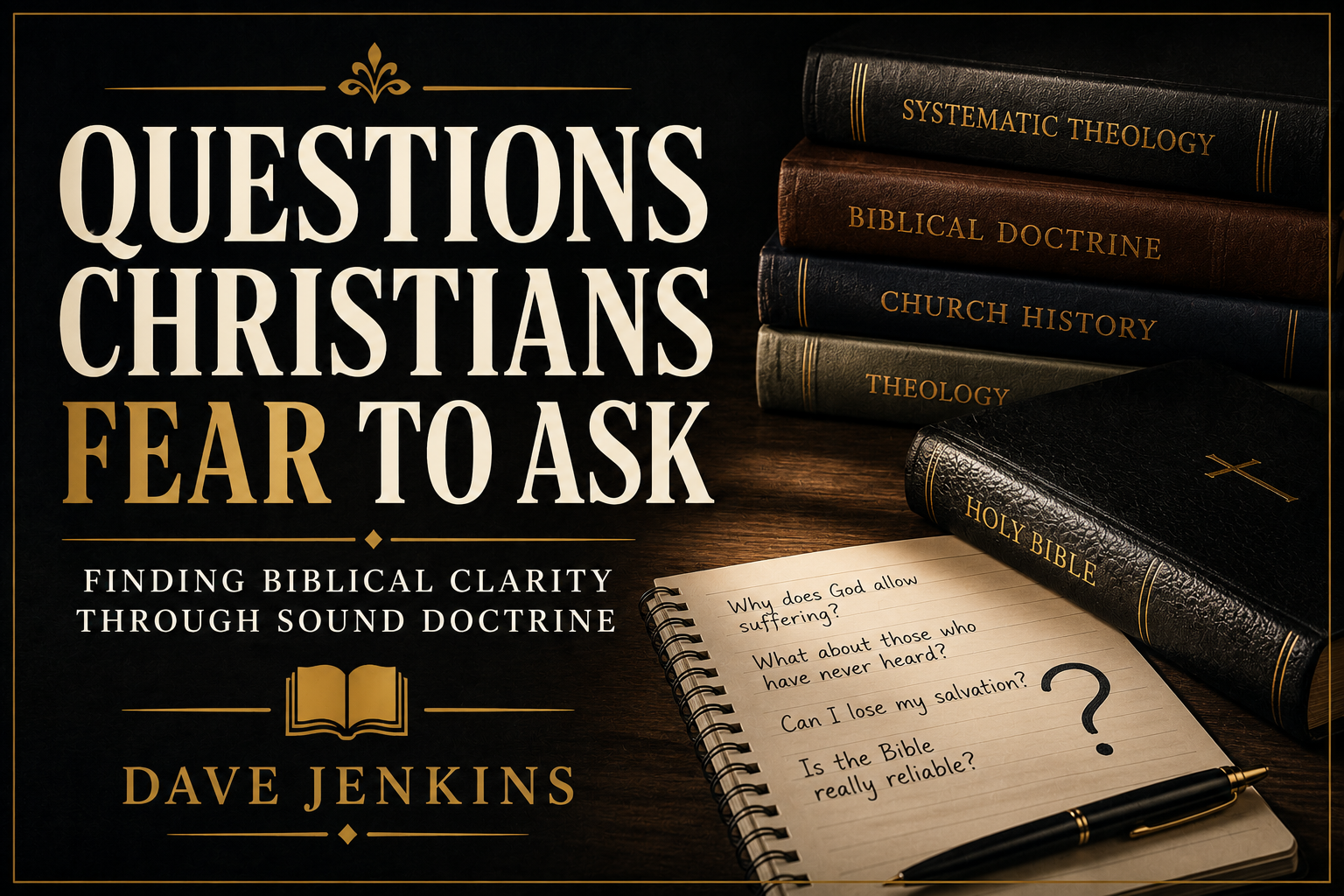
Christians often have questions they hesitate to ask.
Sometimes the hesitation comes from fear. They worry that asking a question will make them appear spiritually immature, theologically uninformed, or lacking in faith. Other times they fear creating controversy or drawing unwanted attention to their struggles. As a result, many believers carry important questions privately, hoping they will eventually find answers on their own.
Yet Scripture never presents honest questions as a threat to spiritual growth. Throughout the Bible, God's people ask questions. The Psalms are filled with them. The prophets asked them. The disciples certainly asked them. Even some of the greatest saints in Scripture wrestled with difficult truths and sought greater understanding.
The danger is not asking questions.
The danger is allowing questions to remain unanswered when God has spoken in His Word.
One of the goals of sound doctrine is to help believers think clearly about God, His Word, and the Christian life. The following questions are among the most common doctrinal questions Christians wrestle with today. While the answers may not remove every mystery, they can provide biblical clarity and confidence.
Why Does Doctrine Matter So Much?
Many Christians assume doctrine is primarily for pastors, theologians, and seminary students. They view theology as something separate from everyday Christian living.
Scripture presents a very different picture.
Doctrine simply refers to what the Bible teaches. Every Christian believes doctrine, whether they realize it or not. The question is not whether we have doctrine but whether our doctrine is biblical.
What we believe about God affects how we worship. What we believe about Christ affects how we trust Him. What we believe about salvation affects our assurance. What we believe about Scripture affects how we make decisions. What we believe about the church affects how we live in Christian community.
Paul repeatedly connects doctrine and godliness throughout his letters. In Titus 2:1, he instructs Titus to teach what accords with sound doctrine. In 1 Timothy, he warns against false teaching because doctrine influences how people live.
Doctrine matters because truth matters.
More importantly, doctrine matters because God has revealed Himself in His Word. To know Him rightly, we must understand what He has said.
Can't We Just Focus on Jesus and Avoid Doctrinal Debates?
At first glance, this sounds like a reasonable question. After all, Christians should focus on Jesus.
The problem is that we cannot separate Jesus from doctrine.
How do we know who Jesus is? How do we know what He taught? How do we know why He died, rose again, and will return? We know these things because Scripture teaches them.
The moment someone says, "Let's just focus on Jesus," they are already making doctrinal claims about Jesus.
Throughout church history, false teachers have often claimed to follow Jesus while denying essential truths about Him. Some denied His deity. Others denied His humanity. Some rejected His atoning work. Others redefined His mission.
Sound doctrine exists to protect the truth about Christ.
The goal of doctrine is not to distract us from Jesus but to help us know the real Jesus revealed in Scripture. Genuine unity is not achieved by minimizing truth. It is achieved by gathering around the truth God has revealed.
How Can I Know Which Teachers to Trust?
This question has become increasingly important in the digital age.
Previous generations primarily learned from pastors, local churches, and trusted Christian books. Today believers have access to countless podcasts, YouTube channels, social media accounts, livestreams, and online ministries.
While many of these resources can be helpful, they also create confusion.
The answer is not to trust personalities. It is to test everything by Scripture.
The Bereans were commended in Acts 17 because they examined the Scriptures daily to determine whether Paul's teaching was true. If even an apostle's teaching was tested against Scripture, every modern teacher should be evaluated in the same way.
Trustworthy teachers submit to Scripture rather than asking Scripture to submit to them. They handle God's Word carefully. They teach sound doctrine. They demonstrate humility and accountability. They are connected to the life of the local church.
No teacher is perfect. Every human teacher is fallible.
That is why Scripture must always remain the final authority.
Why Do Faithful Christians Disagree About Some Doctrines?
This question troubles many believers.
They assume that if the Bible is clear, all faithful Christians should agree about everything. When they discover disagreement among respected pastors and theologians, confusion often follows.
Part of the answer lies in recognizing that not all doctrines carry the same level of importance.
Certain truths are essential to Christianity itself. The Trinity, the deity of Christ, the authority of Scripture, justification by faith alone, and the bodily resurrection of Christ belong in this category. To deny these doctrines is to depart from historic Christianity.
Other doctrines are important but not church-dividing. Faithful Christians have sometimes disagreed about issues such as the timing of Christ's return, certain aspects of church government, or the relationship between divine sovereignty and human responsibility.
Still other issues fall into matters of wisdom and personal conviction.
Recognizing these distinctions helps believers maintain both conviction and charity.
Christians should pursue doctrinal clarity while remembering that faithful believers may disagree on some secondary matters. Humility and confidence are not enemies.
What Should I Do When I Don't Understand a Doctrine?
Every Christian encounters doctrines that seem difficult.
Some passages of Scripture require careful study. Certain theological truths stretch the limits of human understanding. Questions concerning God's sovereignty, the Trinity, providence, suffering, and eternity often require patience.
The first response should be humility.
God is infinite. We are finite. There will always be aspects of His character and works that exceed our full comprehension.
Yet humility should not lead to discouragement.
Scripture is clear enough for believers to understand what God intends them to know. The basic truths necessary for salvation and faithful Christian living are accessible to ordinary Christians.
When difficult questions arise, believers should study God's Word carefully. They should seek guidance from faithful pastors and teachers. They should read sound Christian resources. Most importantly, they should continue trusting God's Word even when complete understanding remains elusive.
Spiritual growth often involves wrestling with difficult truths over time.
Many doctrines that once seemed confusing become clearer through years of study, worship, and discipleship.
Is It Wrong to Question What I've Been Taught?
Not necessarily.
There is a difference between rebellious skepticism and sincere examination.
Scripture encourages believers to test all things and hold fast to what is good. The Bereans were praised for examining Paul's teaching against the Scriptures. Christians are never called to accept human teaching uncritically.
At the same time, believers should approach questions with humility and teachability.
The goal is not to become suspicious of everything. The goal is to ensure that our beliefs are grounded in God's Word.
Healthy questioning can strengthen faith when it drives us back to Scripture. Many believers have developed deeper convictions precisely because they examined what they believed and why they believed it.
Truth has nothing to fear from honest investigation.
Why Does Sound Doctrine Sometimes Feel Divisive?
This may be one of the most emotionally difficult questions Christians face.
Everyone values unity. Christians should desire peace within the church. Yet Scripture repeatedly warns that truth and error cannot coexist indefinitely without conflict.
Jesus Himself acknowledged that His teaching would create division. The apostles regularly confronted false doctrine. Church history demonstrates that many of the church's most significant controversies involved efforts to preserve essential truths.
The problem is not doctrine itself.
The problem is that truth often exposes error.
When biblical teaching challenges cultural assumptions, personal preferences, or false beliefs, tension naturally arises. This does not mean Christians should become combative or argumentative. Scripture calls believers to speak the truth in love.
Yet love does not require abandoning truth.
Real unity must be built upon what God has revealed. Unity that ignores doctrine may appear peaceful for a season, but it ultimately lacks a stable foundation.
How Do I Talk About Doctrine Without Sounding Arrogant?
This concern is understandable.
Many believers have encountered people who seem more interested in winning theological arguments than helping others understand biblical truth. Unfortunately, doctrinal conviction can sometimes be expressed in ways that communicate pride rather than love.
The solution is not weaker convictions.
The solution is greater humility.
Christians should remember that every truth they understand is ultimately a gift of God's grace. None of us arrived at theological understanding through our own wisdom. We have been taught by God's Word, God's Spirit, and God's people.
This reality should produce gratitude rather than pride.
When discussing doctrine, believers should listen carefully, speak respectfully, and seek understanding rather than merely victory. They should remember that people are not projects to be fixed but fellow image-bearers to be loved.
Strong convictions and genuine humility can coexist.
In fact, they should.
What Happens When Churches Stop Teaching Doctrine?
History provides a clear answer.
When churches neglect doctrine, confusion eventually follows.
At first, the effects may seem minimal. Sermons become more inspirational and less theological. Difficult subjects receive less attention. Biblical distinctions become less clear.
Over time, however, deeper problems emerge.
Members struggle to discern truth from error. Cultural assumptions begin shaping beliefs more than Scripture. False teaching gains influence. Discipleship becomes shallow. Churches lose confidence in the authority and sufficiency of God's Word.
Eventually, doctrinal drift becomes visible.
This is why Scripture places such a strong emphasis on teaching sound doctrine. Healthy churches are not built merely on good intentions or positive experiences. They are built upon truth.
Faithful preaching, robust discipleship, doctrinal clarity, and biblical conviction remain essential for long-term church health.
What Is the Most Important Thing Christians Should Remember About Doctrine?
Perhaps the most important thing to remember is that doctrine exists to help us know God.
The purpose of theology is not intellectual superiority. The goal is not merely accumulating information. Sound doctrine is meant to deepen worship, strengthen faith, encourage obedience, and help believers grow in their relationship with Christ.
Every doctrine ultimately points us toward God.
The doctrine of Scripture reveals His voice.
The doctrine of Christ reveals His salvation.
The doctrine of the church reveals His people.
The doctrine of sanctification reveals His transforming grace.
The doctrine of eternity reveals His promises.
When understood properly, doctrine should lead to worship.
Theology and devotion are not enemies. They belong together.
God has not revealed truth merely so that we can win arguments. He has revealed truth so that we may know Him, trust Him, love Him, and glorify Him.
That is why doctrinal clarity matters.
In a noisy age filled with competing voices, believers need confidence that God's truth is knowable, trustworthy, and sufficient. They need not fear difficult questions because God has spoken in His Word.
Christians will never have every answer to every question. Yet they can have confidence that God has revealed everything necessary for salvation, godliness, and faithful living.
The goal is not perfect knowledge.
The goal is faithful discipleship.
And sound doctrine remains one of God's greatest gifts for helping His people walk faithfully until Christ returns.
Clarity in Doctrine: Sound Doctrine in a Noisy World

Dave Jenkins is happily married to his wife, Sarah, and lives in beautiful Southern Oregon. He is a writer, editor, and speaker who loves Christ, His people, the Church, and sound theology.
Dave serves as the Executive Director of Servants of Grace Ministries and the Executive Editor of Theology for Life Magazine. He is the Host and Producer of the Equipping You in Grace Podcast and a contributor to and producer of Contending for the Word.
He is the author of The War of Worldviews: Truth, Lies, and the Battle for the Christian Mind (Theology for Life, 2026), Contentment: The Journey of a Lifetime (Theology for Life, 2024), The Word Matters: Defending Biblical Authority Against the Spirit of the Age and The Word Explored: The Problem of Biblical Illiteracy and What To Do About It (House to House, 2021).
You can connect with Dave on Facebook, X (Twitter), Instagram, YouTube, or subscribe to his newsletter.
When he is not engaged in ministry work, Dave enjoys spending time with his wife, going to movies, sharing a meal at a favorite restaurant, or playing a round of golf with friends. He is also a voracious reader, particularly of Reformed theology and the Puritans, and is often found working through a stack of new books from a wide range of Christian publishers.
Dave earned his M.A.R. and M.Div. from Liberty Baptist Theological Seminary.