⏱️ Estimated Reading Time: 8 min read
Connecting the Church and the Home: Six Vision Distinctives for Family Discipleship
By Brian H. Cosby • Love, Marriage, and the Christian Life
Series: Love, Marriage, and the Christian Life — This article helps strengthen family discipleship by reconnecting
the local church and the home through Scripture-shaped priorities and practical distinctives.
We believe that God has created the church and the family as complimentary institutions—designed to function together and support one another.
The church I pastor (Wayside Presbyterian Church) has a desire to be a multigenerational, family supporting, family integrated church—where parents
are being affirmed, equipped, and encouraged to fulfill their God-given privilege and responsibility of bringing up their children in the nurture and
instruction of the Lord (Eph. 6:4). We want to reach the next generation everyday in homes, not just once a week in church.
Whether they realize it or not, children’s directors and youth ministers have been and are currently replacing parents as the primary source of biblical
instruction, thus turning the hearts of the children—not to the parents—but to the “professionals” (cf. Mal. 4:6). In turn, parents are abdicating their
God-given responsibilities in the home. I actually don’t put the blame on these leaders but on the parents and the overall leadership of the church.
A Necessary Clarification About Children’s and Youth Ministry
Disclaimer: I believe it is possible and sometimes appropriate to have a children’s and/or youth director in a local church, but with the primary purpose
of coming alongside parents to affirm, equip, train, and assist them as they (the parents) raise their children. In some cases, this might be the grandparents.
Let Scripture Shape the Structure
If we were to simply let the Bible inform and direct our structure of ministry in the church and at home (i.e., sufficiency of Scripture), we wouldn’t come up
with much of the age-segregated model that we see so often in the church today, which begs the question: where do you go in the Bible to find justification
or any theological foundational principle for modern youth and children’s ministry programs that are separated and disconnected from the primary role of the parents?
This would be a difficult task.
And yet, youth/children’s ministries are a multi-million dollar industry (youth degrees, staff, bands, t-shirt companies, camps, sound systems, lights, youth facilities, etc.).
The strongest argument for typical modern-day youth and children’s ministries is: I don’t see any reason not to? You will hear philosophical and pragmatic reasons, but you will not
hear biblical or theological reasons.
The Stakes: Discipleship Before Graduation
After a student’s graduation from high school or college, at no other time are these children segregated by age. They are suddenly turned out on their own, supposedly with the knowledge
of how to interact and respect older generations and model character and biblical maturity to younger generations when they’ve never done that in school or in church before.
Currently, around 75% of youth “involved” in church leave the church by the end of their first year in college. However, recent statistics show that most children are really “already gone”
by the time they graduate (cf. Ken Ham and Britt Beemer, Already Gone: Why Your Kids Will Quit Church and What You Can Do To Stop It, 2009). In other words, the issue isn’t simply
the preparation for college, but the present discipleship (or lack thereof) they are receiving.
Faithfulness Over Success: The Ordinary Means of Grace
Because we believe that God alone saves and sanctifies his people, we are given the task to faithfully plant and water the gospel (1 Cor. 3:7) through the means of growing in God’s grace
(Acts 2:42-47): Word, prayer, sacraments, worship, service, and gospel community. This is why we are focused on faithfulness over success. Focusing on the latter will only lead to either
pride or despair, besides it being unbiblical.
What If You’re Not a Parent?
What can you do if you are not a parent? Here are some ideas: mentor a younger man or woman. Affirm and encourage parents in their God-given roles. In the pew at church, help younger families,
as you are able. Teach them to open their Bibles, learn the songs, etc.
Six Vision Distinctives for Connecting the Church and the Home
Let me give you six vision distinctives that we’ve adopted in our church on how to practically connect the church and the home.
1. Fathers Taking Primary Initiative in Family Discipleship
From Scripture, we envision husbands/fathers taking the primary lead in discipling their families in the Lord and using their God-given gift of loving responsibility to invest their lives,
their love, and their faith to the next generation. This is done through teaching, family worship, catechism, and overall discipline and instruction. To be sure, the greatest thing our children
need is our love for God. Let your love for God inform and shape your love for them.
2. Equipping Men to Serve as Loving Leaders in the Home
To this end, we envision equipping and affirming men to be servant-leaders in their home—to provide, protect, nourish, and cherish their families.
- “And these words that I command you today shall be on your heart. You shall teach them diligently to your children…” — Deuteronomy 6:6-7 (cf. Deut. 11:19)
- “We will not hide [God’s Word] from their children, but tell to the coming generation…” — Psalm 78:4-7
- “Train up a child in the way he should go…” — Proverbs 22:6
- “And he will turn the hearts of fathers to their children…” — Malachi 4:6
- “As in all the churches of the saints, the women should keep silent in the churches…” — 1 Corinthians 14:33-35
- “Husbands should love their wives as their own bodies…” — Ephesians 5:28-29
- “Fathers, do not provoke your children to anger…” — Ephesians 6:4
- “Let a woman learn quietly…” — 1 Timothy 2:11-12
- “[The elder] must manage his own household well…” — 1 Timothy 3:4,12
- “And how from childhood you have been acquainted with the sacred writings…” — 2 Timothy 3:15
3. Submitting to the Local Church and Growing in the Truth
We envision individuals and families submitting themselves to the leadership of the local church, studying the truth of Scripture, being present and engaged in worship, and intentionally being
a vibrant source of service, encouragement, and ministry to others.
- “Let the elders who rule well be considered worthy of double honor…” — 1 Timothy 5:17
- “For there are many who are insubordinate, empty talkers and deceivers…” — Titus 1:10-11
- “Obey your leaders and submit to them…” — Hebrews 13:17
- “So I exhort the elders among you…shepherd the flock of God…” — 1 Peter 5:1-2,5
4. Worshiping Together on the Lord’s Day
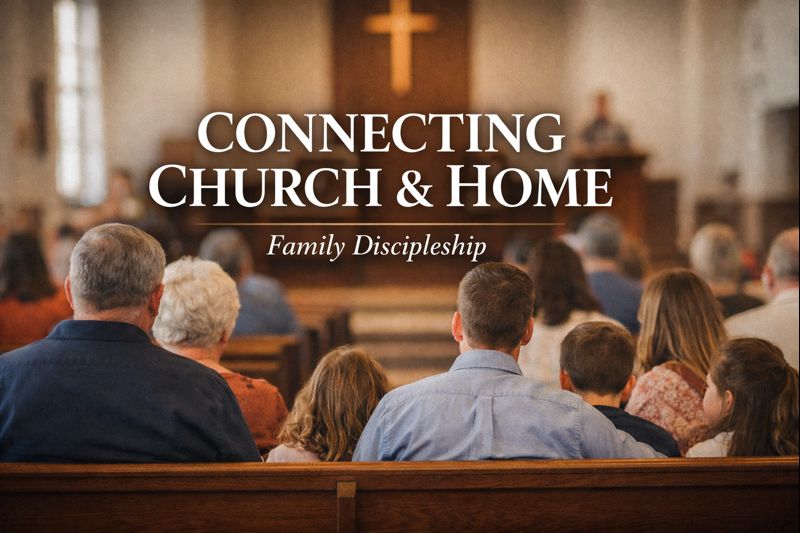
We envision children—young and old—being with their parents in Lord’s Day (Sunday) worship. We want to equip and encourage families with young and old children to worship together. Yes, children
will make noises, but we should be delighted to have children worshipping with us. If a child continues to be fussy, then we have a room for them to go.
- “Assemble the people, men, women, and little ones…” — Deuteronomy 31:12-13
- “There was not a word…that Joshua did not read before all the assembly… and the little ones.” — Joshua 8:35
- “Meanwhile all Judah stood before the LORD, with their little ones…” — 2 Chronicles 20:13
- “A very great assembly of men, women, and children, gathered…” — Ezra 10:1
- “The women and children also rejoiced.” — Nehemiah 12:43
- “Young men and maidens together, old men and children!” — Psalm 148:12-13
- Jesus welcomes children (Matthew 19:13-14; Mark 10:13-16; Luke 18:15-17); “And he took a child…” — Mark 9:36
- Paul addresses children in the assembly (Ephesians 6:1-2; Colossians 3:20).
5. Welcoming the Fatherless and the Spiritually Vulnerable
We envision reaching out to orphans and to other children and youth from either broken homes or homes with unbelieving parents with the gospel of Jesus Christ and welcoming them into the church,
where they find an abundance of fathers, mothers, brothers, and sisters in the faith.
- “Give justice to the weak and the fatherless.” — Psalm 82:3
- “For whoever does the will of my Father…is my brother and sister and mother.” — Matthew 12:50
- “For though you have countless guides in Christ, you do not have many fathers…” — 1 Corinthians 4:15
- “For you know Timothy’s proven worth…” — Philippians 2:22
- “Like a father with his children, we exhorted each one of you…” — 1 Thessalonians 2:11-12
- “To Timothy, my true child in the faith.” — 1 Timothy 1:2
- “Encourage…older men as fathers…older women as mothers…” — 1 Timothy 5:1-2
- “Older women likewise are to…train the young women…” — Titus 2:3-5
- “Onesimus, whose father I became…” — Philemon 1:10
- “Visit orphans and widows in their affliction.” — James 1:27
6. Gospel-Driven Ministry in Church and Home
We envision an emphasis on the gospel of grace in every area of church and family life, recognizing that we are all sinners in need of grace. Thus, this vision of church and home is not law-driven,
but gospel-driven. God’s commands simply point us to that which pleases the Lord.
Conclusion
My hope and prayer are that you will not just cast these thoughts aside, but truly study what the Scriptures have to say. And may God give you grace in the journey of being transformed more and more
by the renewing of your mind.

Brian Cosby (Ph.D., Australian College of Theology) is Senior Pastor of Wayside Presbyterian Church (PCA) in Signal Mountain, Tennessee, and Visiting Professor of historical theology at Reformed Theological Seminary, Atlanta.