When Influencers, Feelings, and “God Told Me” Replace Scripture
By Dave JenkinsWho is shaping the way Christians think today?For many believers, the answer is increasingly not their pastor, their local church, or even regular study of Scripture. Instead, Christians may find themselves being shaped by influencers, podcasters, social media personalities, viral clips, emotions, and subjective spiritual experiences.In this episode of
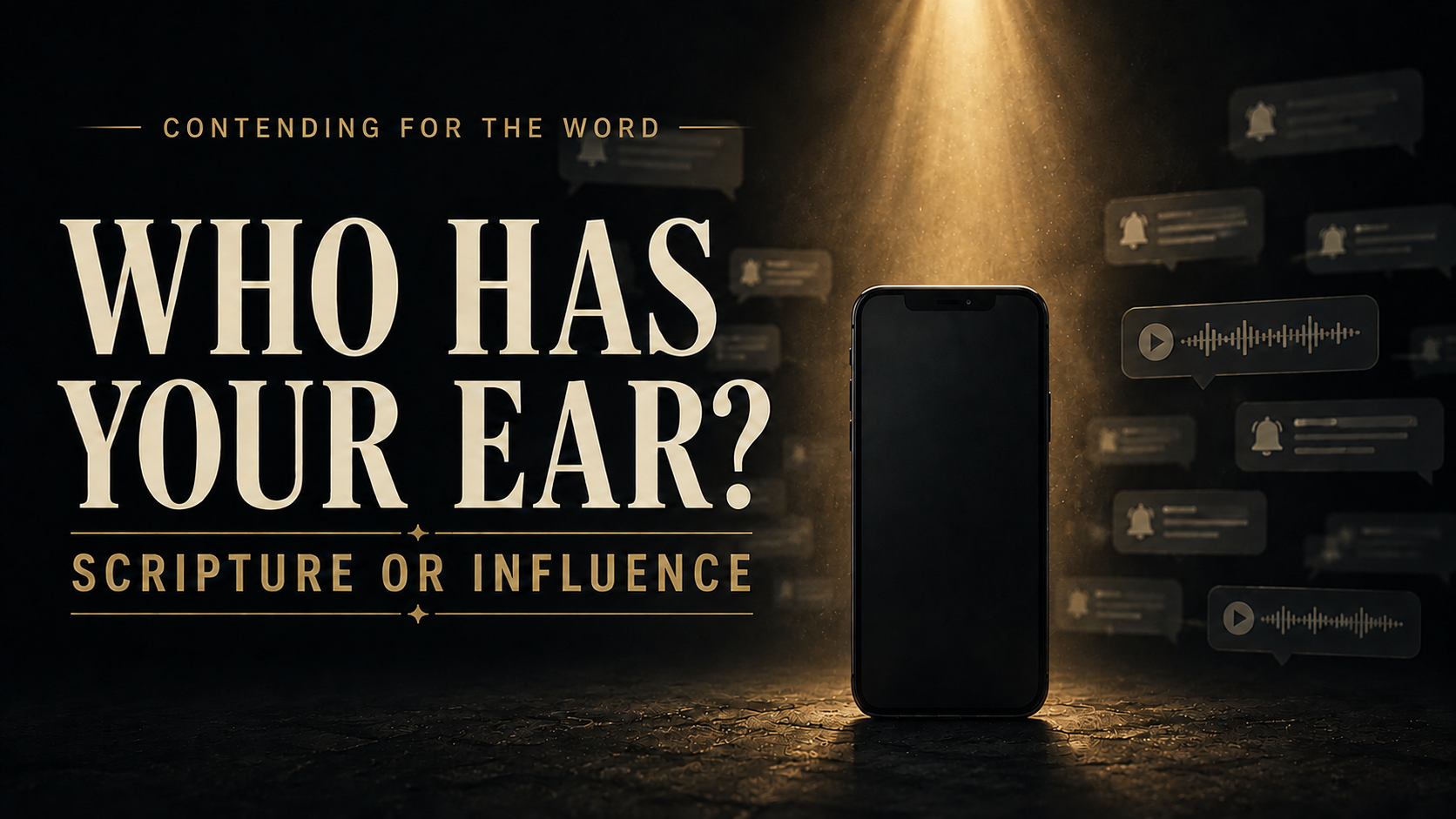
Contending for the Word, Dave Jenkins examines Christian influencer culture, emotionalism, and the growing “God told me” mindset. The deeper issue underneath all three is one of authority: Who or what determines what is true?Influence itself is not the problem. Faithful pastors, teachers, authors, podcasters, and ministries can use online platforms for tremendous good and the glory of God. The danger comes when visibility is confused with credibility and when personalities begin exercising an authority that belongs to the Word of God alone.
Listen or Watch
Influence Is Not the Same as Faithfulness
Social media can subtly condition Christians to assume that a large audience means someone is trustworthy. Followers, views, engagement, and popularity can make a teacher appear credible, but Scripture never uses digital success as a qualification for Christian ministry.The New Testament emphasizes character, sound doctrine, faithfulness, spiritual maturity, and accountability. Healthy Christian leaders point people away from themselves and toward Jesus Christ and His Word. They want Christians to think biblically rather than simply adopting the opinions of a personality.Influence can be a blessing, but influence without biblical accountability can become dangerous.
When Feelings Become Authority
Emotions are not the enemy. God created human beings with emotions, and Scripture displays joy, grief, sorrow, compassion, righteous anger, and many other godly affections. Jesus Himself expressed deep emotion.The problem begins when emotions start functioning as an authority.Feelings may be real, but they are not always right. Something can feel spiritual and still be unbiblical. Something can feel powerful and still be false. Something can feel right while contradicting the clear teaching of Scripture.Christians must therefore evaluate their feelings according to the truth of God’s Word rather than evaluating God’s Word according to their feelings. Emotions are gifts from God, but they make terrible masters. Truth must lead, and our feelings must be submitted to Scripture.
The Growing “God Told Me” Culture
Another significant problem in modern Christianity is the increasing use of phrases such as “God told me,” “the Lord showed me,” “God revealed this to me,” or “I received a word.”The issue is not whether God guides His people, whether Christians should pray for wisdom, or whether the Holy Spirit works in believers. Scripture teaches all of these truths.The concern arises when subjective impressions begin functioning as divine authority.If someone says, “This is my opinion,” the statement can be evaluated. If someone says, “This is how I understand Scripture,” the interpretation can be examined. But when someone says, “God told me,” the claim immediately carries the weight of divine authority.Personal impressions are not infallible. Feelings are not infallible. Human guidance is not infallible. The Word of God is.Christians can pray, seek godly counsel, apply biblical wisdom, and make decisions while trusting the Lord without elevating their personal conclusions to the level of direct revelation from God.
Why Christians Are Drawn to Subjective Authority
Many Christians who are drawn toward influencers, emotionalism, or subjective spiritual claims are not necessarily motivated by bad intentions. Often they are searching for certainty, direction, significance, assurance, or spiritual vitality.Influencers can project certainty. Strong emotions can create the appearance of certainty. Claims of receiving a special word from God can make someone feel spiritually significant.Yet spiritual maturity is not measured by dramatic experiences or extraordinary stories. It is measured by growing faithfulness to Jesus Christ.God ordinarily grows His people through His Word, prayer, worship, the local church, discipleship, obedience, and perseverance. These ordinary means may appear less exciting than spectacular spiritual claims, but they are God’s gracious means for cultivating mature Christians.
How Christians Can Practice Biblical Discernment
Christians today encounter an enormous amount of teaching through podcasts, YouTube videos, social media posts, articles, livestreams, books, and other media. Some of that teaching is excellent. Some of it is deeply problematic.Biblical discernment does not require Christians to become cynical or suspicious of everyone. Instead, believers should follow the example of the Bereans in Acts 17:11, who examined the Scriptures to determine whether what they were hearing was true.When evaluating a teacher, ministry, influencer, or spiritual claim, Christians should ask:
- Is this teaching biblical?
- Does it agree with the clear teaching of Scripture?
- Is it consistent with sound doctrine?
- Does it exalt Jesus Christ?
- Does it direct people toward the Word of God?
- Is the teacher accountable within a faithful local church?
- Is the ministry centered on Christ or on a personality and platform?
The more deeply Christians know Scripture, the better equipped they become to recognize error. Believers do not need to become experts on every false teaching or chase every controversy. They need to know the truth of God’s Word.
Scripture Remains When Everything Else Changes
Influencers come and go. Platforms rise and fall. Trends change. Popular teachers may gain enormous audiences and then disappear. Even our emotions can change dramatically from one day to another.But God’s Word remains.When culture changes, Scripture remains. When trends change, Scripture remains. When influencers fail, Scripture remains. When emotions fluctuate, Scripture remains. When confusion increases, Scripture remains.Christians possess something infinitely more stable than personalities, feelings, or cultural opinion. God has spoken in His Word, and Scripture remains the believer’s final authority.
Christ Is Our Ultimate Stability
The goal of Christian discernment is not merely avoiding error. The goal is knowing Christ, loving Christ, and faithfully following Christ.The church does not ultimately depend upon influencers, celebrities, personalities, movements, or platforms. The church belongs to Jesus Christ. Christ is building His church, preserving His people, and sanctifying His church.Our confidence therefore rests not in our ability to discern perfectly but in Jesus Christ Himself. Christ remains sufficient. His Word remains sufficient. His grace remains sufficient.Truth belongs to God, not our feelings. Authority belongs to God, not influencers. God’s people are safest when they remain anchored in the Word of God.Christian, keep your eyes on Christ. Remain grounded in His Word. Stay connected to a faithful local church. Test every voice and every teaching according to Scripture, and remember that God’s truth remains no matter how loudly the culture speaks.
Listen to More Contending for the Word
Contending for the Word exists to help Christians think biblically, resist deception, remain grounded in Scripture, and faithfully contend for the truth of God’s Word in a confused age.
Listen to more episodes of Contending for the Word on Servants of GraceWatch the Contending for the Word playlist on YouTube