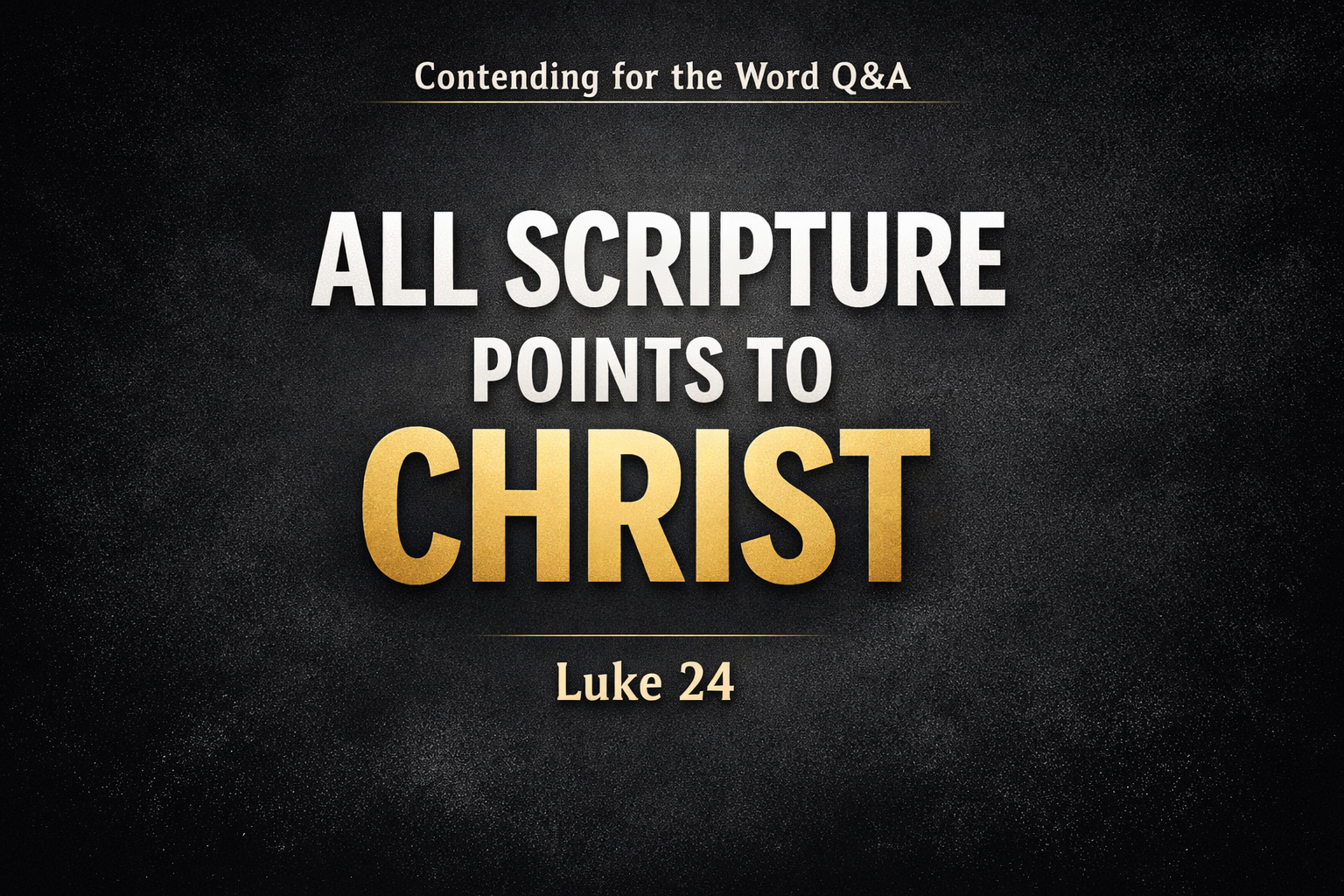
All Scripture Points to Christ: Understanding the Unity of the Bible
Dave Jenkins | Contending for the Word Q&A | April 14, 2026
How does all of Scripture point to Jesus Christ? In this episode of Contending for the Word Q&A, Dave Jenkins explains how the entire Bible—from Genesis to Revelation—is unified around God’s redemptive plan fulfilled finally in Christ alone. Drawing from Luke 24:44–47, Hebrews 1:1–3, and Revelation 5:1–10, this episode helps listeners read the Bible with Christ at the center.
Listen to the Audio
Watch the Video
Key Scriptures
- Luke 24:44–47
- Hebrews 1:1–3
- Revelation 5:1–10
Episode Highlights
- Scripture points to Christ through promise and fulfillment
- Scripture reveals humanity’s need for a Savior
- Scripture points to Christ through types and shadows
- Scripture finds its fulfillment and meaning in Jesus Christ
- The Bible is one unified story centered on Christ
Full Article
How does the whole Bible point to Jesus Christ? That question matters because many Christians struggle to understand how the different books, genres, and authors of Scripture fit together. Some read the Bible as a collection of disconnected stories, moral examples, or religious lessons. But Scripture itself teaches something far greater. The Bible is one unified revelation of God’s redemptive plan, fulfilled finally in Jesus Christ.
In Luke 24:44–47, the risen Christ says, “everything written about me in the Law of Moses and the Prophets and the Psalms must be fulfilled.” Jesus does not present Himself as a side theme in the Bible. He declares that the whole of Scripture points to Him. Hebrews 1:1–3 reinforces this truth by saying that God has spoken finally and fully in His Son. Revelation 5:1–10 then shows us that the Lamb alone is worthy to accomplish God’s saving purposes and bring redemptive history to its appointed end.
The big idea is this: all Scripture points to Jesus by revealing God’s plan of redemption, fulfilled finally in Christ alone. The Bible is not a random collection of spiritual reflections. It is one story with one central figure—Jesus Christ.
Why All Scripture Points to Christ
1. Scripture Points to Christ Through Promise and Fulfillment
From the opening chapters of Genesis, Scripture moves forward with expectation. God promises a Savior. The law exposes sin and points beyond itself. The prophets speak of a coming King, Servant, and Redeemer. These are not vague religious hopes. They are divine promises that find their fulfillment in Jesus Christ.
Christ does not suddenly appear in the New Testament as though He were unrelated to what came before. He comes as the fulfillment of all that God had been promising throughout redemptive history. Every covenant, every prophetic hope, and every saving promise finds its yes and amen in Him.
2. Scripture Points to Christ by Revealing Our Need
The Bible does not merely tell us that Christ is coming. It also shows us why we need Him. Scripture reveals human sin, rebellion, weakness, and inability. The law displays the holiness of God and exposes our guilt. The narratives of Scripture repeatedly show the failure of men and women to obey God faithfully. The sacrificial system reveals the seriousness of sin and the necessity of atonement.
All of this prepares us to see the necessity of Christ. Scripture points us to Jesus not only by predicting Him, but by showing us that we cannot save ourselves. The Bible strips away self-reliance so that we might look to Christ alone.
3. Scripture Points to Christ Through Types and Shadows
Throughout the Bible, God uses persons, offices, institutions, and events to foreshadow the coming of Christ. Priests point to the true High Priest. Kings point to the true King. Sacrifices point to the final sacrifice. The temple, the feasts, and the covenant structures all serve as shadows that prepare the way for the substance, who is Christ.
These shadows are not ends in themselves. They exist to direct our attention forward. When Christ comes, the shadows find their fulfillment in Him. He is greater than the priesthood, greater than the sacrifices, greater than the temple, and greater than every earthly mediator that came before Him.
4. Scripture Finds Its Fulfillment and Meaning in Christ
Hebrews tells us that God has spoken finally and fully in His Son. Revelation shows us that history itself culminates in the worship of the Lamb. This means that Scripture does not merely lead us toward Christ as one theme among many. It finds its fulfillment and meaning in Him.
Every promise, warning, command, and hope ultimately converges on Jesus Christ. He is not an addition to the Bible’s message. He is at the center of it. To read Scripture rightly is to read it with Christ at the center.
Reading the Bible with Christ at the Center
When you read the Bible, do not ask only, “What should I do?” Ask also, “What does this passage reveal about God’s plan of redemption? How does it expose my need? How does it point me to Christ and His grace?” Reading Scripture this way guards us from moralism, despair, and self-reliance. It keeps the gospel central.
All Scripture points to Jesus because all of God’s purposes are fulfilled in Him. As you read God’s Word, let it lead you again and again to Christ—your Savior, your King, and your hope.
Takeaways / Reflection Questions
- Do you read the Bible as one unified story centered on Jesus Christ?
- How does the Old Testament deepen your understanding of Christ’s person and work?
- In what ways does Scripture expose your need for Christ?
- How can reading the Bible with Christ at the center guard you from moralism and self-reliance?
Call to Action
Thank you for listening to or watching this episode of Contending for the Word Q&A. For more from Contending for the Word Q&A please visit our page or on YouTube. Be sure to subscribe to the show, share this episode, and continue growing in God’s Word as you stand firm in His truth.