Biblical Clarity in an Age of Information Overload
By Dave Jenkins
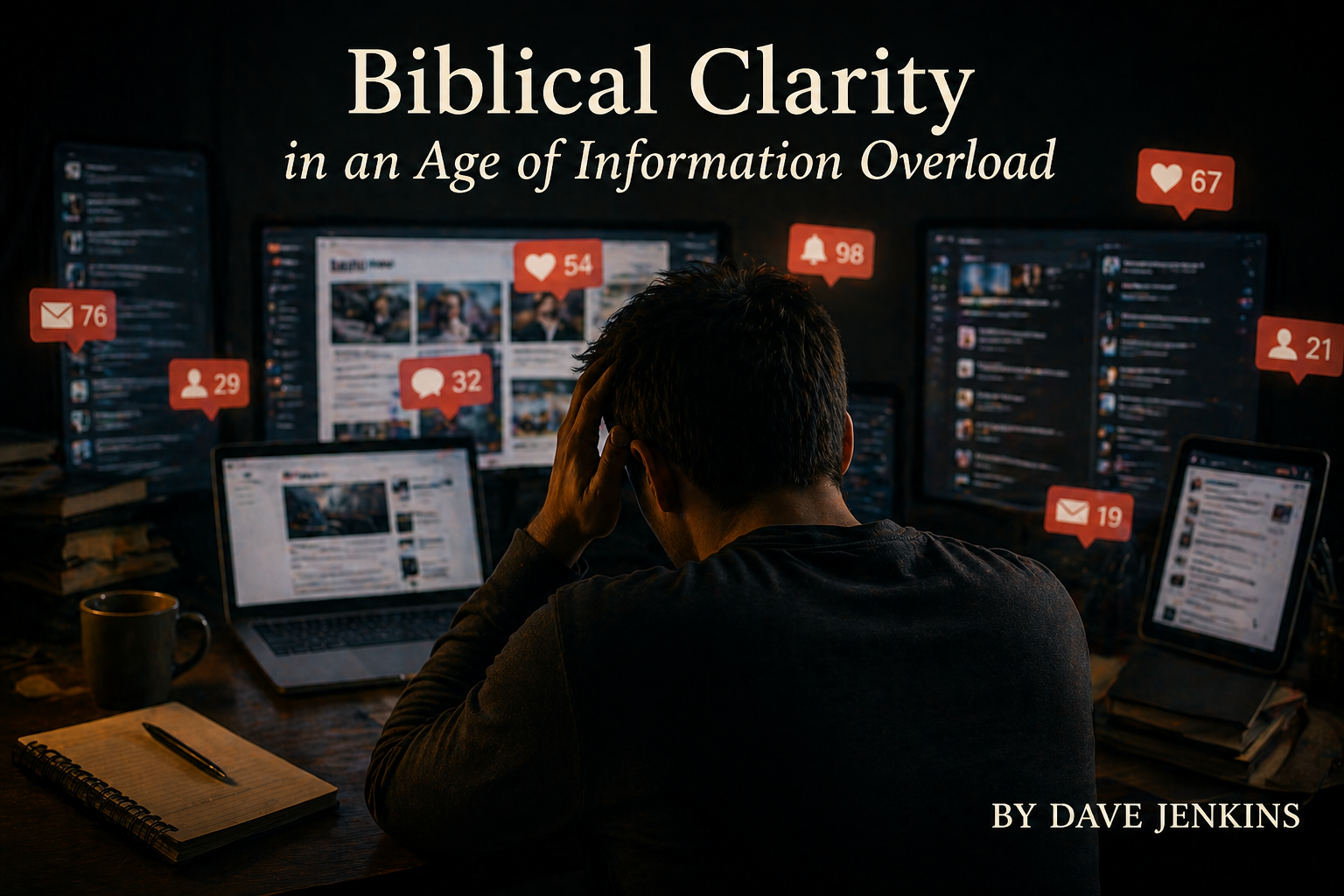
We are living in an age, not of information scarcity, but of information saturation. Every day, we are bombarded with voices—news feeds, social media posts, podcasts, videos, articles, and endless streams of commentary. The opinions of others are ubiquitous, our subsequent reactions to these opinions are constant, and our attention is fragmented. In such an environment, the challenge is no longer simply finding information but discerning what is true. This presents a unique challenge for Christians. The question is no longer whether we have access to truth, but whether we are able to recognize it, hold fast to it, and live in light of it.
In a world filled with noise, clarity is not found in hearing more voices, but in hearing the right One. Scripture speaks directly into this challenge. God has not left His people to navigate a sea of competing ideas without direction. He has spoken clearly in His Word. The problem is not that God’s voice is unclear, but that we are often distracted, overwhelmed, and inattentive.
The Problem of Too Many Voices
The modern digital landscape is built on constant engagement. Platforms are designed to keep us scrolling, reacting, and consuming. The result is a steady diet of fragmented information that rarely encourages deep thinking or sustained reflection. This constant exposure shapes how we think. It trains us to prefer speed over depth, reaction over reflection, and novelty over truth. We become accustomed to forming opinions quickly rather than carefully considering what is true. In such an environment, even serious theological questions can be reduced to soundbites and slogans.
The danger is not merely distraction but distortion. When our thinking is shaped more by algorithms than by Scripture, our understanding of truth becomes unstable. We may begin to evaluate ideas based on popularity, emotional impact, or cultural acceptance rather than on their faithfulness to God’s Word.
Why Clarity Matters More Than Ever
In the midst of this noise, the doctrine of the clarity of Scripture becomes especially important. God’s Word is not one voice among many. It is the Voice of Truth. Psalm 119:130 reminds us, “The unfolding of your words gives light; it imparts understanding to the simple.” In a world filled with confusion, Scripture provides light. This clarity does not mean that every question is answered instantly or that every passage is equally simple. It does mean, however, that God has spoken in a way that can be understood.
The essential truths of who God is, who we are, what sin is, and how we are saved are not hidden behind layers of ambiguity. They are revealed plainly in the pages of Scripture. This is crucial in a digital age. When information is abundant, but wisdom is scarce, clarity becomes a lifeline. Scripture anchors the believer in truth that does not shift with trends or change with cultural moods.
Digital Distraction and Spiritual Drift
One of the subtle dangers of information overload is spiritual drift. We may not consciously reject Scripture, but we may gradually give it less attention. Time once spent reading, meditating, and studying the Word is replaced by scrolling, watching, and reacting. This shift often happens quietly. We still affirm the authority of Scripture. We still believe it is important. But in practice, other voices begin to shape our thinking more than God’s Word does.
Jesus warned of this kind of distraction in Luke 8:14, where He speaks of the seed that is choked by “cares and riches and pleasures of life.” While the context is broader than digital culture, the principle applies. When our attention is consumed by lesser things, our ability to receive and respond to the Word is weakened. The issue is not technology itself. Technology can be used for good, including the spread of biblical teaching. The issue is how easily it captures our attention and reshapes our habits. Without intentional discipline, we can become spiritually distracted in ways that dull our sensitivity to truth.
Learning to Discern in a Digital Age
The solution is not withdrawal from the world but renewed commitment to discernment. Discernment begins with a clear standard: the Word of God. Hebrews 5:14 describes mature believers as those who have their powers of discernment trained by constant practice to distinguish good from evil. This kind of discernment requires more than occasional exposure to Scripture. It requires consistent, careful engagement with the text. As we read and study the Bible, our thinking is shaped, our categories are formed, and our ability to evaluate competing ideas is strengthened.
In practical terms, this means slowing down. It means resisting the pressure to react instantly to every issue. It means taking the time to ask, “What does Scripture actually say?” before forming conclusions. It means testing every idea, not against cultural opinion, but against the Word of God.
Re-centering Our Lives on the Word
If we are to live with clarity in an age of information overload, we must be intentional about how we order our lives. Scripture must not be an afterthought; it must be central.
This begins with regular, unhurried time in the Word. Not reading for the sake of checking a box, but reading to understand, to meditate, and to be shaped. Psalm 1 describes the blessed man as one who delights in the law of the Lord and meditates on it day and night. That kind of steady, rooted engagement stands in contrast to the constant distraction of the digital age.
It also means evaluating what we allow to shape our thinking. What we listen to, watch, and read has an impact. If our intake is dominated by shallow or misleading content, our understanding of truth will be affected. If, however, our minds are consistently shaped by Scripture, we will be better equipped to navigate the complexities of the world around us.
Clarity in a Confused Age
We do not need more information—we need clarity. And that clarity is found not in endless content, but in the enduring truth of God’s Word. In a world that constantly demands our attention, the call of Scripture is simple and steady: listen to God, open His Word, read it carefully, believe it fully, and live in light of it. The voices around us will continue to multiply. The noise will not go away. But God’s Word remains clear, sufficient, and trustworthy. In an age of information overload, clarity is not found in hearing everything, it is found in hearing what God has said, And His Word is enough.