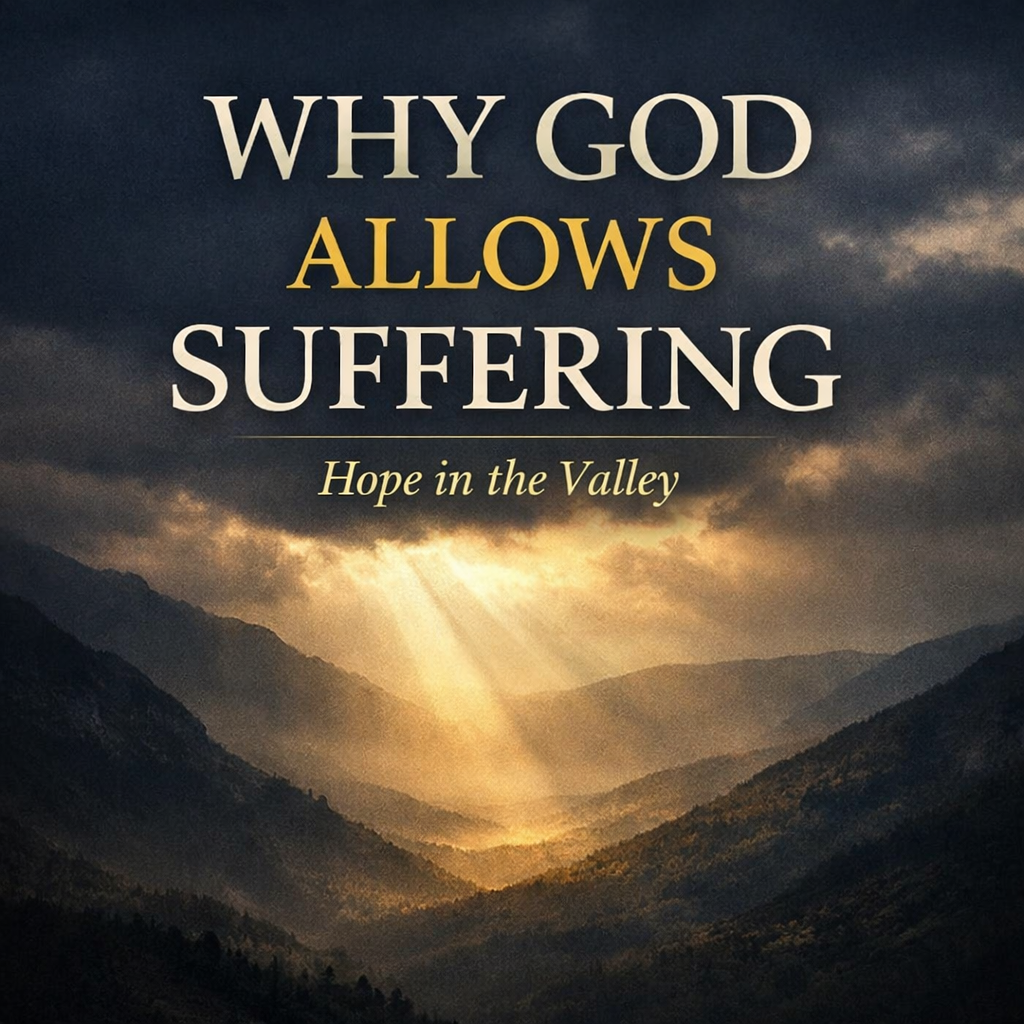
Few questions press more deeply on the human heart than this one: Why does God allow suffering? It is not merely a philosophical question. It is a personal one. It rises in hospital rooms and funeral homes. It surfaces in quiet moments of loss, disappointment, and confusion. It lingers when prayers seem unanswered and when circumstances refuse to change.
For many, suffering becomes the lens through which they begin to question everything, God’s goodness, His power, and even His presence. Yet Scripture does not avoid this question. Nor does it answer it with vague sentiment or shallow reassurance. Instead, it provides a clear, comprehensive, and deeply hopeful framework, one that does not remove the reality of suffering but places it within the purposes of a sovereign and faithful God. To understand suffering rightly, we must begin not with our experience, but with God’s Word.
Suffering and the Reality of the Fall
The Bible is clear that suffering is not part of God’s original creation. In Genesis 1–2, God declares His creation “very good.” There is no death, no pain, no sorrow. Humanity lives in perfect fellowship with God, in a world marked by order, goodness, and life. Suffering enters the world in Genesis 3.
When Adam and Eve rebel against God, sin brings devastating consequences, not only spiritually, but physically and relationally. The ground is cursed. Pain enters human experience. Death becomes a reality. What was once whole is now fractured. This is the foundational truth we must grasp: Suffering is not random. It is rooted in the fall. Every experience of pain, loss, or hardship traces back to a world that has been broken by sin. Yet even here, Scripture does not leave us without hope.
God’s Sovereignty Over Suffering
One of the most difficult, yet essential, truths the Bible teaches is that suffering is not outside of God’s control. Scripture consistently affirms that God is sovereign over all things.
Lamentations 3:37–38 asks:
“Who has spoken and it came to pass, unless the Lord has commanded it?
Is it not from the mouth of the Most High that good and bad come?”
This does not mean that God delights in evil or is the author of sin. But it does mean that nothing, including suffering, falls outside His sovereign rule. For many, this truth is uncomfortable.
But it is also the only foundation for real hope. If suffering were random, it would be meaningless. If it were outside of God’s control, it would be terrifying. But because God is sovereign, suffering is never purposeless.
The Purpose of Suffering in the Life of the Believer
Scripture makes clear that God uses suffering for specific and meaningful purposes in the lives of His people. Romans 8:28 reminds us:
“And we know that for those who love God all things work together for good, for those who are called according to his purpose.”
This “good” is not defined by comfort or ease. It is defined by God’s greater purpose, to conform us to the image of Christ (Romans 8:29). James 1:2–4 calls believers to “count it all joy… when you meet trials of various kinds,” because those trials produce steadfastness. Likewise, 1 Peter 1:6–7 describes suffering as a refining fire, testing and strengthening genuine faith. Suffering, then, is not wasted.
- It deepens our dependence on God.
- It exposes the idols of our hearts.
- It strengthens our faith.
- It shapes our character
- It conforms us more fully to Christ.
What feels like disruption is often divine formation.
Suffering Reveals What We Trust
In seasons of ease, it is easy to assume that our trust is firmly in the Lord. But suffering has a way of revealing what truly holds our hearts. When comfort is removed, when control is stripped away, when certainty disappears, we begin to see more clearly what we have been relying on. Suffering exposes misplaced trust. It reveals where we have looked for security, identity, or meaning apart from God. And in doing so, it graciously redirects us. God does not expose these things to condemn us, but to draw us back to Himself.
The Cross: The Ultimate Answer to Suffering
While Scripture provides a framework for understanding suffering, it ultimately points us to a person, the Lord Jesus Christ. The cross is the clearest demonstration that God can use even the greatest evil to accomplish the greatest good. The unjust suffering of Christ was not meaningless. It was the very means by which God secured redemption for His people.
Acts 2:23 declares that Jesus was “delivered up according to the definite plan and foreknowledge of God,” even as He was crucified by sinful men. At the cross, we see both the reality of evil and the sovereignty of God fully displayed. This changes how we understand our own suffering. If God could use the cross, the worst act in human history, for eternal good, then we can trust Him to work through our suffering as well.
The cross assures us that:
- God is not distant from suffering.
- God is not indifferent to suffering.
- God has entered into suffering.
And through Christ, suffering will not have the final word.
What This Means for Us
Understanding these truths does not remove the pain of suffering. It does, however, transform how we walk through it. It means that:
- Your suffering is not meaningless.
- Your pain is not unseen.
- Your circumstances are not outside God’s control.
Even when you do not understand what God is doing, you can trust who He is. He is good. He is faithful. He is sovereign. And He is working, even in the valley.
For Pastors and Ministry Leaders
Suffering requires careful, patient shepherding. Those who are hurting do not need simplistic answers or rushed conclusions. They need faithful presence and biblical truth. We must resist the temptation to explain away suffering or minimize its weight. Instead, we:
- Sit with those who grieve.
- Speak the truth of God’s Word with gentleness.
- Point consistently to the character of God.
- Anchor hope in the gospel.
Faithful shepherding does not remove the valley. It helps people walk through it with their eyes fixed on Christ.
Final Encouragement
Suffering is one of the hardest realities of life in a fallen world. But it is not outside the purposes of God. The valley is real. The pain is real. But so is the hope. Because the God who rules over suffering is the same God who redeems it. And in Christ, we are reminded that the story does not end in the valley. It ends in glory.
Call to Action
If you are walking through suffering, you are not alone. We would be honored to pray for you. Reach out through our contact page and let us know how we can serve you. And stay with us, more articles in the Hope in the Valley series are coming soon, as we continue to explore what it means to trust God in every season.
For more from this series please visit here or at our YouTube.