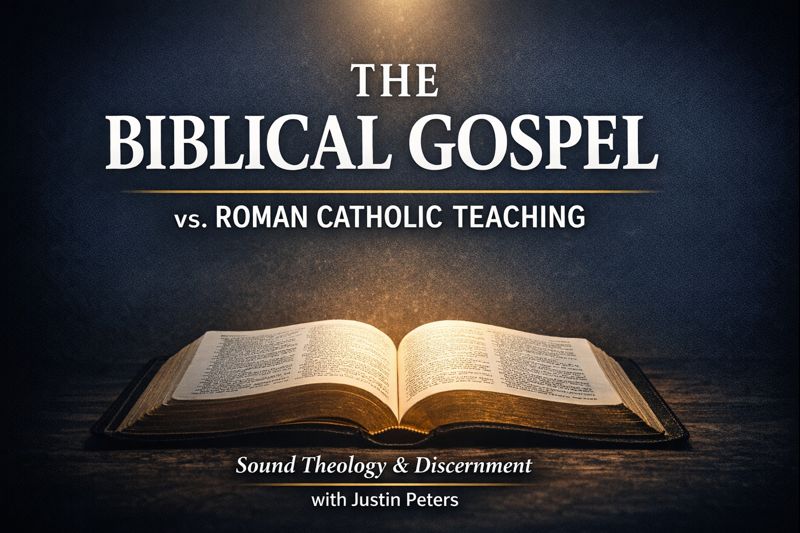
The Biblical Gospel vs. Roman Catholic Teaching on Salvation
Show: Sound Theology & Discernment
Host: Justin Peters
Date: January 2026
Show Summary
In this episode of Sound Theology & Discernment, Justin Peters contrasts the biblical gospel with
Roman Catholic teaching on salvation by examining a widely circulated exchange in which Ben Shapiro asks how a
sinner is saved and Bishop Robert Barron responds by appealing to Vatican II, conscience, and “indirect” reception
of Christ’s grace. Justin shows from Scripture that salvation is by grace alone through faith alone in Christ alone,
that Jesus is not a “privileged” way to heaven but the only way, and that any gospel that mixes grace with works is
no gospel at all.
Audio Player
Video Player
Key Scriptures
- John 14:6
- Acts 4:12
- Romans 3:27–28
- Romans 11:6
- Galatians 1:8–9
- Hebrews 7:26–27
- James 2:10
- Leviticus 17:11
Episode Notes
- The weightiest question: What must I do to be saved? Scripture answers with Christ alone, not human merit.
- The purpose of the Law: God’s Law exposes sin and drives us to Christ; it cannot justify (cf. Romans 3:20).
- Why “sincerity” cannot save: A sincere conscience is not a substitute for repentance and faith in Jesus.
- Authority matters: The final authority for faith and practice is Scripture, not councils or tradition.
- Grace and works: Works are the fruit of justification, not the cause; adding works to grace empties grace of meaning (Romans 11:6).
- Christ’s finished work: Jesus offered Himself once for all—no additional merit can be added to His atonement (Hebrews 7:27).
- Gospel clarity: The Bible does not present Jesus as one option among many, but as the only Savior (Acts 4:12).
Full Article
Ben Shapiro’s question gets to the heart of eternity: how can a guilty sinner be made right with a holy God?
Many people assume that religious devotion, moral effort, or sincere rule-keeping can secure heaven. But Scripture
is clear that all have sinned and fall short of God’s glory (Romans 3:23) and that no one will be justified by works
of the Law (Romans 3:20). The Law reveals God’s holiness and our guilt, functioning as a tutor that leads us to Christ.
The biblical gospel is not that God grades on a curve, nor that heaven is granted to those who try their best.
Salvation is a gift purchased by Christ and received by faith. Jesus Christ alone lived in perfect obedience,
died as the once-for-all sacrifice for sinners, and rose bodily from the dead. Because of His finished work,
sinners are justified by faith apart from works of the Law (Romans 3:28).
Any message that treats Jesus as merely the “privileged” route to heaven, or that suggests a person may be saved
outside of explicit faith in Christ, contradicts the plain teaching of Scripture. Jesus did not say He is a way,
but the way: “I am the way, and the truth, and the life. No one comes to the Father except through Me”
(John 14:6). Likewise, the apostles proclaimed, “There is salvation in no one else” (Acts 4:12).
The good news is that Christ saves sinners who come to Him empty-handed. Our works cannot earn grace; they can only
follow as the grateful fruit of a new heart. If you are trusting in religious effort, ritual, tradition, or sincerity,
lay it down and come to Christ. Turn from sin and place your trust in Jesus—His righteousness is sufficient, His
sacrifice is complete, and His promise is sure: “Whoever comes to Me I will never cast out” (John 6:37).
Takeaways
- Salvation is by grace alone through faith alone in Christ alone.
- Jesus is not a “privileged” way to heaven—He is the only way.
- Scripture, not councils or tradition, is the final authority.
- Good works are the fruit of salvation, not the cause of it.
Call to Action
If this episode helped clarify the gospel, please share it with a friend and subscribe for more episodes of
Sound Theology & Discernment. For more biblical teaching and resources, visit Justin’s page at Servants of Grace or at our YouTube.
This video first appeared at Justin’s YouTube and is posted here with his permission: https://www.youtube.com/watch?v=uoiuc2v9Kgo