⏱️ Estimated Reading Time: 8 min read
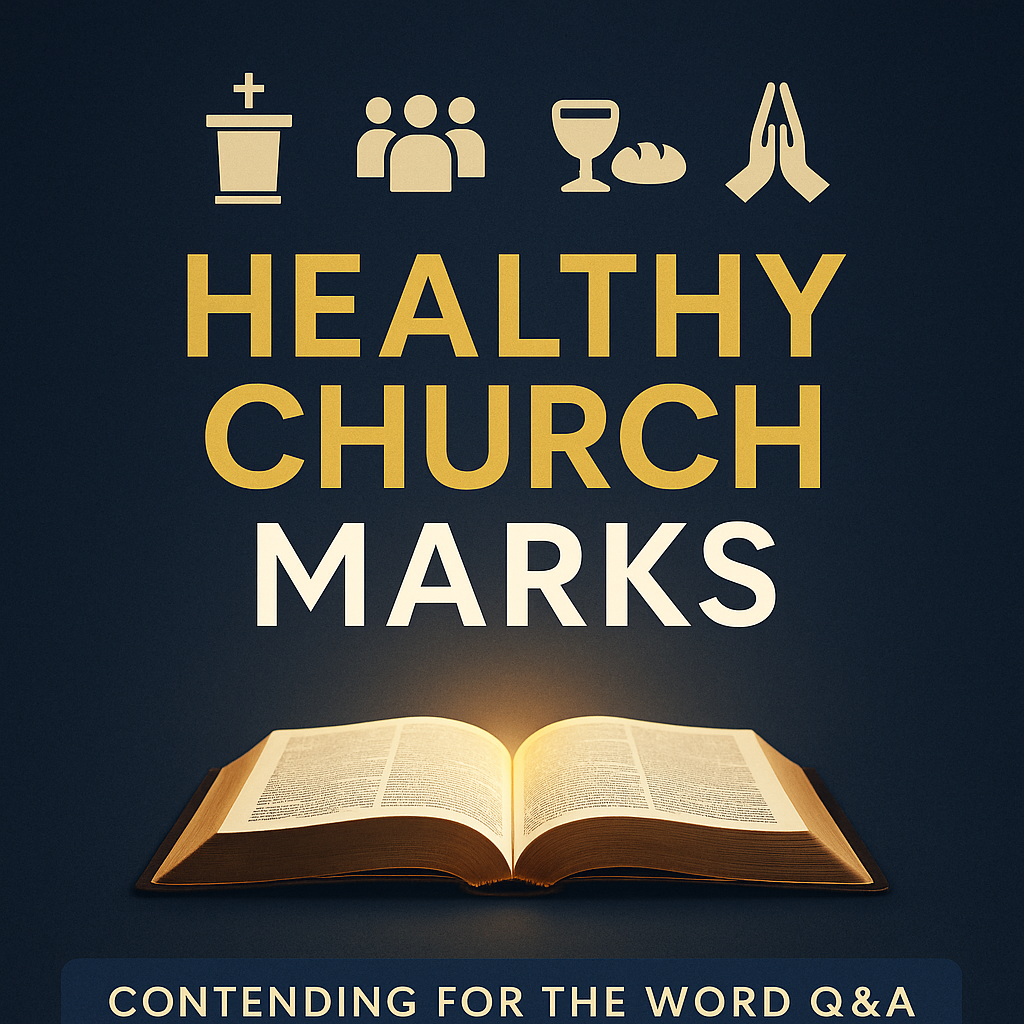
Marks of a Healthy Local Church
Show: Contending for the Word Q&A with Dave Jenkins
Episode Type: Q&A Teaching
Question: What makes a healthy local church?
Show Summary
What makes a church truly healthy is not numbers, buildings, or programs, but faithfulness to Christ and His Word.
In this episode of Contending for the Word Q&A, Dave Jenkins walks through Acts 2:42-47 and explains the biblical marks of a healthy local church. He looks at how Scripture shapes the life of the church, the role of biblically qualified male elders, the importance of meaningful membership and discipline, and the central place of worship, prayer, and mission.
Listen to the Episode
Watch the Episode
Key Scriptures
- Acts 2:42-47
- 1 Timothy 3:1-7
- Titus 1:5-9
- Matthew 18:15-20
- 1 Corinthians 5:1-13
Episode Highlights
- Why the health of the local church affects your walk with Christ, your family, and your witness.
- How Acts 2:42-47 gives a clear snapshot of normal New Testament church life.
- Why a healthy church is shaped by the Word of God through expositional preaching and sound doctrine.
- The character and responsibilities of biblically qualified male elders as under shepherds of Christ.
- The importance of meaningful membership, fellowship, and loving church discipline.
- How worship, prayer, generosity, and mission mark a church that is centered on Christ.
- When it may be time to seek a faithful local church and how to do so wisely.
Full Article
All right everybody, welcome back to the Contending for the Word Q&A podcast. I am your host, Dave Jenkins.
Today we are going to look at a question that gets right to the heart of Christian discipleship and ministry:
what makes a healthy local church?
This is not just a theoretical question. The health of the local church affects your walk with Christ, your family,
your growth in the grace of God, and your witness to a watching world. So we need to ask it slowly and thoughtfully:
what makes a healthy local church? Is it numbers, buildings, and budgets? Is it how exciting the worship feels or
how well the pastor seems to preach? Is it the kind of programs the church offers or how relevant the church seems
to the surrounding culture? Scripture gives us a very different set of criteria. A healthy church is not first about impressing people. A healthy church is about pleasing Christ, obeying His Word, and shepherding His flock.
Anchored in Acts 2:42-47
I want to anchor our time in Acts 2:42-47, one of the clearest snapshots of church life in the New Testament:
“And they devoted themselves to the apostles’ teaching and the fellowship, to the breaking of bread and the prayers…
And the Lord added to their number day by day those who were being saved.”
Notice what God highlights here. Not fog machines. Not celebrity personalities. Not marketing strategies. Instead we
see devotion to the apostles’ teaching, fellowship, the breaking of bread, prayer, reverence, generosity, and mission.
These are the marks of a healthy local church.
Here is the big idea we are going to unpack. A healthy local church is a people saved by Christ, shaped by the Word of
God, shepherded by biblically qualified male elders, and sent into the world in holiness and love.
1. A Healthy Church is Shaped by the Word of God
Acts 2:42 says that the early church devoted themselves to the apostles’ teaching. That means the church constantly
gathered around the Word of God, listened to it, believed it, and obeyed it.
A healthy church is not built on the personality of the pastor or the preferences of the people or the trends of the
culture. A healthy church is built on the whole counsel of God. That means at least three things.
First, it means expositional preaching. The pulpit is not a place for the pastor’s opinions. It is a place for the Word
of God to be opened, explained, and applied week after week. The Scriptures, not the headlines and not the preacher,
set the agenda.
Second, it means sound doctrine. The church is grounded in the historic, biblical gospel, the deity and humanity of Christ, His sinless life, His substitutionary death, His bodily resurrection, and His second coming. The authority, inerrancy, and sufficiency of the Word of God are non-negotiable.
Third, Scripture shapes the entire life of the church. The Word of God forms counseling, worship, small groups, children’s ministry, and outreach. Scripture is not just a Sunday morning accessory. It is the church’s life and bread, and the church gladly submits to it because it is the church’s treasure. A church cannot be spiritually healthy if it is malnourished by the Word of God.
2. A Healthy Church is Shepherded by Biblically Qualified Men
Passages like 1 Timothy 3 and Titus 1 lay out the qualifications for elders. The emphasis is not on gifting or charisma, but on character and doctrine. Elders are to be above reproach, able to teach, holding firm to the trustworthy Word, and modeling godliness in the home, in speech, in love, and in purity.
A healthy church does not treat leadership lightly. It understands that Christ is the Chief Shepherd and elders are
under shepherds who will give an account to Him. In a healthy church, leaders guard the flock from false teaching,
feed the flock with sound doctrine, and care for the flock through prayer, counsel, and example.
Where leadership is corrupt, self serving, or doctrinally drifting, the church will eventually suffer. Where leadership
is humble, accountable, and faithful to the Word of God, the church is protected and nourished.
3. A Healthy Church Practices Meaningful Fellowship and Discipline
Acts 2 speaks of the believers being together in fellowship. The New Testament is filled with one another commands: love one another, bear one another’s burdens, encourage one another, confess sins to one another, pray for one another. This assumes more than casual attendance. It assumes committed, accountable relationships in a defined local body.
A healthy church takes membership seriously. People know who their shepherds are, and leaders know who they will give an account for. Members commit to one another in doctrine, worship, and life.
This also means a healthy church practices church discipline, not as a harsh weapon, but as a loving rescue mission.
In Matthew 18 and 1 Corinthians 5, discipline aims at restoration and holiness. It protects the purity of the church and the reputation of Christ.
Ignoring sin is not loving at all. Confronting sin with gentleness and truth is an act of love. A church that has no
category for discipline will quickly drift into compromise. A healthy church takes sin seriously because it takes Christ and His gospel seriously.
4. A Healthy Church is Devoted to Worship, Prayer, and Mission
In Acts 2 we see the breaking of bread, prayer, awe at the work of God, generosity toward those in need, and the Lord
adding to their number day by day. Healthy churches are reverent in worship, prayerful rather than self-sufficient,
generous rather than self absorbed, and missional rather than turned inward.
Worship is centered on Christ and guided by the Word of God. Prayer meetings are not an afterthought, they are essential. The church cares for the hurting, supports missions, and clearly proclaims the gospel at home and abroad. When a church is saturated with worship, prayer, and mission, it will not be easily shaken by the pressures of the culture.
Responding to What Scripture Teaches
When we ask what makes a healthy church, we are really asking if this is a church where Christ is honored and His Word is obeyed. Is this a church where leaders are faithful, members are committed, and sin is taken seriously? Is this a church where worship, prayer, and mission are essential, not optional?
If you are in a church that is striving, however imperfectly, to be shaped by the Word of God, shepherded by biblically qualified elders, serious about membership and discipline, and devoted to worship, prayer, and mission, then thank the Lord. Pray for your leaders, encourage your fellow members, and lean all the way in and commit.
If you are in a place where the Word of God is minimized, where doctrine is treated as divisive, where sin is ignored,
where leaders are not accountable or not biblically qualified, it may be time to pray seriously about where the Lord
would have you be planted. Seek counsel from trusted, theologically mature believers and ask the Lord to lead you to a faithful local church. A healthy local church is a people saved by Christ, shaped by the Word, shepherded by biblically qualified leaders, and sent into the world in holiness and love.
Takeaways and Reflection Questions
- Is your local church clearly shaped by the teaching of Scripture in its preaching, worship, and ministries?
- Do your leaders meet the biblical qualifications for elders and take seriously their calling to shepherd the flock?
- How are you participating in meaningful fellowship, membership, and accountability in your church?
- Where can you grow in praying for your church, serving in your church, and supporting its mission?
Stay Connected
If this episode encouraged you, please share it with a friend, subscribe to Contending for the Word Q&A,
and leave a review where you listen to podcasts. For more from Contending for the Word Q&A please visit our page at Servants of Grace or at our YouTube.

Dave Jenkins is happily married to his wife, Sarah, and lives in beautiful Southern Oregon. He is a writer, editor, and speaker who loves Christ, His people, the Church, and sound theology.
Dave serves as the Executive Director of Servants of Grace Ministries and the Executive Editor of Theology for Life Magazine. He is the Host and Producer of the Equipping You in Grace Podcast and a contributor to and producer of Contending for the Word.
He is the author of The War of Worldviews: Truth, Lies, and the Battle for the Christian Mind (Theology for Life, 2026), Contentment: The Journey of a Lifetime (Theology for Life, 2024), The Word Matters: Defending Biblical Authority Against the Spirit of the Age and The Word Explored: The Problem of Biblical Illiteracy and What To Do About It (House to House, 2021).
You can connect with Dave on Facebook, X (Twitter), Instagram, YouTube, or subscribe to his newsletter.
When he is not engaged in ministry work, Dave enjoys spending time with his wife, going to movies, sharing a meal at a favorite restaurant, or playing a round of golf with friends. He is also a voracious reader, particularly of Reformed theology and the Puritans, and is often found working through a stack of new books from a wide range of Christian publishers.
Dave earned his M.A.R. and M.Div. from Liberty Baptist Theological Seminary.