⏱️ Estimated Reading Time: 8 min read
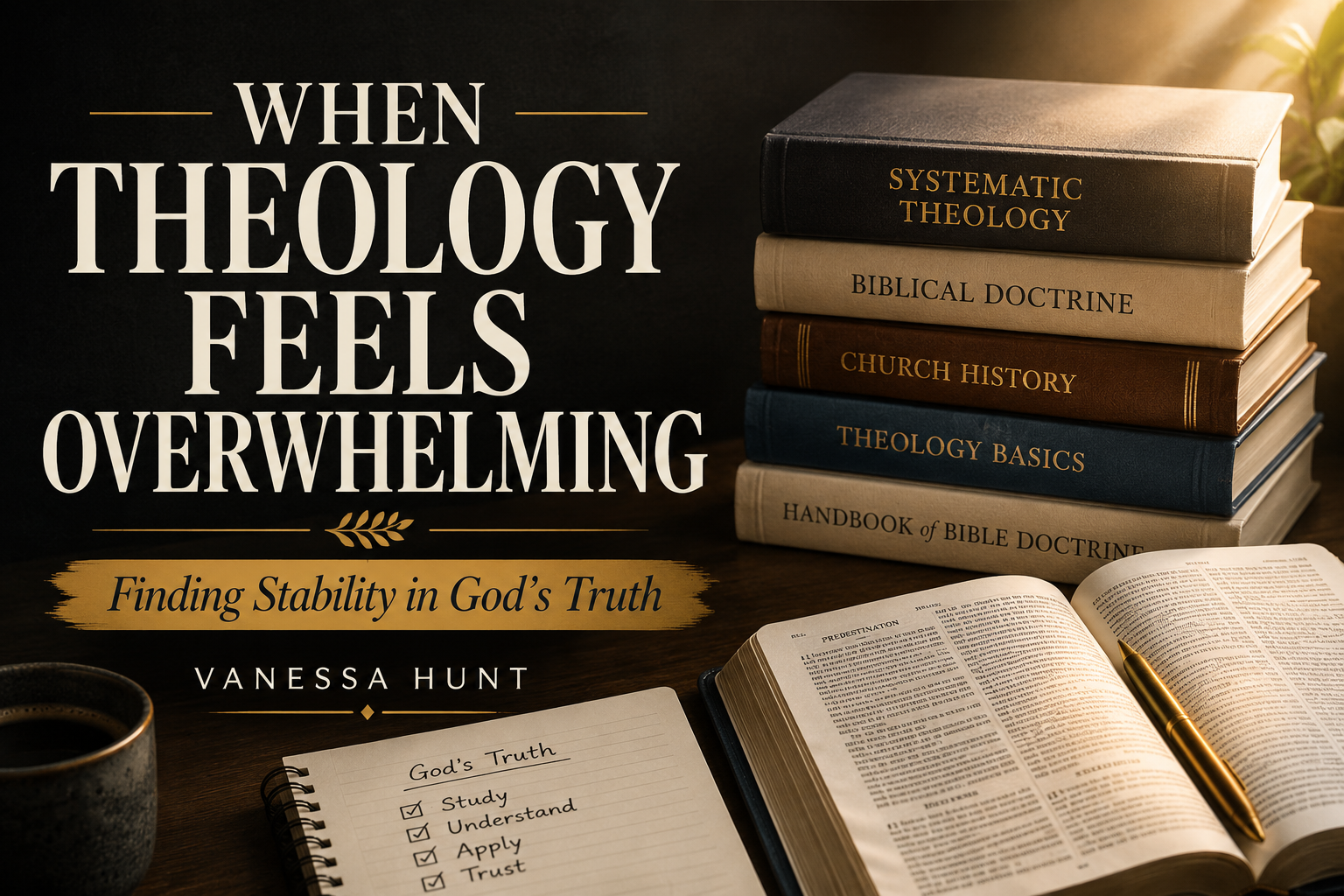
Finding Stability When Theology Feels Overwhelming
By Vanessa Hunt
Last Christmas my husband gave me the book ‘Daily Doctrine’ by Kevin DeYoung. It sits with my Bible next to my bed and I read from both books every night. Broken up into sections that cover everything from Anthropology to Soteriology, each day’s reading is only about a page or two long, making it very easy to get through. Reverend DeYoung does an excellent job of taking what can often be challenging concepts and making them easy to digest. For many weeks I felt like I was doing a pretty good job of understanding and applying terminology and was excited to be learning so much. That was until I came to a daily reading that included the words supralapsarianism and infralapsarianism. A sudden temptation reared up inside of me to close this book and give up. I mean, why exactly do I even need to have such words in my brain? I’m a homemaker, a wife, a mom and yes, a Christian writer too but I’ve made it this far without knowing those terms so I’m sure I could do just fine without them for the rest of my life.
Rather than giving into the temptation to quit, I took a deep breath and continued reading. I’ll admit that it required going over it a couple of times to fully comprehend but, in the end, I’m so glad that I didn’t let myself become overwhelmed by these concepts that were new to me. In our culture today, where people are either content with thirty second clips on TikTok or completely outsourcing their thinking to AI, it feels practically rebellious to require more of ourselves. As women, we are far more likely to have conversations about our families than we are about theology. But this is an area that has been sorely neglected by churches for both men and women. The reality is that we will always prioritize what we value and that means that we must make theology a priority in our lives.
If you’ve only ventured into the shallow end of theology (the study of God) or even if you’re still standing on the side looking down at the water, it can be very easy to quickly feel like you’re drowning in terms and concepts. So, I’d like to recommend a few ways that you can find stability when it becomes overwhelming.
1. Big Words Aren’t Better
When studying theology, you can quickly find yourself sifting through the most advanced books and other sources. Suddenly you feel as though you are taking a PhD level class while a toddler is at your feet begging for another goldfish cracker. But it’s important to remember that the Bible was written for ordinary people to be able to read and understand. As Christians, we don’t have to rely on someone else to interpret it for us. If we are taking an exegetical approach to our reading, we will be able to comprehend everything that is necessary for salvation and sanctification. “Now Jesus did many other signs in the presence of the disciples, which are not written in this book; but these are written so that you may believe that Jesus is the Christ, the Son of God, and that by believing you may have life in his name.” (John 20:30-31) And, if we want to go deeper with theology, there are so many sources for study that don’t require a degree in linguistics.
2. Don’t Be Intimidated
If you spend a few minutes in the online theology world, you’ll quickly realize that there is a segment of people who love to debate and especially love to be right. For someone who is more focused on studying theology to grow in their faith and be better equipped to share the Gospel, this can be very intimidating. There is some benefit to hearing debates and dialogue about these “in-house” issues within Christendom. Particularly when it comes to areas like eschatology and the age of the earth which fall within the category of interpretation rather than being salvific. But when arguing becomes sport and well-intentioned dialogue devolves into mudslinging, we are no longer faithfully representing Christ to a watching world. 2 Timothy 2:23 says, “Have nothing to do with foolish, ignorant controversies; you know that they breed quarrels.” Rather than allowing yourself to be intimidated to the point of discouragement, remember that these people don’t exemplify the reason we study theology. We study it to be able to give an answer or a defense for why we believe what we believe (1 Peter 3:15) not to always be on the defensive.
3. You Don’t Need to Know Everything
The bandwidth for study that a college student has is very different than that of a stay-at-home mom or full-time employee. Taking the time to learn new concepts doesn’t have to be overwhelming if you make the choice to just tackle one at a time. It can be really discouraging when you hear people discussing theological issues and you realize that you have no idea what they are talking about. Or if you are asked a question by a skeptic and you don’t know exactly how best to respond. As followers of Christ, we have been charged with sharing the Good News with others and this message is the foundation upon which everything else is built. The use of apologetics that is rooted in theology will always help us to remove roadblocks that may be in the way of someone understanding Christianity. But ultimately, we must trust that the Holy Spirit will move in their heart and help us to know how best to be a witness. We can’t allow fear or insecurity to keep us from engaging in those conversations. “For God gave us a spirit not of fear but of power and love and self-control. Therefore do not be ashamed of the testimony about our Lord, nor of me his prisoner, but share in suffering for the gospel by the power of God, who saved us and called us to] a holy calling, not because of our works but because of his own purpose and grace, which he gave us in Christ Jesus before the ages began.” (2 Timothy 1:7-9)
4. Learn How to Persevere
Social media may have conditioned our culture to be satisfied by bite-sized information (much of which is inaccurate) but, as Christians, we should never be willing to outsource our minds to an algorithm. The proper study of any topic will require perseverance, but this is especially true for something that is so integral to our sanctification. If we can accept the fact that this is not a short trip but a long journey, we are more likely to stay diligent in our study of theology. And we know that even the process itself will produce character qualities that are essential for the mature believer to possess. “Blessed is the man who remains steadfast under trial, for when he has stood the test he will receive the crown of life, which God has promised to those who love him.” (James 1:12) Whether it’s reading, listening to an audiobook or podcast or attending a class, incorporating this into your everyday life doesn’t need to feel like a monumental task. Simply take it a little bit at a time and you’ll be surprised by how quickly it becomes ingrained in your mind and heart.
The deep love I have for my husband compels me to want to know him more and to continue to learn new things about him even after thirty years together. How much more should our love for the Lord compel us to want to know Him more; to plumb the depths of His Word knowing that all of it is for our edification. And, while there will always be mysteries and things our human minds cannot comprehend, we must resist growing weary or discouraged in our pursuit of understanding His ways.
“Therefore, beloved, since you are waiting for these, be diligent to be found by him without spot or blemish, and at peace. And count the patience of our Lord as salvation, just as our beloved brother Paul also wrote to you according to the wisdom given him, as he does in all his letters when he speaks in them of these matters. There are some things in them that are hard to understand, which the ignorant and unstable twist to their own destruction, as they do the other Scriptures. You therefore, beloved, knowing this beforehand, take care that you are not carried away with the error of lawless people and lose your own stability. But grow in the grace and knowledge of our Lord and Savior Jesus Christ. To him be the glory both now and to the day of eternity. Amen.” (2 Peter 3:14-18)
Clarity in Doctrine: Sound Doctrine in a Noisy World

Vanessa Hunt is a Willamette Valley, Oregon based author and speaker who is passionate about helping women develop a solid Biblical worldview through which they will be better equipped to navigate the culture, workplace, marriage and parenting. She offers encouragement and inspiration on her website At the Picket Fence and in her book, ‘Life in Season: Celebrating the Moments that Fill Your Heart and Home’. Her greatest joys are her husband Robb and their two mostly-grown children. Vanessa and Robb are Outpost Directors for their local Stand to Reason apologetics class. She is a regular contributor to Clear Truth Media and Club31 Women, a division of Baker Publishing. Her work has been featured in Proverbs31 Women, Joyful Life Magazine, Home Front, Good Housekeeping, Better Homes & Gardens and HGTV.