⏱️ Estimated Reading Time: 8 min read
Why Worship Needs Clarity
By Dave Jenkins
Worship is never a small matter because the God we worship is not a small God.
When Christians gather on the Lord’s Day, we are not gathering merely to hear music we enjoy, experience certain emotions, or participate in religious activities. We gather before the living God. He is holy, sovereign, righteous, gracious, and worthy of all glory. Our worship, therefore, must begin with who God is and with what He has revealed about Himself in His Word.
Jesus told the woman at the well, “God is spirit, and those who worship him must worship in spirit and truth” (John 4:24). Those words confront every generation of Christians with an important reality: sincerity by itself is not enough. Strong emotion is not enough. Good intentions are not enough. Worship must be governed by truth.
This is why the church needs clarity in worship.
Worship Begins with God
One of the easiest mistakes to make in worship is to begin with ourselves.
What kind of music do I prefer? Did I enjoy the service? Did the message speak to me? Did I feel something? Was the worship powerful?
Those questions reveal how easily worship can become centered on human experience rather than the glory of God.
Biblical worship begins somewhere entirely different. It begins with God.
The Psalms repeatedly call the people of God to worship because of who the Lord is and what He has done. “Oh come, let us worship and bow down; let us kneel before the LORD, our Maker!” (Psalm 95:6). We worship because He is our Creator. We worship because He is holy. We worship because He has revealed Himself. Above all, Christians worship because God has redeemed sinners through the person and work of the Lord Jesus Christ.
Worship is our response to God’s revelation of Himself.
That means we do not have the freedom to reinvent God according to our preferences. Nor do we have the freedom to determine for ourselves what worship ought to be. God has spoken in His Word, and His Word must govern both our understanding of Him and our worship of Him.
Clarity in worship therefore begins with clarity about God.
Worship Requires Truth
Jesus did not separate worship from truth. Neither should we.
This matters because our culture prizes authenticity. People are often told that what matters most is whether an experience feels genuine. The assumption is that sincerity validates the experience.
Scripture teaches something very different.
A person can be sincere and sincerely wrong.
The prophets of Baal were sincere when they cried out to their false god on Mount Carmel (1 Kings 18:25–29). The Athenians were religious when Paul encountered their many objects of worship (Acts 17:22–23). Yet neither sincerity nor religious enthusiasm made their worship acceptable to God.
Truth matters because the object of worship matters.
Christian worship is worship of the Triune God who has revealed Himself in Scripture. It is centered upon the Lord Jesus Christ and His finished work. It is shaped by the gospel. It is governed by the Word of God.
This means theology and worship can never safely be separated.
Every song teaches something. Every prayer communicates something about God. Every sermon presents a vision of God, humanity, sin, salvation, and the Christian life. Even the structure of a worship service communicates what a church believes is important.
The question is not whether our worship is theological.
It is whether our theology is biblical.
The Mind and Heart Belong Together
Insisting upon truth does not mean biblical worship should be cold, lifeless, or merely intellectual.
Scripture knows nothing of a choice between truth and affection.
Paul said, “I will sing praise with my spirit, but I will sing with my mind also” (1 Corinthians 14:15). Biblical worship involves understanding and affection. The mind apprehends truth, and the heart responds to that truth with love, gratitude, joy, reverence, repentance, and praise.
The problem is not emotion in worship.
The problem is emotion detached from truth.
There is a significant difference between biblical affection and emotional manipulation. Music can move us. Atmosphere can affect us. Repetition can intensify an emotional response. A gifted speaker can stir an audience. None of these experiences necessarily demonstrate that the Holy Spirit is at work.
The Spirit of God works through the Word He inspired.
True Christian affections are not manufactured by techniques. They arise as believers behold the glory of God revealed in Scripture and respond in faith.
We should want Christians to sing passionately. We should want congregations filled with gratitude and joy. We should want believers deeply moved by the gospel.
But we want their hearts moved because their minds have been filled with truth.
Discernment Matters in Worship
This is also why worship requires discernment.
Christians sometimes treat worship music as though it occupies a theological neutral zone. We carefully evaluate sermons and books but may sing songs without considering what they teach or the theology of the ministries producing them.
Yet songs are powerful teachers.
A congregation may forget portions of a sermon by Tuesday and still remember the songs it sang years later. Words joined to melody become embedded in the memory. What Christians sing repeatedly helps shape what they believe about God.
Therefore, what we sing matters.
We should ask whether our songs accurately describe God, Christ, sin, grace, salvation, the church, and the Christian life. We should consider whether they are rich in biblical truth or vague enough to mean almost anything. We should be discerning about the ministries and theological movements shaping contemporary worship.
Discernment is not opposed to worship. Discernment protects worship.
The goal is not suspicion for its own sake. The goal is faithfulness.
Reverence and Joy Are Friends
Our age also needs to recover reverence.
Reverence is sometimes caricatured as gloomy Christianity—as though taking God seriously means Christians cannot rejoice.
Scripture presents no such contradiction.
Psalm 2:11 tells us, “Serve the LORD with fear, and rejoice with trembling.”
There is both rejoicing and trembling.
When Isaiah saw the Lord “sitting upon a throne, high and lifted up,” he did not respond casually (Isaiah 6:1). Confronted by the holiness of God, he became painfully aware of his own sinfulness. Yet the same God who revealed His holiness also provided cleansing.
That pattern matters.
Biblical worship brings us before the holy God, exposes our sin, directs us to His grace, and produces gratitude and praise.
Reverence does not extinguish joy. It gives joy its proper foundation.
Christians have more reason to rejoice than anyone because we know that the holy God against whom we have sinned has provided salvation through His Son.
Worship Extends Beyond Sunday
Clarity in worship also requires us to understand that worship is bigger than music.
Singing is an important part of Christian worship, but worship cannot be reduced to a twenty-minute musical portion of a church service.
The gathered church worships through hearing the Word preached, praying, singing, giving, confessing the faith, observing baptism, and receiving the Lord’s Supper. These ordinary means may appear unimpressive to a culture addicted to novelty, but Christ uses them to nourish, strengthen, and build up His church.
And worship does not end when the congregation leaves the building.
Paul urges Christians “to present your bodies as a living sacrifice, holy and acceptable to God, which is your spiritual worship” (Romans 12:1).
The Christian life is lived before the face of God.
We worship Him in our homes. We worship Him through obedience. We worship Him as we serve our families, work faithfully, suffer with hope, love our neighbors, gather with the saints, and pursue holiness.
Sunday worship prepares Christians for lives of worship.
Beholding the Glory of God with Understanding
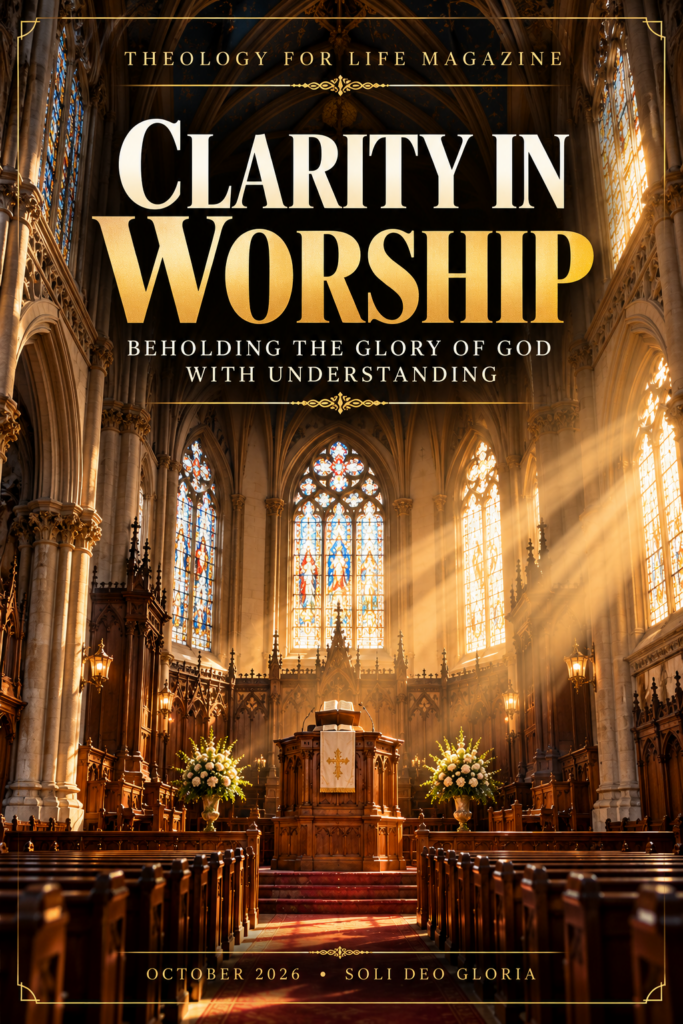
That brings us to the theme of this issue of Theology for Life: Clarity in Worship: Beholding the Glory of God with Understanding.
Throughout this issue, our contributors will consider worship from several angles: Scripture and worship, the Psalms, worldview, emotional manipulation, discernment in music, mysticism, counterfeit spirituality, the ordinary means of grace, the Lord’s Supper, family worship, suffering, and the lessons Christians can learn from church history.
These subjects are diverse, but they revolve around one central conviction:
God determines how He is to be worshiped because worship belongs to Him.
The church does not need increasingly sophisticated methods for manufacturing experiences. We need deeper confidence in the sufficiency of Scripture.
We do not need less theology in worship. We need better theology.
We do not need to choose between truth and affection. We need hearts set aflame by truth.
We do not need worship centered upon ourselves. We need to behold the glory of the Triune God revealed in His Word and supremely in the person and work of Jesus Christ.
Clarity in worship matters because God matters.
May the Lord use this issue to help us know Him more faithfully, worship Him more reverently, love Him more deeply, and join the psalmist in saying:
“Oh come, let us worship and bow down; let us kneel before the LORD, our Maker!” (Psalm 95:6).