⏱️ Estimated Reading Time: 11 min read
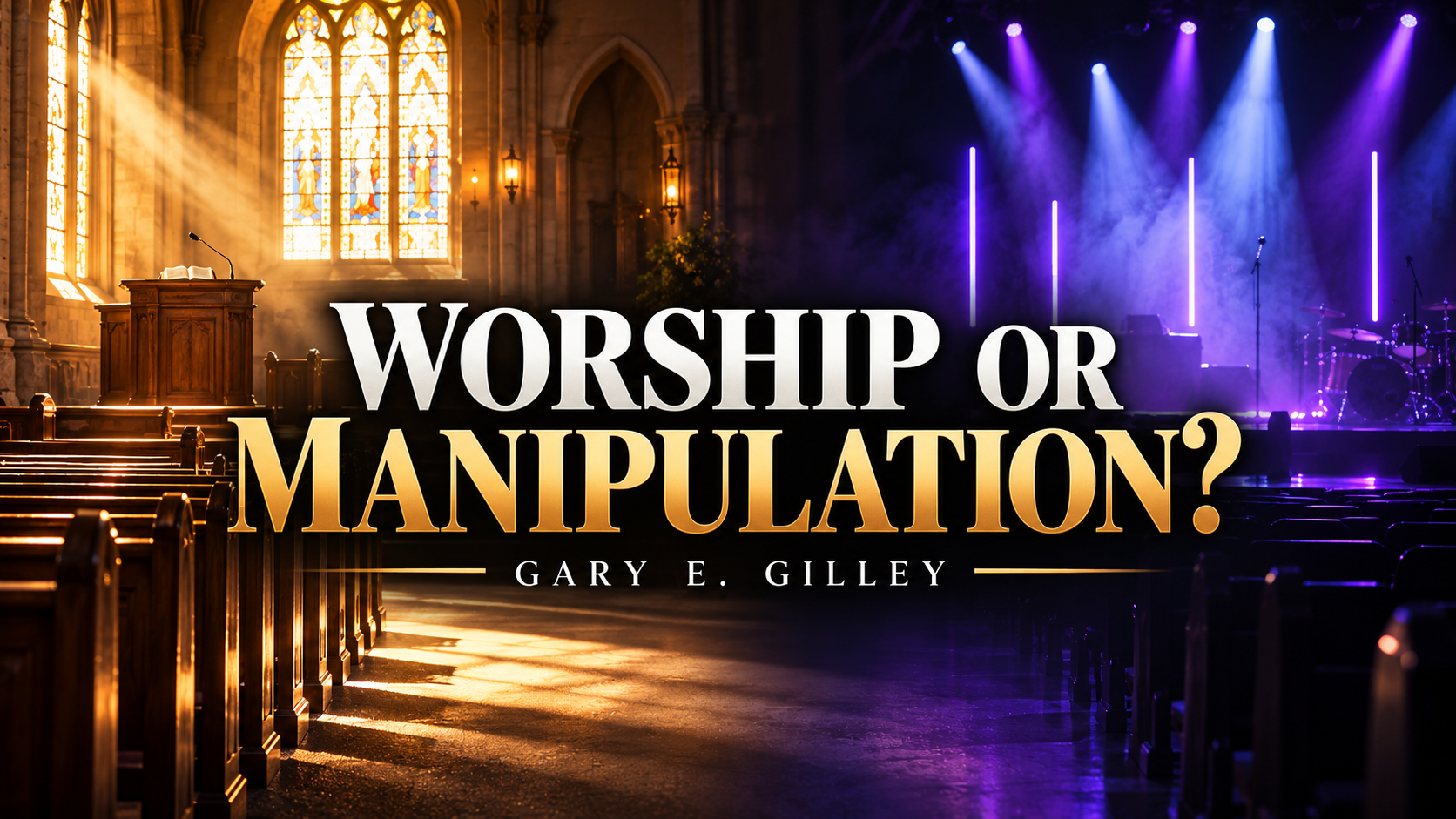
Worship Theology vs. Emotional Manipulation
By Gary E. Gilley
I enjoy being entertained as much as the next person, but I do not want to be manipulated. Entertainment at its best should be straight forward, fun, and without alternative motives. Manipulation may appear similar on the surface, but it is a disguised effort to control my emotions or behavior. It is important to distinguish between the two. Even within a church setting, entertainment can be appropriate. At the church I pastor, we have a number of entertaining events, such as an annual church retreat and various social outings. Every year on New Year’s Eve we host what we call a “fun night” in which we invite our people to perform what are often outrageous skits, songs, and games. Some of these efforts are funny, some are groaners, and some are bizarre. But everyone knows the goal is to have fun and entertain. In the right context, this attempt is appropriate; of all the creatures that the Lord put on earth, only humans have the capacity for humor, laughter, and musical enjoyment. Let’s face it. We love to have good time, and Christians have more reasons than others to embrace such moments.
Here’s the rub: when God’s people gather to worship Him, whether we want to or not, whether we are aware or not, we bring a piece of our culture, our personal background, and our sinful flesh with us. We have come to corporately worship our holy, magnificent, glorious God, but this is a most difficult task due to several challenges. First, we are self-centered creatures, but true worship is about Another. Secondly, we are immersed in a world filled with entertainment, an environment to which we have grown accustomed. Stepping out of that environment is uncomfortable and seems abnormal. As Neil Postman warned years ago, we are a society that is “amazing ourselves to death,” and that warning came long before the smart phone and social media. Next, we may be the most easily distracted generation in all of history. Due to our intake of television, social media, and smart phones, we are constantly stimulated by the mundane and superficial. Coupled with this is the fact that our attention span has been reduced to almost zero because of these same forces.
Given our self-centered natures, our love of entertainment, the ease at which we are distracted and our short attention span, pity the pastor or musical leader who wants to design a worship service that will both honor God and somehow keep the attention of the worshippers. This is especially true because the majority of Christians today could be described as mystics. That is, they have been trained to live their lives and make their decisions based more on their feelings and experiences than on the Word of God. What works for them and their personal preferences will trump what Scripture teaches in most lives, and that includes what they expect and want in a worship service. If their desires are not met, they will simply trot on down the street to a church that is more to their liking. Given the reality of such headwinds, how do spiritual leaders who want to lead their people in true worship of God accomplish such a task?
We begin with the recognition that few Christians in modern times have been taught or have seen many examples of true worship. In addition, it is essential to be aware of yet another barrier to corporate worship and that is the saturation of our culture with the influence of therapeutic psychology. Among the many concerns the biblically astute believer has with secular psychology is that it trains the individual to treasure the self, while the Scriptures teach us to treasure the Lord. Psychology tells us to love ourselves; the Bible calls on us to love God and others. Psychology offers many roads to truth, that is, our personal truth as we understand it; the Lord points to absolute truth as proclaimed in the Word. Psychology informs us that we should please ourselves. After all, we only live once; the Bible informs us that we should live to please Christ, and we will live eternally.
Since most Americans accept these psychological myths, even if only by default, the first task of church leadership must be to disconnect Christians from therapeutic philosophy and replace it with a biblical mindset and worldview. Such massive topics are far beyond the scope of this short article, so we must narrow our thoughts to the subject at hand which is how we can worship so that the heart is engaged rather than manipulated by pragmatism, emotional techniques, or psychological misinformation.
In order to do that, we must turn to the Scriptures to determine what kind of worship pleases God and, especially for the purpose of this article, what the content of our worship should be when God’s people gather. Jesus informed the woman at the well in John 4:23 that the day would come when it did not matter where we worshipped but that we did so in spirit and truth. By that Jesus meant that our worship must be defined by our sincere devotion to the Lord and commitment to His truth. Worship is to be grounded in heartfelt adherence to the Lord’s revelation. This means that worship is always about God, not about us. As a result, the often-asked question “What did you get out of the worship service?” is fundamentally the wrong question. The correct question might be, “What did you offer to God during the service?” That is, did you sincerely honor Him with your singing, involvement in prayer, attention and application to the reading and preaching of the Word?
What are the components that make up a God-centered corporate worship service? The New Testament does not leave us guessing. In the very first worship services of the church, the newly redeemed, Holy Spirit-indwelt saints came together to hear the teachings of the Apostles (Acts 2:42). The text says they were devoted to it. While we are not given the actual content of their instruction, we can safely assume from the writings of the Apostles that they taught truth from the Old Testament, the teachings of Jesus, and the Holy Spirit-inspired doctrines later found in the epistles. The early church did not gather for a pep-rally or entertainment; they gathered because they wanted to be taught the life-changing, Christ-honoring truth of God. Later Paul would lay down for Timothy that his primary responsibility as a pastor was to preach the Word of God (1 Timothy 4:2). Preaching involves not only explaining the Word so that people can know God’s will; it also includes exhortation (Titus 1:9), which is, encouraging and urging believers to apply it to their lives. For this reason, the text of Scripture must be exegeted accurately. The preacher is not to force the Bible to say what he wants it to say. He does not manipulate people by forcing the text to support his personal opinions. Rather he, using proper hermeneutical methods, systematically unfolds the revealed truths of the Word so that God’s people are equipped to walk in that truth.
The first church also came together to fellowship (Acts 2:42). Some have said they do not need church to worship God. They can do so at home or in nature, and that is true. Yet the people of God throughout recorded history have always gathered to worship. Uniting ourselves with other believers provides strength. It enables us to “stimulate one another to love and good deeds,” and encourage one another (Hebrews 10:24-25). Once again, worship is not about us. True, we can and should worship individually, but we cannot uplift one another if we ignore the injunction to come together. And the early believers deeply desired to be with other like-minded followers of Christ as they worshipped.
The Lord’s Supper as well has been a central component of corporate worship since the inception of the church. Acts 2:42 mentions that first Christians came together to break bread and, while this might simply refer to eating together, most believe that the communion was at least included. There is nothing entertaining about partaking of the elements that represent the Lord’s cross-work. As a matter of fact, the Supper, properly administered and explained, will likely bring more discomfort to unbelievers and wayward Christians than amusement. This might be, sadly, why many of the seeker-oriented, larger churches relegate the Supper to more sparsely attended services. Even of greater concern is offering the elements to mass crowds, which includes many unconverted people, with little or no explanations as to its meaning.
The final component at the first church gatherings was prayer. Again, there is nothing entertaining about true heartfelt corporate prayer. A prayer filled with theological depth, confession, praise, and supplication that will last several minutes is not what many bargain for today when they go to church. Many want a snappy 15-minute sermon, a quick communion service, if at all, a short prayer to at least acknowledge God, and great music.
Speaking of music, what role should it play in our corporate worship? It is here where we must be abundantly careful. Music, while a great gift from God, can be the most misused of the elements of worship. Music in our society is one of the primary forms of entertainment, and it is often used as a means of emotional and behavioral manipulation. When music is brought into the church without careful biblical reflection, it is a ready made instrument for abuse. It is instructive to observe that while music has been a part of the worship of God’s people throughout the centuries, it was not a key aspect of Israel’s worship until initiated by King David. When we come to the New Testament, it is amazing to note how little attention is given to music in the context of the church or even the individual lives of believers. Nothing is said about the early Christians in Acts 2:42 devoting themselves to music. Singing is not even mentioned. In the epistles, which flesh out the teachings of the Apostles, only two passages explain its use in the context of the of the church gathered, and they both say essentially the same thing. Colossians 3:16 tells us singing is for the purpose of admonishing one another in all wisdom. Ephesians 5:19 remind us that when we sing we are addressing “one another.” In other words, the purpose of singing in the church is to minister God’s truth to other believers in order to instruct and encourage them in their walk and worship of the Lord. Music in the context of corporate worship is not designed to give the worshipper a personal thrill. It is God’s pleasure that music is used to minister to others and lift our hearts jointly to the praise and glory of God.
When we put all of these elements together, we see corporate worship very differently from how it is often depicted in the modern church. Grant Castleberry summarizes this thought very well,
These are the five main elements that the Apostles taught are to be a part of our worship: praying the Word, singing the Word, reading the Word, preaching the Word, and seeing the Word. But what has happened over two thousand years is that the church has added elements to and subtracted elements from its worship. On one hand, the church said: “It’s not enough. We need to add more. We need icons to pray to. We need theatrical depictions of the biblical stories. We need an element of entertainment.” On the other hand, there has also been the idea that what the Apostles taught is unneeded: “Scripture readings lull people to sleep. True preaching will offend the seeker. The Lord’s Supper, rightly administered, will make people uncomfortable.”
Worship of our marvelous Lord is the greatest of all privileges bestowed on the believer. However, we must be careful to worship as God intended and resist all temptations to be manipulated by unbiblical methods, or unscrupulous people. May our worship truly honor God in spirit and in truth.
1 Grant Castleberry, The Honor of God (Sanford, FL: Ligonier Ministries, 2025), p. 128.
Clarity in Worship: Beholding the Glory of God with Understanding

Dr. Gary E. Gilley has been pastoring at Southern View Chapel in Springfield, Illinois since 1975.