⏱️ Estimated Reading Time: 5 min read
Why Sola Scriptura Still Matters: Lessons from Tyndale and the Reformers
Always Reforming: Fidelity to God’s Word in Every Generation
By James Williams
How can believers know the invisible God? How do we know what He is like, what He desires, and what He requires of us? We can know Him because He has revealed Himself. Where, then, do we find His authoritative Word? This question stood at the heart of the Reformation, and it remains pressing today.
Restricted Access to Scripture
In the medieval church, the biblical gospel was often obscured by teachings and practices that departed from Scripture. Many ordinary people had limited access to the Bible in a language they understood. In England, restrictions on unauthorized Bible translation and circulation hindered access to God’s Word.
Church authorities often feared that ordinary readers would misinterpret Scripture. These restrictions left many people dependent upon what church leaders told them, with little opportunity to examine those teachings against God’s written Word.
Divine Revelation, Scripture, and Tradition
A central question during the Reformation concerned the authority by which the church established its doctrine. The Reformers challenged the claim that church tradition and ecclesiastical judgments could bind the conscience alongside Scripture. They insisted that every teaching of the church must be tested by God’s written Word.
From the Reformers’ perspective, treating tradition as an additional infallible authority undermined the sufficiency of Scripture. They affirmed that while tradition can serve the church, only Scripture is the inspired, inerrant, and final authority for faith and life.
As Paul explains in 2 Timothy 3:16–17, all Scripture is breathed out by God and equips the man of God for every good work. The church receives its authority from God’s Word and must remain subject to it.
Sola Scriptura: Scripture Alone
The Reformers stood on sola Scriptura, the conviction that Scripture alone is the church’s final infallible authority for faith and life. Because Scripture is God’s inspired Word, it is truthful and trustworthy in all that it affirms. Because it is sufficient, the church does not need another infallible source of revelation to complete its teaching.
Sola Scriptura does not mean that teachers, creeds, and confessions are unnecessary. It means that their authority is subordinate to Scripture and that their teaching must be tested by it.
Martin Luther insisted that popes and councils could err and that their judgments must be tested by the Word of God. His refusal to surrender this conviction brought condemnation from church authorities.
In his second Invocavit sermon, preached in March 1522, Luther credited the progress of reform to the power of God’s Word:
“I did nothing; the Word did everything.”
Because they trusted the power of the Word, the Reformers worked to make Scripture accessible. Luther translated the New Testament into German while staying at the Wartburg. His work on the complete German Bible continued afterward, with its publication in 1534. Others gave their lives to the same cause, including William Tyndale.
William Tyndale and the English Bible
Although English manuscript Bibles associated with Wycliffe already existed, England still lacked a freely circulating, printed English Bible translated from the original languages. William Tyndale resolved to help change this.
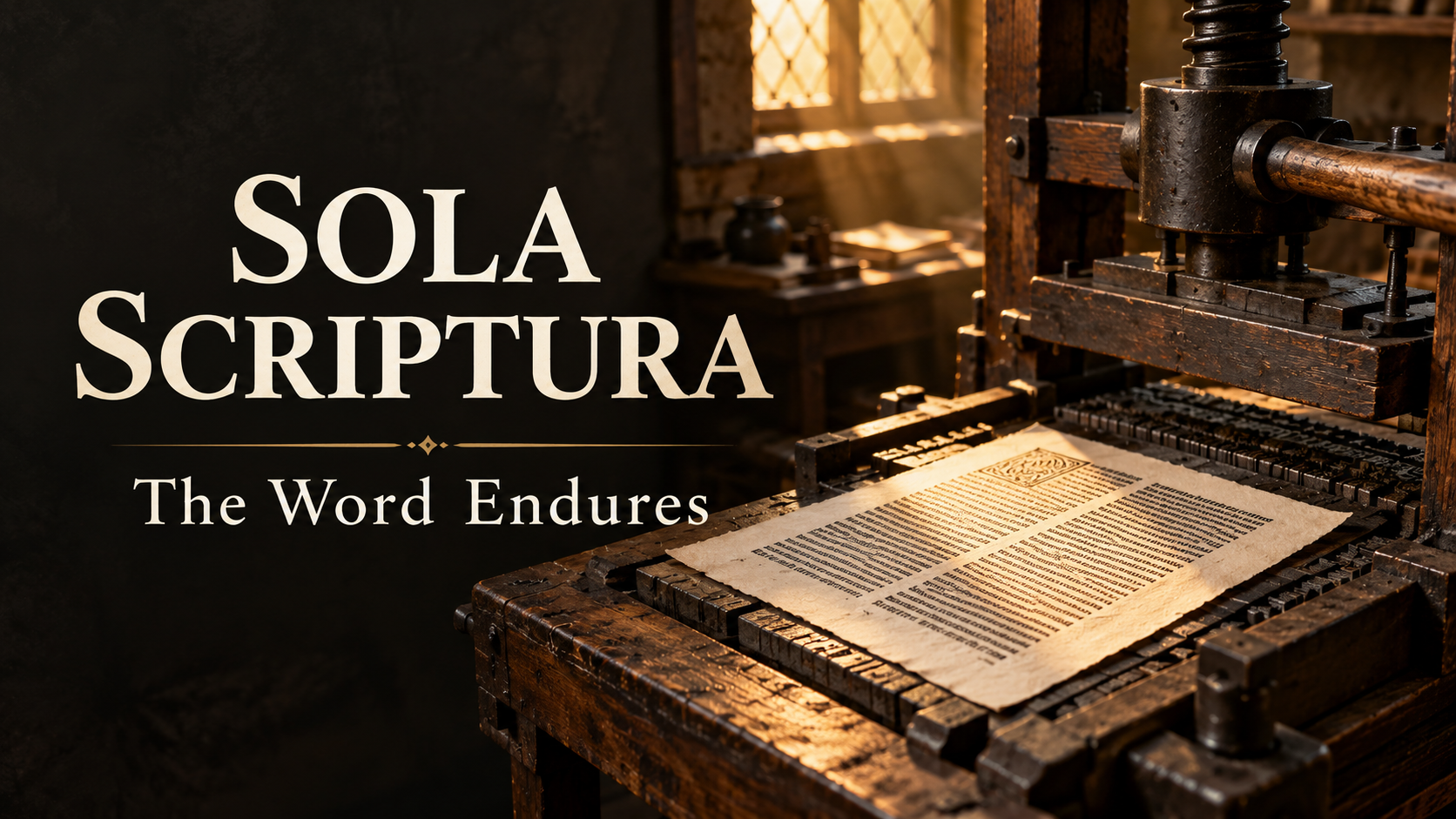
Tyndale left England in 1524 and continued his translation work on the European continent under constant threat. His printed English New Testament appeared in 1526. Copies were smuggled into England among commercial goods. Authorities burned copies they discovered, but the Word continued to spread.
Tyndale also translated the Pentateuch and other portions of the Old Testament from Hebrew. His work helped ordinary English readers encounter Scripture in clear, memorable language.
Eventually, Tyndale was betrayed, arrested, and imprisoned. In 1536, he was condemned as a heretic and executed by strangulation before his body was burned. John Foxe records his final prayer as:
“Lord, open the king of England’s eyes.”
In 1538, an order issued under Henry VIII required an English Bible to be placed in every parish church. The Great Bible followed in 1539, drawing substantially on Tyndale’s translations through the work of other translators and editors.
Tyndale’s translations also profoundly shaped the King James Version of 1611. His influence continues to echo in English Bibles today.
Foxe also reports that Tyndale, during a dispute with a learned opponent, expressed his determination to help ordinary people understand Scripture:
“If God spare my life, ere many years I will cause a boy that driveth the plough shall know more of the Scripture than thou dost.”
God’s Word and Today
Many suffered and gave their lives in the work of making Scripture available. Yet in our generation, the authority of God’s Word continues to be challenged. Outside the church, skeptics dismiss the Bible as merely a human book. Inside the church, some minimize or reject its clear teaching.
The authority of Scripture is undermined when preachers prioritize entertainment over faithful exposition or when cultural trends are elevated above God’s truth. The issue remains the same: Will we submit to what God has said, or will we place another authority above His Word?
We must not take lightly the access to Scripture we enjoy. Honoring the Reformers’ legacy means more than possessing a Bible. It means reading Scripture carefully, testing teaching by it, and submitting our beliefs and conduct to its authority.
May we stand with the Reformers and faithful believers throughout church history in declaring sola Scriptura. May we receive the inspired, inerrant, and sufficient Scriptures as the final authority for our lives and doctrine. Through this Word, God makes known the gospel of Jesus Christ and equips His people to live faithfully before Him.
“For the word of God is living and active, sharper than any two-edged sword, piercing to the division of soul and of spirit, of joints and of marrow, and discerning the thoughts and intentions of the heart.”
Hebrews 4:12
James serves as an Associate Pastor at FBC Atlanta, TX. He is married to Jenny and they have three children and are actively involved in foster care. He’s currently working on his PhD in Systematic Theology. His hobbies include: fishing, reading, writing, and running.