⏱️ Estimated Reading Time: 26 min read
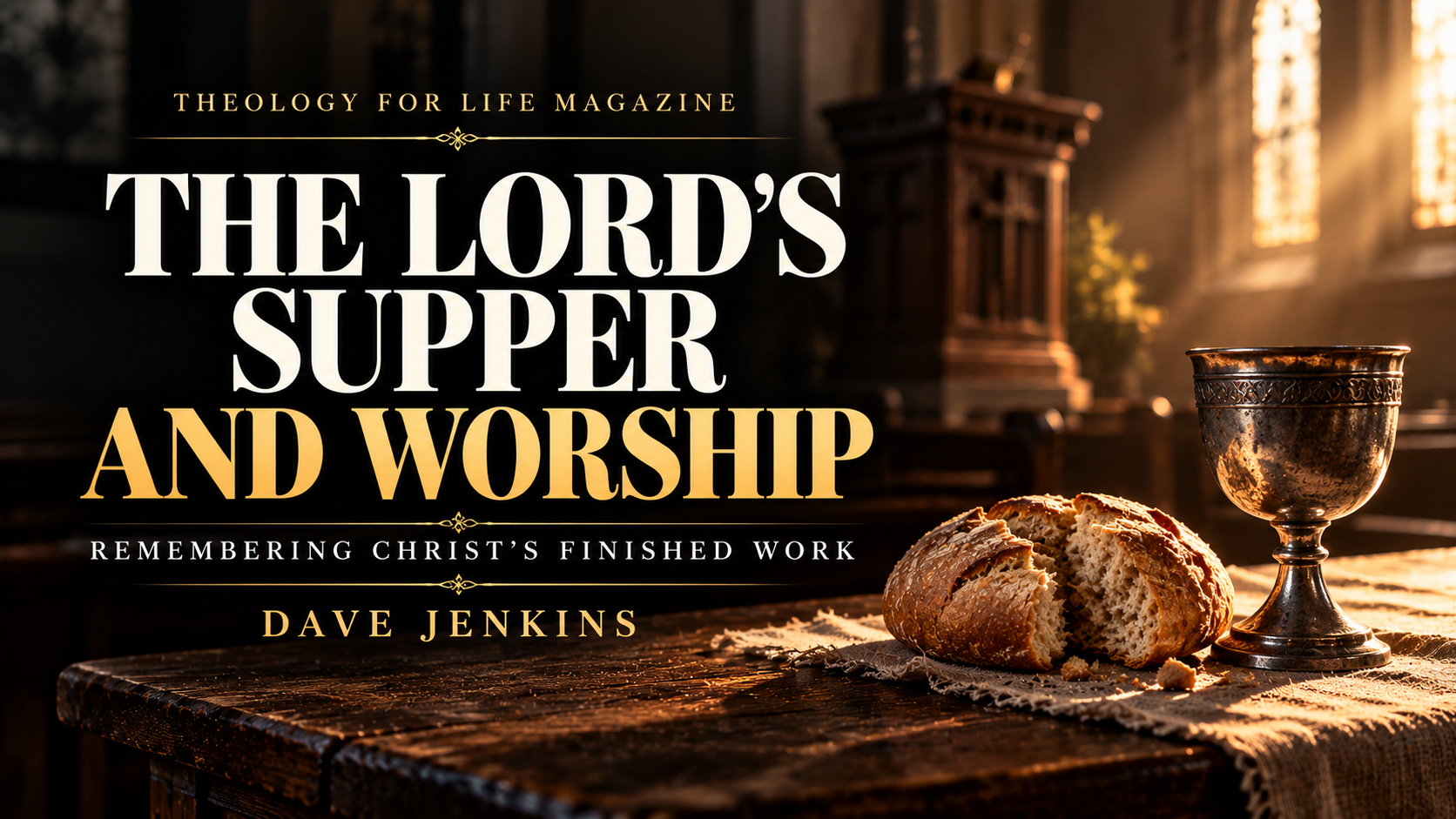
The Lord’s Supper and Worship
By Dave Jenkins
Theology for Life Magazine — October 2026
Clarity in Worship: Beholding the Glory of God with Understanding
Introduction: Remembering Christ in the Gathered Church
When the church gathers for worship, believers come together to hear God’s Word, pray, sing His praises, enjoy fellowship, and participate in the ordinances Christ has given His people. Among these ordinances, the Lord’s Supper occupies a significant place in the worship of the local church.
The Lord’s Supper is not an empty religious ceremony. Neither is it an opportunity to manufacture a spiritual experience. It is a Christ-appointed ordinance through which believers remember the Savior’s sacrificial death, proclaim the gospel, examine their hearts, and look forward to His return.
In a church culture that can sometimes measure worship by musical intensity, emotional experiences, or personal preferences, the Lord’s Supper reminds Christians that true worship is grounded in the finished work of Jesus Christ.
At the Lord’s Table, the attention of the congregation is directed away from human accomplishments and toward the crucified and risen Savior.
The bread reminds believers of the body of Christ given for His people. The cup reminds them of His blood poured out for the forgiveness of sins. Together, these visible signs direct the church toward the gospel that saves and sustains every Christian.
The Apostle Paul writes in 1 Corinthians 11:26:
“For as often as you eat this bread and drink the cup, you proclaim the Lord’s death until he comes.”
Here we discover something essential about the relationship between the Lord’s Supper and worship. The Supper is a proclamation of Christ’s death, a corporate confession of faith, and a reminder of the hope that belongs to God’s redeemed people.
To understand its significance, we must begin with the biblical foundations of this ordinance.
The Lord’s Supper and the Passover
The Lord’s Supper cannot be properly understood apart from the Old Testament background of the Passover.
In Exodus 12, God instructed the Israelites to sacrifice a lamb and place its blood upon the doorposts and lintels of their houses. When the Lord brought judgment upon Egypt, He passed over the homes marked by the blood.
This event became central to Israel’s remembrance of God’s redeeming work.
The Passover reminded God’s covenant people that their deliverance came through His mercy and power.
Their freedom from Egypt was not the result of their own strength or righteousness. It was accomplished by the Lord, who remained faithful to His promises.
The Passover also pointed forward to a greater redemption.
John the Baptist identified Jesus as “the Lamb of God, who takes away the sin of the world” (John 1:29).
The Apostle Paul later declared, “For Christ, our Passover lamb, has been sacrificed” (1 Corinthians 5:7).
Jesus is the fulfillment of the saving purposes anticipated in the Passover.
His death accomplishes what the blood of animals could never accomplish: the definitive sacrifice for the sins of His people.
The author of Hebrews explains that the sacrifices offered under the old covenant could not finally take away sins. Christ, however, offered Himself once for all, securing redemption through His perfect sacrifice (Hebrews 9:11–14; 10:10–14).
This background is essential for understanding the Lord’s Supper.
The ordinance does not repeat Christ’s sacrifice.
It points believers back to the sacrifice already accomplished at Calvary.
The Lord’s Table is therefore a gospel-centered act of remembrance and proclamation.
Christ Instituted the Lord’s Supper
The Gospels record that Jesus instituted the Lord’s Supper during His final meal with His disciples before His crucifixion.
Matthew 26:26–28 states:
“Now as they were eating, Jesus took bread, and after blessing it broke it and gave it to the disciples, and said, ‘Take, eat; this is my body.’ And he took a cup, and when he had given thanks he gave it to them, saying, ‘Drink of it, all of you, for this is my blood of the covenant, which is poured out for many for the forgiveness of sins.'”
Jesus gave His disciples bread and the cup, directing their attention toward His approaching death.
The bread signified His body given for them.
The cup signified His blood poured out for the forgiveness of sins.
The words of Jesus explain the meaning of the ordinance.
The Supper is centered upon His sacrificial death and the blessings secured through the new covenant.
Luke 22:19 records Christ’s instruction: “Do this in remembrance of me.”
The church does not observe the Lord’s Supper because human tradition has made it meaningful.
The church observes it because Jesus commanded His disciples to do so.
This is important for understanding biblical worship.
God determines how His people are to worship Him. The church is not free to replace Christ’s commands with practices that seem more appealing or emotionally powerful.
The Lord’s Supper belongs to the ordinary worship of the church because it has been instituted by the Lord Jesus Himself.
The Lord’s Supper Directs Our Attention to Christ’s Finished Work
At the center of the Lord’s Supper stands the finished work of Jesus Christ.
His death was not merely an example of sacrificial love.
It was an atoning sacrifice for sinners.
Isaiah 53:5 declares:
“But he was pierced for our transgressions; he was crushed for our iniquities; upon him was the chastisement that brought us peace, and with his wounds we are healed.”
The prophet anticipated the suffering Servant who would bear the sins of His people.
The New Testament identifies Jesus as the fulfillment of this prophecy.
First Peter 2:24 declares that Christ “bore our sins in his body on the tree, that we might die to sin and live to righteousness.”
Second Corinthians 5:21 teaches that God made Him who knew no sin to be sin for us, so that in Him we might become the righteousness of God.
These passages explain why the cross is central to Christian worship.
Jesus willingly bore the judgment deserved by sinners.
He satisfied divine justice through His perfect obedience and sacrificial death.
His resurrection confirmed His victory over sin and death.
The Lord’s Supper reminds believers that their acceptance before God rests entirely upon Christ.
We do not come to the Table to earn forgiveness.
We come because forgiveness has been secured through the blood of Jesus.
We do not participate to complete His sacrifice.
We participate because His sacrifice is complete.
The Table directs our attention toward the sufficiency of Christ.
This is why the Lord’s Supper should produce gratitude, humility, reverence, and joy among God’s people.
The Lord’s Supper and the New Covenant
When Jesus instituted the Supper, He described the cup in connection with the new covenant.
Luke 22:20 records His words:
“This cup that is poured out for you is the new covenant in my blood.”
This language recalls Jeremiah 31:31–34, where God promised a new covenant characterized by forgiveness, a transformed relationship with His people, and the inward work of His grace.
The new covenant is established through the blood of Jesus Christ.
Hebrews 9:15 identifies Christ as the mediator of the new covenant.
His sacrificial death secures the inheritance promised to those who are called.
The Lord’s Supper therefore reminds believers that their relationship with God rests upon His covenant faithfulness.
Salvation is not founded upon human effort, religious performance, or personal achievement.
It is grounded in the saving work of Christ.
Through Him, believers receive forgiveness and are brought into fellowship with God.
This covenantal significance gives the Supper a deeply personal and corporate character.
Christ has redeemed a people for Himself.
When the congregation participates in the Lord’s Supper, it remembers the Savior whose blood has secured its redemption.
The Lord’s Supper as a Means of Grace
Throughout church history, Christians have discussed the relationship between the Lord’s Supper and the spiritual nourishment of believers.
Within the Reformed tradition, the Supper has commonly been understood as a means of grace through which God strengthens the faith of His people.
This does not mean the bread and cup possess spiritual power in themselves.
Nor does it mean that participating in the ordinance automatically grants salvation or forgiveness.
The effectiveness of the Supper is not found in the physical elements or the performance of a religious act.
Rather, believers are directed through the ordinance to Christ and His promises.
The Holy Spirit strengthens God’s people as they receive the truth of the gospel by faith.
The Westminster Shorter Catechism, in Question 92, describes a sacrament as a holy ordinance instituted by Christ in which, through sensible signs, Christ and the benefits of the new covenant are represented, sealed, and applied to believers.
The emphasis is upon Christ and His saving benefits.
The Supper is not a substitute for the Word of God.
It is inseparably connected to the gospel revealed in Scripture.
The preached Word explains the meaning of Christ’s sacrifice, while the visible signs of bread and the cup direct believers toward that same saving reality.
Christians should therefore approach the Table with faith in the Savior, rather than confidence in the act of participation itself.
The Lord’s Supper is intended to strengthen believers by reminding them of the grace they have received through Jesus Christ.
Remembering Christ Is More Than Recalling Historical Information
When Jesus commanded His disciples to observe the Supper in remembrance of Him, He was not asking them merely to recall a historical event.
Biblical remembrance involves bringing God’s saving works to mind in a way that shapes present faith and obedience.
Throughout the Old Testament, Israel was repeatedly instructed to remember the Lord’s mighty acts.
The people were to remember their deliverance from Egypt, God’s provision in the wilderness, and His faithfulness to His covenant promises.
Such remembrance was intended to cultivate gratitude, trust, and obedience.
The Lord’s Supper functions similarly within the life of the church.
Believers remember that Christ died for their sins.
They remember that their salvation was purchased at the cost of His blood.
They remember that they belong to Him.
They remember that their hope rests upon His resurrection and promised return.
This remembrance is not merely intellectual, although it certainly involves the mind.
It engages the heart.
The truths remembered should produce worship.
A Christian who approaches the Table thoughtfully is reminded that salvation is entirely a gift of God’s grace.
Pride has no rightful place before the cross.
Neither does self-righteousness.
The Lord’s Supper directs every believer toward the Savior who accomplished what sinners could never accomplish for themselves.
The Lord’s Supper Is a Proclamation of the Gospel
Paul writes in 1 Corinthians 11:26:
“For as often as you eat this bread and drink the cup, you proclaim the Lord’s death until he comes.”
This statement reveals the public and corporate significance of the Supper.
The congregation proclaims the death of Jesus Christ through its participation.
The bread and cup visibly communicate the gospel.
They remind believers that Christ gave His body and shed His blood for sinners.
This proclamation is especially significant because the church is a gathered people united by faith in the same Savior.
Christians come from different backgrounds, generations, and circumstances.
Some are experiencing seasons of joy.
Others are walking through grief, disappointment, illness, or hardship.
Yet they gather around the same gospel.
They confess the same Lord.
They depend upon the same grace.
The Lord’s Supper reminds the congregation that the foundation of Christian unity is not shared personality, cultural preference, or life experience.
It is Jesus Christ and His saving work.
The Table is therefore a visible proclamation of the gospel that unites the church.
The Lord’s Supper and the Unity of the Church
In 1 Corinthians 10:16–17, Paul writes:
“The cup of blessing that we bless, is it not a participation in the blood of Christ? The bread that we break, is it not a participation in the body of Christ? Because there is one bread, we who are many are one body, for we all partake of the one bread.”
Paul connects participation in the Supper with the unity believers share in Christ.
The church is one body because its members belong to the same Lord.
The Supper is not merely an individual moment of private reflection.
It is a corporate ordinance observed within the fellowship of God’s people.
This truth carries practical implications.
Christians cannot rightly celebrate their unity in Christ while deliberately cultivating division, bitterness, or contempt toward fellow believers.
Paul’s correction of the Corinthians demonstrates the seriousness of this issue.
The Corinthian church had allowed divisions and selfishness to corrupt its observance of the Lord’s Supper.
Some members were eating abundantly while others went hungry.
Rather than displaying the unity of the body, their conduct exposed social divisions and a lack of love.
Paul rebuked them because their behavior contradicted the meaning of the ordinance.
The Lord’s Supper should remind believers that they belong to one another in Christ.
Those redeemed by the same Savior should pursue humility, reconciliation, patience, and love.
The Table calls the church to remember not only what Christ has done for individual believers but also what He has accomplished in creating one redeemed people.
Examining Ourselves Before the Lord
One of the most important passages concerning the Lord’s Supper is found in 1 Corinthians 11:27–32.
Paul warns against participating in an unworthy manner.
He writes in verse 28:
“Let a person examine himself, then, and so eat of the bread and drink of the cup.”
Self-examination is therefore an important part of preparing for the Lord’s Supper.
However, Christians must understand what Paul is teaching.
He does not command believers to make themselves worthy of Christ’s sacrifice.
No sinner could ever accomplish that.
Our worthiness before God is found in Jesus Christ alone.
Paul’s warning concerns the manner in which believers approach the ordinance.
The Corinthians were treating the Lord’s Supper carelessly, allowing selfishness, division, and disregard for fellow believers to characterize their gathering.
Their behavior demonstrated a failure to understand the significance of the Table.
Self-examination should therefore involve honest reflection before God.
Are we approaching the Supper with faith in Christ?
Are we confessing known sin rather than cherishing it?
Are we treating fellow believers with love?
Are we seeking reconciliation where relationships have been damaged?
Are we remembering the Savior with reverence and gratitude?
These questions are not intended to drive repentant believers away from Christ.
They are intended to encourage sincere participation.
The Christian who recognizes personal sin and turns to Christ in repentance should remember that the Supper proclaims the sufficiency of the Savior’s sacrifice.
The Table is not reserved for those who have achieved spiritual perfection.
It is for believers who depend upon the grace of Jesus Christ.
The Danger of Treating the Lord’s Supper Casually
Because the Lord’s Supper is familiar to many Christians, it can become routine.
A congregation may participate regularly without giving sufficient thought to the meaning of the ordinance.
The bread is distributed.
The cup is received.
A few familiar words are spoken.
Then the service continues.
Yet the familiarity of the practice should never diminish its significance.
Paul’s warning to the Corinthians demonstrates that the Lord takes the observance of the Supper seriously.
First Corinthians 11:29 warns against eating and drinking without discerning the body.
In the immediate context, the Corinthians’ failure to recognize the significance of the ordinance was closely connected to their disregard for fellow members of the church.
Their conduct contradicted the gospel proclaimed through the Supper.
This should encourage pastors and congregations to approach the ordinance with biblical seriousness.
The Lord’s Supper should not be treated as an optional addition to worship whose meaning is rarely explained.
Neither should it become a dramatic ritual designed primarily to produce an emotional response.
The ordinance should be administered with clarity, reverence, and pastoral care.
Believers should understand why they are participating and what the bread and cup signify.
The emphasis should remain upon Jesus Christ.
The Lord’s Supper Is Not a Repetition of Christ’s Sacrifice
One essential truth must remain clear in any biblical understanding of the Lord’s Supper: Christ’s sacrifice is finished.
Hebrews 10:12 declares:
“But when Christ had offered for all time a single sacrifice for sins, he sat down at the right hand of God.”
The author of Hebrews contrasts Christ’s completed sacrifice with the repeated offerings of the old covenant priesthood.
Those sacrifices could not finally remove sin.
Christ’s sacrifice accomplished redemption once for all.
Hebrews 10:14 adds:
“For by a single offering he has perfected for all time those who are being sanctified.”
The Lord’s Supper does not add to this sacrifice.
It does not repeat the offering of Christ.
It does not make His saving work more complete.
Rather, it points believers toward the sacrifice that has already secured their redemption.
This distinction matters because the gospel rests upon the sufficiency of Christ.
Nothing can be added to His finished work.
The believer’s confidence is not in the bread, the cup, the minister, or the ritual.
It is in the crucified and risen Savior.
The Supper is meaningful precisely because it directs the church toward the salvation Christ has already accomplished.
The Lord’s Supper and the Presence of Christ
Christians have differed throughout church history concerning how Christ is present in the Lord’s Supper.
Roman Catholic theology teaches transubstantiation, while Lutheran and Reformed traditions have developed different explanations of Christ’s presence in the ordinance.
Within historic Reformed theology, the Lord’s Supper is understood as a genuine spiritual communion with Christ by faith through the work of the Holy Spirit.
Christ is not physically or locally contained in the bread and cup.
His glorified human body remains in heaven until His return.
Nevertheless, believers truly enjoy fellowship with their living Savior through faith as the Holy Spirit directs them toward His promises.
This understanding protects two important truths.
First, Christ’s sacrifice is complete and His glorified humanity is not transformed into the physical elements.
Second, the Supper is more than an empty ceremony or a purely mental exercise.
The risen Christ continues to nourish and strengthen His people spiritually.
The Supper is therefore an occasion for believers to rest in His promises and rejoice in the communion they enjoy with Him.
The focus remains upon the Savior rather than the elements themselves.
The Lord’s Supper and the Ordinary Means of Grace
The Lord’s Supper should be understood within the broader life of the local church.
God has given His people ordinary means through which they are instructed, strengthened, and encouraged in the faith.
The ministry of the Word, prayer, baptism, and the Lord’s Supper belong to the life of the gathered church.
Acts 2:42 describes the early believers as devoted to the apostles’ teaching, fellowship, the breaking of bread, and prayers.
The precise relationship between ordinary shared meals and the Lord’s Supper in every occurrence of the phrase “breaking bread” requires attention to context. Nevertheless, the passage presents a church devoted to teaching, fellowship, and prayer, and Acts 20:7 also associates the gathered church with the breaking of bread.
The ordinary life of the church is not spiritually insignificant.
God works through the truth of His Word and the ordinances Christ has appointed.
This should encourage Christians who may feel that worship must always involve extraordinary experiences to be meaningful.
The Lord does not require His people to pursue constant novelty.
He calls them to faithful participation in the life of His church.
The Lord’s Supper reminds believers that God’s grace is not dependent upon dramatic circumstances.
The simple signs of bread and the cup direct the church toward the greatest saving act in history.
Christ died for sinners and rose again.
That truth is sufficient to sustain worship.
The Lord’s Supper and the Local Church
The New Testament presents the Lord’s Supper as an ordinance connected to the gathered church.
Paul repeatedly addresses the Corinthians concerning what happens when they come together as a congregation.
In 1 Corinthians 11:18, he writes, “For, in the first place, when you come together as a church, I hear that there are divisions among you.”
The surrounding passage concerns the church’s corporate observance of the Supper.
This context is important.
The Lord’s Supper should not be detached from the fellowship, teaching, discipline, and pastoral oversight of the local church.
Christ has given pastors responsibility for shepherding His people.
They are to teach sound doctrine, guard the congregation from error, and care for the spiritual well-being of the flock.
The administration of the Lord’s Supper should reflect that responsibility.
Pastors should explain the meaning of the ordinance.
They should instruct believers concerning self-examination.
They should clarify who should participate according to their church’s biblical convictions.
They should also ensure that the Supper is observed in a manner consistent with Scripture.
Churches differ concerning the precise qualifications for participation, including questions related to baptism and church membership.
These differences should be addressed carefully and biblically.
What must remain clear is that the Supper belongs to the worship of Christ’s people and should be observed under faithful pastoral care.
The Lord’s Supper and Christian Assurance
The Christian life includes seasons of spiritual weakness.
Believers may struggle with guilt, discouragement, doubt, or a heightened awareness of their remaining sin.
During such seasons, the Lord’s Supper can provide significant encouragement.
The ordinance directs believers away from their fluctuating emotions and toward the objective promises of the gospel.
Christ’s death does not become less sufficient because a Christian feels weak.
His resurrection does not become less certain because a believer experiences discouragement.
His promises do not become unreliable because His people struggle with doubt.
The bread and cup remind Christians that salvation rests upon the Savior’s finished work.
Romans 8:1 declares:
“There is therefore now no condemnation for those who are in Christ Jesus.”
This promise belongs to everyone who is united to Christ by faith.
The Lord’s Supper helps believers remember the foundation of that assurance.
Christ has borne the condemnation His people deserved.
He has satisfied divine justice.
He has secured their redemption.
Assurance should never be confused with presumption or indifference toward sin.
Believers are called to repentance, holiness, and perseverance.
Yet the Christian’s confidence before God rests upon Christ’s righteousness, not personal spiritual achievement.
At the Table, weary believers are reminded to look again to their Savior.
The Lord’s Supper and the Hope of Christ’s Return
The Lord’s Supper does not direct the church only toward the past.
It also points forward.
Paul writes that believers proclaim the Lord’s death “until he comes” (1 Corinthians 11:26).
The ordinance therefore contains an important element of future hope.
The church remembers the Savior who died and rose again while awaiting His glorious return.
Jesus Himself connected the institution of the Supper with the future fulfillment of God’s kingdom.
Matthew 26:29 records His words:
“I tell you I will not drink again of this fruit of the vine until that day when I drink it new with you in my Father’s kingdom.”
The Lord’s Supper reminds believers that redemption is moving toward its appointed completion.
Christ will return.
The dead in Christ will be raised.
Sin and death will be finally defeated.
God’s people will dwell with Him forever.
Revelation 19:6–9 describes the marriage supper of the Lamb, portraying the joy and triumph associated with the consummation of God’s redemptive purposes.
The Lord’s Supper anticipates the fullness of fellowship believers will enjoy with Christ in glory.
This future hope is especially precious during suffering.
Christians may gather around the Table while grieving the loss of loved ones, facing serious illness, or enduring difficult circumstances.
Yet the ordinance reminds them that the present world is not the end of the story.
The Savior who died for His people will return for them.
Their hope is secure because He lives.
The Lord’s Supper and Reverence in Worship
The Lord’s Supper should cultivate reverence because it directs believers toward the holiness of God and the cost of redemption.
The cross reveals both the seriousness of sin and the greatness of divine grace.
Sin is not a minor problem that God simply overlooks.
It is rebellion against His holy character.
The death of Jesus demonstrates the seriousness of the judgment sinners deserve.
At the same time, the cross reveals the astonishing love and mercy of God.
Romans 5:8 declares:
“But God shows his love for us in that while we were still sinners, Christ died for us.”
The Lord’s Supper brings these truths before the congregation.
We remember the holiness of God.
We remember the seriousness of sin.
We remember the sacrifice of Christ.
And we rejoice in the grace that has reconciled sinners to their Creator.
Such remembrance should produce reverence.
But reverence should not be confused with joylessness.
Christians can approach the Table with solemn gratitude and genuine joy.
The ordinance is serious because the cross is serious.
It is joyful because Christ has accomplished redemption.
Biblical worship holds these realities together.
The Lord’s Supper and the Christian Life
Participation in the Lord’s Supper should influence how believers live beyond the worship service.
The gospel proclaimed at the Table calls Christians to lives of repentance, gratitude, love, and obedience.
If we remember that Christ gave Himself for us, we should respond by offering ourselves in service to Him.
Romans 12:1 calls believers to present their bodies as living sacrifices, holy and acceptable to God, which is their spiritual worship.
If we remember that Christ forgave our sins, we should be willing to forgive others.
Ephesians 4:32 instructs believers to be kind and tenderhearted, forgiving one another as God in Christ forgave them.
If we remember that Christ purchased a people for Himself, we should love the church.
First John 4:11 declares:
“Beloved, if God so loved us, we also ought to love one another.”
The Lord’s Supper should never become a ceremony disconnected from daily discipleship.
The truths confessed at the Table should shape our relationships, priorities, and conduct.
Christians who remember the Savior’s sacrifice should seek to honor Him in their homes, churches, workplaces, and communities.
Worship is not confined to a particular moment in a service.
The gathered worship of the church should equip believers to live faithfully before the Lord throughout the week.
Preparing Our Hearts for the Lord’s Table
How, then, should Christians prepare to participate in the Lord’s Supper?
Preparation begins with remembering the gospel.
We should consider the person and work of Jesus Christ.
We should remember that He lived the perfect life we could never live and died the sacrificial death we deserved.
We should rejoice that He rose from the dead and now intercedes for His people.
Preparation also involves honest self-examination.
Believers should confess known sin and turn from it in repentance.
They should consider whether they are harboring bitterness, refusing reconciliation, or neglecting love for fellow Christians.
They should approach the Table with humility rather than self-righteousness.
Preparation also requires faith.
The Lord’s Supper is not intended to direct Christians toward confidence in their spiritual performance.
It directs them toward Christ.
We come acknowledging our weakness and resting in His sufficiency.
We come with gratitude for His mercy.
We come with hope because He has promised to return.
Pastors can help their congregations prepare by explaining these truths regularly.
The church should understand that the Lord’s Supper is neither a casual religious custom nor an occasion for unnecessary fear among repentant believers.
It is a sacred ordinance given by Christ for the good of His people.
Recovering the Centrality of Christ at the Lord’s Table
The church must continually guard against allowing worship to become centered upon human preferences, emotional experiences, or religious performance.
The Lord’s Supper provides a needed corrective.
At the Table, believers are reminded that the foundation of their worship is not what they have accomplished for God.
It is what God has accomplished for them through Jesus Christ.
The bread and cup proclaim the Savior’s sacrifice.
They remind Christians of the new covenant established through His blood.
They call believers to self-examination and repentance.
They express the unity of the body of Christ.
And they direct the church toward the promised return of the Lord.
These truths should shape how congregations understand and observe the ordinance.
Pastors should teach its meaning clearly.
Church members should participate thoughtfully.
The Supper should be administered with biblical reverence and gospel-centered joy.
Above all, Christ should remain central.
Conclusion: Worshiping the Savior Who Gave Himself for Us
The Lord’s Supper is a precious gift from Jesus Christ to His church.
It reminds believers of the gospel, strengthens their faith, encourages unity, and directs their hope toward the return of the Savior.
The ordinance is simple in its outward elements.
Bread.
The cup.
The gathered people of God.
Yet the truths proclaimed through these signs are profound.
The eternal Son of God took on human flesh.
He lived in perfect obedience to the Father.
He willingly gave Himself as a sacrifice for sinners.
He shed His blood to secure redemption.
He rose victoriously from the grave.
And He will return in glory.
Christian, when you come to the Lord’s Table, remember what Christ has done for you.
Remember that your salvation rests upon His grace.
Remember that your forgiveness was purchased through His blood.
Remember that you belong to His redeemed people.
And remember that the Savior who died and rose again will one day return.
Do not approach the Supper carelessly.
Neither should you approach it as though your hope rests upon your own spiritual accomplishments.
Come with humility.
Come with repentance.
Come with gratitude.
Come trusting in the finished work of Jesus Christ.
The Lord’s Supper directs our hearts toward the Savior who loved us and gave Himself for us.
And as the church remembers His sacrifice, proclaims His death, and awaits His return, may our worship be filled with biblical clarity, reverence, gratitude, and joy.
For the glory belongs not to those who gather around the Table, but to the Lord Jesus Christ, whose body was given and whose blood was shed for the salvation of His people.
“For as often as you eat this bread and drink the cup, you proclaim the Lord’s death until he comes.” — 1 Corinthians 11:26