⏱️ Estimated Reading Time: 21 min read
Worship in Isaiah 6: Beholding the Holiness and Glory of God
By Dave Jenkins
Worship in Isaiah 6 begins with a breathtaking vision of God’s holiness and glory. When the prophet Isaiah saw the Lord seated upon His throne, he did not respond with casual familiarity, self-confidence, or a desire for an extraordinary religious experience. He responded with reverence, confession, and an overwhelming awareness of his own sinfulness. Yet the Lord did not leave Isaiah in despair. God provided cleansing, extended grace, and commissioned His servant to proclaim His Word.
Isaiah’s vision teaches us something essential about biblical worship: true worship begins with God revealing Himself, exposes the reality of our sin, directs us toward His provision of grace, and produces a life of faithful obedience.
In an age when worship is frequently evaluated by musical preferences, emotional intensity, or personal experiences, Isaiah 6 calls the church to recover a God-centered understanding of worship. The central question is not whether a worship service produces a particular feeling. The question is whether our worship faithfully responds to the God who has revealed Himself in Scripture.
Isaiah’s vision reminds us that the clearer our understanding of God’s holiness becomes, the more deeply we recognize our need for His grace. And the more clearly we understand His grace, the more willingly we should offer ourselves in His service.
The Lord Is Seated Upon His Throne
Isaiah begins his account with a historical detail that provides an important setting for the vision:
“In the year that King Uzziah died I saw the Lord sitting upon a throne, high and lifted up; and the train of his robe filled the temple” (Isaiah 6:1).
King Uzziah had ruled Judah for many years. His reign brought significant prosperity and military strength, but his later years were marked by pride and divine judgment. According to 2 Chronicles 26, Uzziah became proud and unlawfully entered the temple to burn incense, a responsibility reserved for the priests. The Lord struck him with leprosy, and he remained isolated until his death.
Against this historical background, Isaiah receives a vision of the true King.
Earthly rulers rise and fall. Nations experience prosperity and decline. Human leaders possess limited authority, and even the strongest kingdoms eventually pass away.
But the Lord remains enthroned.
Isaiah does not see an empty throne. He does not see a God struggling to maintain control over history. He sees the Lord seated, high and lifted up, reigning in sovereign majesty.
This is where biblical worship begins.
We must understand who God is before we can respond to Him rightly.
God is not dependent upon His creation. He does not need human approval. He is not strengthened by our worship, nor is His glory diminished when sinners refuse to acknowledge Him.
He is the eternal, self-existent, sovereign Lord of heaven and earth.
Psalm 115:3 declares, “Our God is in the heavens; he does all that he pleases.”
Likewise, Psalm 103:19 states, “The LORD has established his throne in the heavens, and his kingdom rules over all.”
These truths should shape how Christians approach corporate worship.
We do not gather to place God at the center of our lives as though He were waiting for our permission to reign. We gather because He already reigns, and through His Word He calls us to acknowledge His greatness, receive His grace, and respond in faith.
Worship becomes clearer when God, rather than human experience, occupies the center of our attention.
The Holiness of God Defines True Worship
Isaiah continues by describing the heavenly beings surrounding the throne:
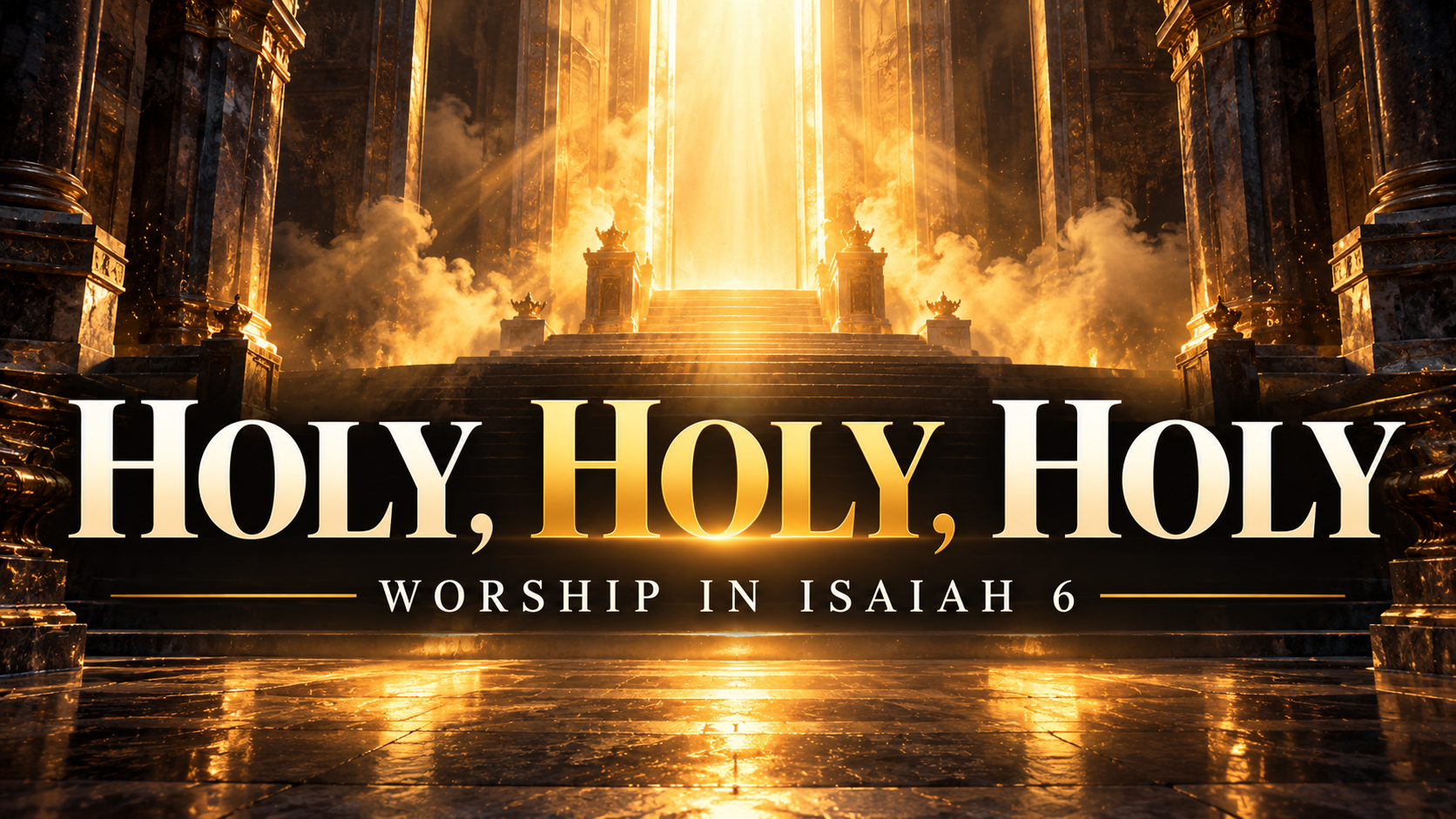
“Above him stood the seraphim. Each had six wings: with two he covered his face, and with two he covered his feet, and with two he flew. And one called to another and said: ‘Holy, holy, holy is the LORD of hosts; the whole earth is full of his glory!'” (Isaiah 6:2–3).
The seraphim declare the holiness of God.
The threefold repetition is significant. In Hebrew expression, repetition communicates emphasis. Here, the repeated declaration draws our attention to the absolute holiness of the Lord.
God is holy.
He is utterly distinct from His creation. He is morally perfect, infinitely pure, and entirely free from sin or corruption.
His holiness is not merely one attribute among many that Christians may occasionally consider. God’s holiness characterizes everything He is and does.
His love is holy love.
His justice is holy justice.
His mercy is holy mercy.
His judgments are holy judgments.
His promises are the promises of the Holy One who cannot lie.
Isaiah’s vision does not present God’s holiness as an abstract theological concept. The seraphim respond to the Lord with reverence, and their proclamation fills the heavenly scene.
The foundations of the thresholds shake, and the house is filled with smoke (Isaiah 6:4).
The entire vision communicates the majesty of the Lord.
Notice also that the seraphim declare, “The whole earth is full of his glory!”
God’s glory is not confined to the temple. His majesty extends throughout creation. The heavens declare His glory, and the earth bears witness to His power and wisdom.
Yet the glory of God is most clearly understood through His own revelation.
Creation testifies to His greatness, but Scripture reveals His character, purposes, commands, promises, and saving work with clarity.
Christian worship must therefore be governed by what God has revealed about Himself.
We do not have the freedom to redefine holiness according to cultural preferences or personal expectations.
We are called to worship the Lord as He truly is.
Psalm 99:9 declares, “Exalt the LORD our God, and worship at his holy mountain; for the LORD our God is holy!”
The holiness of God should produce reverence in the gathered church.
Reverence does not mean that Christian worship must be joyless, cold, or emotionally detached. Scripture repeatedly commands God’s people to rejoice in Him.
But biblical joy is never separated from a proper understanding of the One we worship.
Psalm 2:11 instructs us, “Serve the LORD with fear, and rejoice with trembling.”
There is no contradiction between reverence and joy.
Both belong to worship that is shaped by the truth of God’s Word.
Seeing God’s Holiness Exposes Our Sin
Isaiah’s response to the vision is immediate and deeply personal:
“And I said: ‘Woe is me! For I am lost; for I am a man of unclean lips, and I dwell in the midst of a people of unclean lips; for my eyes have seen the King, the LORD of hosts!'” (Isaiah 6:5).
Isaiah does not congratulate himself for receiving an extraordinary vision.
He does not compare himself favorably with the people around him.
He does not respond by declaring his own spiritual importance.
He confesses his sin.
The clearer Isaiah’s vision of God’s holiness becomes, the clearer his awareness of his own unworthiness becomes.
This is one of the most important lessons Isaiah 6 teaches about worship.
When God reveals His holiness, sinners are confronted with the truth about themselves.
We live in a culture that frequently encourages people to define themselves according to their feelings, accomplishments, preferences, or personal experiences.
Scripture directs us toward a different standard.
We must understand ourselves in light of God’s holy character and righteous law.
Romans 3:23 declares, “For all have sinned and fall short of the glory of God.”
Isaiah recognized that he was not merely surrounded by sinful people. He himself was a sinner.
His confession begins with the words, “Woe is me!”
Earlier in Isaiah’s prophecy, he had pronounced woes against the sins of Judah. Now, standing before the holiness of God, he recognizes his own need for mercy.
He confesses that he is a man of unclean lips.
This is particularly significant because Isaiah would serve as a prophet, speaking the Word of the Lord to God’s people.
The very instrument through which he would proclaim divine truth was marked by human sinfulness.
Isaiah’s confession reminds us that no preacher, teacher, musician, or church member approaches God on the basis of personal righteousness.
Every Christian stands in need of divine grace.
Worship that minimizes sin will inevitably minimize the greatness of salvation.
If we fail to understand God’s holiness, we will fail to understand the seriousness of our rebellion against Him.
And if we fail to understand the seriousness of sin, we will not rightly appreciate the wonder of Christ’s saving work.
This is why biblical worship should include the honest acknowledgment of sin.
When Scripture is faithfully read and preached, the people of God are confronted with His righteous commands and gracious promises.
We are reminded that we have sinned in thought, word, and deed.
We are called to repentance.
And we are directed toward the Savior who alone can cleanse us.
True worship does not flatter sinners.
It humbles us before the holiness of God and magnifies the grace that He provides in Jesus Christ.
God Provides the Cleansing We Cannot Produce
Isaiah’s confession is followed by a remarkable demonstration of divine mercy:
“Then one of the seraphim flew to me, having in his hand a burning coal that he had taken with tongs from the altar. And he touched my mouth and said: ‘Behold, this has touched your lips; your guilt is taken away, and your sin atoned for'” (Isaiah 6:6–7).
Isaiah cannot cleanse himself.
He cannot remove his guilt through religious effort.
He cannot make himself acceptable to God through personal achievement.
The Lord provides the cleansing that Isaiah needs.
The burning coal comes from the altar, connecting the prophet’s cleansing with the sacrificial provision God had established for His people.
Through this symbolic act, the Lord declares that Isaiah’s guilt has been removed and his sin atoned for.
Notice the order.
Isaiah sees the holiness of God.
He confesses his sin.
God provides cleansing.
Only then does Isaiah respond to the Lord’s commission.
This order matters because it reminds us that acceptable service flows from divine grace rather than serving as the means of obtaining it.
The same principle stands at the heart of the gospel.
Sinners cannot reconcile themselves to God through moral improvement, religious performance, or sincere intentions.
We need a Savior.
And God has provided that Savior in His Son, Jesus Christ.
Jesus lived the sinless life that we have failed to live.
He obeyed the Father perfectly.
He went willingly to the cross, bearing the penalty for the sins of His people.
He rose bodily from the grave, demonstrating His victory over sin and death.
Through faith in Him, sinners receive forgiveness and are declared righteous before God.
First John 1:7 declares, “The blood of Jesus his Son cleanses us from all sin.”
Hebrews 9:14 explains that the blood of Christ purifies our conscience from dead works to serve the living God.
The cleansing Isaiah received in his vision anticipates the greater saving provision revealed through Jesus Christ.
We should not confuse the symbolic coal in Isaiah’s vision with the finished work of Christ. The vision belongs to its own prophetic and covenantal setting. Yet within the unfolding revelation of Scripture, it directs our attention toward the truth that forgiveness comes from God’s gracious provision, not human merit.
For Christians, the foundation of cleansing is the atoning death and victorious resurrection of Jesus Christ.
This truth should profoundly shape our worship.
We do not gather before God pretending that we have no sin.
We gather as redeemed sinners who have received mercy through the Lord Jesus Christ.
We confess our sins because God is holy.
We rejoice in forgiveness because Christ is sufficient.
We approach the throne of grace with confidence because our great High Priest has opened the way into God’s presence.
Hebrews 4:16 invites believers to draw near with confidence to the throne of grace, that we may receive mercy and find grace to help in time of need.
Christian worship is therefore marked by both humility and assurance.
We know that we are sinners.
And we know that Christ is a sufficient Savior.
Isaiah’s Vision Directs Us to the Glory of Jesus Christ
Isaiah 6 becomes even more significant when we consider how the New Testament interprets this passage.
In John 12, the Apostle John explains the unbelief of many who witnessed the ministry of Jesus Christ.
He quotes Isaiah’s prophecy concerning spiritual blindness and hardness of heart, including words from Isaiah 6.
Then John makes a remarkable statement:
“Isaiah said these things because he saw his glory and spoke of him” (John 12:41).
In context, John is speaking about Jesus Christ.
This means Isaiah’s vision of divine glory is inseparably connected to the glory of the Son of God.
The Lord Jesus Christ is not merely a religious teacher who helps us understand worship.
He is the eternal Son, worthy of the worship that belongs to God alone.
John begins his Gospel by declaring that the Word was with God and that the Word was God (John 1:1).
He later writes:
“And the Word became flesh and dwelt among us, and we have seen his glory, glory as of the only Son from the Father, full of grace and truth” (John 1:14).
The glory revealed in Isaiah’s vision finds its fullest revelation in the incarnate Son of God.
Jesus Christ reveals the Father.
He accomplishes redemption.
He provides the cleansing sinners need.
And through Him, believers are brought into fellowship with the living God.
This is why Christian worship must be Christ-centered.
We do not approach God apart from the mediation of His Son.
First Timothy 2:5 declares that there is one God and one mediator between God and men, the man Christ Jesus.
Jesus Himself teaches that no one comes to the Father except through Him (John 14:6).
Through the saving work of Christ and by the power of the Holy Spirit, believers have access to the Father (Ephesians 2:18).
Our worship is therefore Trinitarian.
We worship the Father through the Son by the Holy Spirit.
We praise the triune God for the salvation He has accomplished.
We proclaim the person and work of Christ because He is the center of God’s redemptive purposes.
And we look forward to the day when every knee will bow and every tongue confess that Jesus Christ is Lord, to the glory of God the Father (Philippians 2:10–11).
Isaiah’s vision should not lead Christians to pursue extraordinary visions of their own.
It should lead us to behold the glory of Christ through the Scriptures that testify about Him.
God has spoken clearly in His Word.
And through that Word, the Holy Spirit opens our understanding to the glory of Jesus Christ.
Grace Produces Willing Obedience
After Isaiah receives cleansing, the Lord speaks:
“And I heard the voice of the Lord saying, ‘Whom shall I send, and who will go for us?’ Then I said, ‘Here I am! Send me'” (Isaiah 6:8).
Isaiah’s response is striking.
The man who had just confessed his unworthiness now willingly offers himself for the Lord’s service.
What has changed?
Isaiah has received grace.
His guilt has been removed.
His sin has been atoned for.
And now he responds to the Lord with willing obedience.
This is another essential pattern for biblical worship.
God’s grace does not leave His people unchanged.
It produces gratitude, love, humility, and a desire to obey Him.
Romans 12:1 teaches believers to present their bodies as a living sacrifice, holy and acceptable to God, which is their spiritual worship.
Paul’s appeal comes after eleven chapters explaining the mercies of God in salvation.
Christian obedience is therefore grounded in the grace we have received.
We do not obey God in order to earn justification.
We obey because we have been justified through faith in Jesus Christ.
We do not serve God to purchase His favor.
We serve because His favor has been freely given to us in Christ.
This matters for how we understand the relationship between corporate worship and daily Christian living.
Worship is not limited to what happens during a Sunday service.
The gathered church worships through the ordinary means God has appointed, including the reading and preaching of Scripture, prayer, singing, and the ordinances of baptism and the Lord’s Supper.
Yet the truths we receive and confess in corporate worship should shape our lives throughout the week.
If we worship the holy God, we should pursue holiness.
If we praise Him for His mercy, we should show mercy to others.
If we confess Christ as Lord, we should submit to His commands.
If we rejoice in His faithfulness, we should trust Him in difficult circumstances.
If we celebrate His grace, we should serve others with humility and gratitude.
True worship bears fruit in obedience.
Isaiah’s words, “Here I am! Send me,” remind us that the proper response to divine grace is a life surrendered to the Lord’s will.
Faithful Worship Does Not Depend on Visible Results
It would be easy to stop reading Isaiah 6 at verse 8.
The prophet has seen the Lord, received cleansing, and responded willingly to God’s call.
But the chapter does not end there.
The Lord gives Isaiah a difficult commission.
He is to proclaim God’s Word to a people whose hearts are hardened and whose ears are dull.
Isaiah 6:9–10 describes the spiritual blindness and resistance that would characterize many of his hearers.
The prophet’s ministry would not be measured by immediate popularity or widespread acceptance.
He would speak God’s truth even when many refused to listen.
This is an important lesson for the church today.
We live in a culture that frequently evaluates success according to numbers, influence, visibility, and measurable outcomes.
Churches may feel pressure to make worship more entertaining in order to attract attention.
Pastors may be tempted to soften difficult biblical truths in order to avoid opposition.
Christians may begin to assume that faithfulness must always produce immediate and visible success.
Isaiah’s commission challenges these assumptions.
God calls His servants to faithfulness.
We are responsible to proclaim His Word accurately, worship Him according to His commands, and trust Him with the results.
This does not mean that spiritual fruit is unimportant.
Scripture teaches that God works through His Word to save sinners and sanctify His people.
But the effectiveness of God’s Word does not depend upon human manipulation.
Isaiah was called to speak faithfully even when the response would be difficult.
Likewise, the church must remain committed to biblical worship and sound doctrine regardless of cultural pressures.
Second Timothy 4:2 commands ministers to preach the Word, being ready in season and out of season.
Faithful preaching must not be replaced by entertainment.
Biblical singing must not be reduced to emotional manipulation.
Prayer must not become a performance.
And worship must never be shaped primarily by the desire to impress an audience.
The Lord Himself is worthy of our obedience.
That is sufficient reason to remain faithful.
God Preserves His People and Fulfills His Promises
Isaiah’s commission includes the announcement of devastating judgment.
The land would experience destruction, and the people would suffer the consequences of their rebellion.
Yet the chapter closes with a word of hope.
Isaiah 6:13 speaks of a holy seed remaining, even after the tree has been cut down.
Judgment would not overturn God’s redemptive purposes.
The Lord would preserve a remnant according to His gracious promises.
This theme continues throughout Isaiah’s prophecy.
God’s people repeatedly fail, but the Lord remains faithful.
His promises do not depend upon human strength.
His saving purposes cannot be defeated.
Ultimately, the hope of God’s people rests in the promised Messiah.
Isaiah later announces the coming of the child who would be called Wonderful Counselor, Mighty God, Everlasting Father, and Prince of Peace (Isaiah 9:6).
He also describes the suffering servant who would bear the sins of many and make intercession for transgressors (Isaiah 53:12).
The same prophetic book that begins with the vision of God’s holiness directs our attention toward the Savior who accomplishes redemption.
Jesus Christ is the fulfillment of God’s saving promises.
Through His life, death, and resurrection, He secures the salvation of His people.
And through His ongoing intercession, He preserves those who belong to Him.
This gives Christians confidence in worship.
Our hope does not rest in the strength of our emotions, the quality of our singing, or the success of our religious efforts.
Our hope rests in the finished work of Jesus Christ and the faithfulness of the God who cannot lie.
Worship in Isaiah 6: Lessons for the Church Today
Isaiah’s vision provides a framework for understanding biblical worship.
First, worship must be centered upon God Himself.
The Lord is seated upon His throne. His glory, not our preferences, must govern our worship.
Second, worship must reflect God’s holiness.
We should approach Him with reverence, humility, gratitude, and joy.
Third, worship must take sin seriously.
We cannot rightly understand grace if we refuse to acknowledge our guilt before a holy God.
Fourth, worship must proclaim God’s provision of salvation.
Isaiah received cleansing from the Lord. Christians rejoice in the greater cleansing accomplished through the blood of Jesus Christ.
Fifth, worship must be Christ-centered.
John 12:41 connects Isaiah’s vision of divine glory to Jesus Christ. The church must therefore behold the glory of God through the revelation of His Son.
Sixth, worship should produce grateful obedience.
Those who have received grace should respond with willing service.
Finally, worship must remain faithful to God’s Word regardless of visible results.
Isaiah’s difficult commission reminds us that obedience to the Lord matters more than human approval.
These principles should shape how pastors shepherd their congregations and how Christians participate in gathered worship.
We should ask whether our services direct attention toward God’s character and works.
We should examine whether our songs communicate biblical truth.
We should consider whether preaching faithfully explains and applies Scripture.
We should ensure that prayer reflects dependence upon God rather than confidence in human ability.
And we should continually direct the congregation toward Jesus Christ, the only mediator between God and man.
Clarity in worship does not come from discovering new techniques or manufacturing extraordinary experiences.
It comes from receiving God’s revelation, understanding His truth, and responding to Him through faith in Jesus Christ.
Behold the Holy God and Worship Him
Isaiah 6 confronts us with a vision of divine holiness that should transform how we understand worship.
The Lord is enthroned.
He is holy, holy, holy.
His glory fills the earth.
His holiness exposes our sin.
His grace provides cleansing.
And His mercy produces grateful obedience.
But the greatest encouragement for Christians is that the glory Isaiah beheld directs us toward Jesus Christ.
The eternal Son of God entered our world, took upon Himself a true human nature, lived in perfect righteousness, and gave His life as a sacrifice for sinners.
He rose victoriously from the grave and now reigns at the right hand of the Father.
Through Him, guilty sinners are forgiven, reconciled to God, and welcomed into His presence.
Christian, when you gather with your local church, remember whom you have come to worship.
You are not gathering merely to participate in a religious tradition.
You are not gathering simply to enjoy music, hear an encouraging message, or experience a particular emotion.
You are gathering with the redeemed people of God to worship the living and holy Lord.
Come with reverence.
Come with humility.
Come with gratitude for the grace of God in Jesus Christ.
Listen carefully to His Word.
Sing His praises with understanding.
Confess your sins and rejoice in the forgiveness Christ has secured.
And leave the gathered assembly prepared to serve the Lord faithfully in every area of life.
The same God who revealed His holiness to Isaiah has made Himself known through His written Word and supremely through His Son.
We do not need to seek another revelation of His glory.
We need to behold the glory He has already revealed.
And as we behold the glory of God in the face of Jesus Christ, may our hearts respond with reverence, gratitude, faith, and obedience.
Let the declaration of the seraphim shape our worship:
“Holy, holy, holy is the LORD of hosts; the whole earth is full of his glory!” (Isaiah 6:3).
May the church never lose sight of the holiness of God, the seriousness of sin, the sufficiency of Christ, and the wonder of divine grace.
For the God who is holy is also the God who saves.
And He alone is worthy of all our worship.