⏱️ Estimated Reading Time: 21 min read
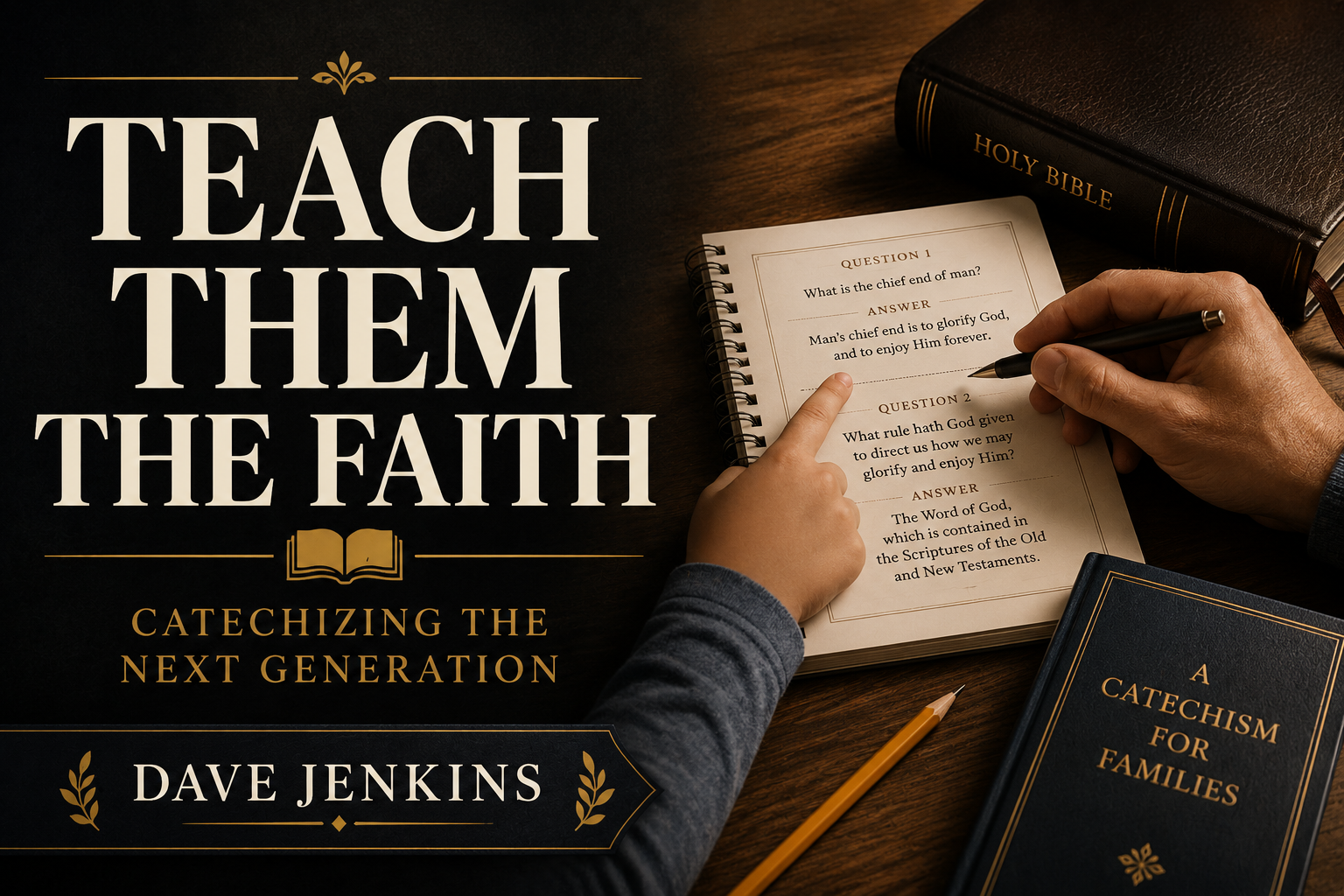
Catechizing the Next Generation
By Dave Jenkins
Few responsibilities are more important than passing the Christian faith from one generation to the next.
Every Christian parent desires to see their children know Christ, love His Word, walk in truth, and remain faithful throughout their lives. Every faithful church longs to see young people mature into strong disciples who understand the gospel, embrace biblical truth, and stand firm amid the pressures of an increasingly hostile culture.
Yet many Christian families find themselves asking a troubling question: Why are so many young people leaving the faith?
While the reasons are often complex, one reality has become increasingly difficult to ignore. Many young people have inherited Christian experiences without developing Christian convictions. They have attended church, participated in youth programs, listened to sermons, and learned Bible stories, yet they often struggle to explain what Christians believe and why those beliefs matter.
When questions arise about God, Scripture, truth, morality, salvation, identity, suffering, or the exclusivity of Christ, many lack the theological foundation necessary to respond. As a result, they become vulnerable to confusion, skepticism, and competing worldviews that promise certainty while rejecting biblical truth.
This challenge is not merely a youth ministry problem. It is a discipleship problem.
Throughout Scripture, God repeatedly commands His people to teach the next generation. The responsibility does not belong exclusively to pastors, youth leaders, or Christian schools. It belongs first to parents and then to the broader covenant community of God's people. Biblical discipleship requires intentional instruction. Faithful churches and families must actively teach children not only what the Bible says but also how its truths fit together.
Historically, one of the church's most effective tools for accomplishing this task has been catechesis.
For many modern Christians, the word "catechism" feels unfamiliar. Some associate it exclusively with certain church traditions. Others view it as outdated, overly formal, or irrelevant to contemporary discipleship. Yet for centuries, faithful Christians used catechisms to help children and adults learn Scripture, understand doctrine, and develop a coherent understanding of the Christian faith.
The church's historic commitment to catechesis was not accidental. Christian leaders understood that lasting discipleship requires more than inspiration. It requires instruction.
In an age marked by biblical illiteracy, doctrinal confusion, and relentless cultural pressure, the church would do well to recover this wisdom.
Catechizing the next generation is not about producing little theologians who can recite answers mechanically. It is about helping young people know God, understand His truth, love Christ, and develop convictions rooted in Scripture. It is about preparing them to stand firm in a world that constantly challenges biblical Christianity.
The church has always been one generation away from theological decline. Every generation must therefore receive, embrace, and pass on the faith once for all delivered to the saints.
The question is not whether the next generation will be taught.
The question is who will do the teaching.
The Crisis of Biblical and Doctrinal Illiteracy
One of the greatest challenges facing the church today is not merely hostility from the culture but ignorance within the church itself.
Many Christians possess only a limited understanding of basic biblical doctrine. They may know portions of Scripture, recognize familiar Bible characters, and understand certain moral teachings, yet struggle to explain foundational truths about God, salvation, the gospel, the church, or the Christian life.
This problem becomes especially apparent among younger generations.
Numerous studies have documented growing biblical illiteracy among professing Christians. Young people often possess strong opinions about social issues while lacking confidence regarding basic theological questions. They may know what Christianity opposes but struggle to articulate what Christianity teaches.
This should concern every parent, pastor, and church leader.
The issue is not intelligence. Young people are capable of learning remarkably complex ideas. They master technology, absorb information from countless sources, and navigate an increasingly complicated world. The challenge is not their ability to learn but what they are being taught.
The reality is that every child is being catechized by someone.
Schools catechize.
Social media catechizes.
Entertainment catechizes.
Influencers catechize.
Peers catechize.
The surrounding culture constantly communicates answers to life's most important questions. What is truth? What gives life meaning? Who determines right and wrong? What is human identity? What constitutes happiness? What should people worship?
Children and teenagers are receiving answers to these questions every day.
If Christian families and churches fail to provide biblical answers, other voices will gladly fill the vacuum.
This is one reason doctrinal instruction matters so much.
Many parents assume that occasional spiritual conversations will be sufficient to prepare their children for the challenges they will face. While such conversations are valuable, Scripture points toward something far more intentional. The biblical vision of discipleship involves ongoing instruction, consistent teaching, and deliberate formation.
Children need more than positive experiences at church.
They need truth.
They need categories for understanding reality.
They need biblical answers to life's most important questions.
They need to understand who God is, who they are, why Christ came, what salvation means, why Scripture matters, what the church is, and how Christians should live.
Without these foundations, many young people enter adulthood spiritually vulnerable. They may possess emotional attachment to Christianity without possessing theological conviction. When their beliefs are challenged, they often discover that they lack the doctrinal framework necessary to respond.
This reality helps explain why many young adults struggle when confronted by secular ideologies, skeptical arguments, or cultural pressures. The issue is not always rebellion. Sometimes it is simply that no one helped them develop deep theological roots.
The solution is not fear.
The solution is discipleship.
The church must recover confidence that biblical truth is both knowable and teachable. Parents must recognize that theological instruction is not optional. Churches must embrace their responsibility to help equip families for the task of spiritual formation.
The next generation desperately needs more than entertainment, programs, and activities.
They need biblical truth.
And that truth must be taught intentionally.
The Biblical Mandate to Teach the Next Generation
The responsibility to teach the next generation is not a modern ministry strategy. It is a biblical mandate woven throughout the storyline of Scripture.
From the earliest pages of God's Word, we see the Lord's concern that His truth be faithfully passed from one generation to the next. The covenant people of God were never intended to keep His works, His commandments, and His promises to themselves. They were called to remember, proclaim, and teach them so that future generations would know the Lord and walk in His ways.
One of the clearest expressions of this responsibility appears in Deuteronomy 6. After affirming the uniqueness and supremacy of God in the Shema, Moses instructed Israel concerning how His truth was to be transmitted:
"And these words that I command you today shall be on your heart. You shall teach them diligently to your children" (Deut. 6:6–7).
Notice where the process begins. God's Word must first be in the hearts of parents before it can be effectively passed to children. Biblical discipleship is not merely the transfer of information. It is the passing on of truth that has already taken root in the life of the teacher.
Moses then describes an intentionally comprehensive approach to discipleship. Parents were to speak of God's truth when sitting in their homes, when walking along the way, when lying down, and when rising up. In other words, the instruction of children was not confined to occasional formal lessons. It was to become part of the normal rhythm of life.
This passage reveals something important about biblical discipleship. Teaching children is not merely reactive. It is proactive.
Parents are not called simply to answer questions when they arise. They are called to actively shape the worldview, understanding, and convictions of their children through regular exposure to God's truth.
Psalm 78 reinforces this responsibility.
The psalmist declares that God's people must tell the coming generation "the glorious deeds of the LORD, and his might, and the wonders that he has done" (Psalm 78:4). The purpose is clear:
"That the next generation might know them, the children yet unborn, and arise and tell them to their children" (Psalm 78:6).
This passage presents a multi-generational vision of discipleship. One generation teaches the next, which in turn teaches the generation that follows. God's truth is handed down like a precious inheritance.
The psalmist also explains why this matters. Future generations must know God's works and His Word so that they will "set their hope in God and not forget the works of God, but keep his commandments" (Psalm 78:7).
Knowledge and obedience belong together.
The goal is not merely that children accumulate information. The goal is that they know God, trust God, and walk faithfully before Him.
The New Testament continues this emphasis.
Paul reminds Timothy of the influence of his mother and grandmother, who helped establish him in the faith from childhood. Timothy's spiritual formation did not begin in adulthood. It began through years of exposure to Scripture and faithful instruction.
Paul writes:
"From childhood you have been acquainted with the sacred writings, which are able to make you wise for salvation through faith in Christ Jesus" (2 Tim. 3:15).
This verse highlights the immense value of early theological formation.
Children are capable of learning Scripture.
Children are capable of learning doctrine.
Children are capable of developing meaningful theological understanding.
Too often, modern churches underestimate the spiritual capacity of young people. We assume children need constant entertainment when Scripture suggests they need truth. We assume doctrine is too complicated when history demonstrates otherwise. We assume theological instruction can wait until later when God's Word consistently calls for early and ongoing discipleship.
Paul's instruction to fathers in Ephesians 6:4 further reinforces this responsibility:
"Bring them up in the discipline and instruction of the Lord."
The language here is intentional. Parents are not merely responsible for providing physical care. They are called to provide spiritual formation.
This responsibility can feel overwhelming.
Many parents worry that they lack theological training. They fear they do not know enough to disciple their children effectively. Some assume that because they are not pastors or scholars, they are unqualified for the task.
Scripture offers a different perspective.
God does not call parents to be seminary professors. He calls them to be faithful.
The primary qualification for family discipleship is not advanced theological education but a willingness to teach God's truth consistently and humbly. Parents grow alongside their children. They learn together. They answer questions. They open Scripture. They point their families to Christ.
The church exists in part to support this work.
Pastors, elders, teachers, and ministry leaders should view themselves as partners in helping parents fulfill their biblical calling. Churches do not replace the family. They equip the family. Healthy churches recognize that one of their most important ministries is preparing parents to become effective disciplers within their own homes.
This biblical vision stands in sharp contrast to many contemporary approaches to spiritual formation.
Modern culture often encourages parents to remain neutral and allow children to determine their own beliefs later in life. Scripture never presents neutrality as an option. Every child is being shaped by competing influences. Every child is developing convictions about truth, morality, identity, and purpose.
The question is not whether formation is happening.
The question is whether that formation is being guided by God's Word.
For this reason, the biblical mandate to teach the next generation remains as urgent today as it was in the days of Moses. Parents and churches must embrace the responsibility God has given them. The spiritual well-being of future generations depends upon it.
Faithful discipleship begins when God's people take seriously the call to teach His truth to those who come after them.
That responsibility leads naturally to an important question: What exactly is catechesis, and why has the church historically viewed it as such an effective tool for accomplishing this task?
What Catechesis Is and Why It Matters
For many Christians today, the word catechesis sounds unfamiliar, formal, or even intimidating. Some associate it with church traditions different from their own. Others assume it refers to a rigid educational system that emphasizes memorization at the expense of genuine faith. Still others have never encountered the term at all.
Yet catechesis has been one of the most important tools for Christian discipleship throughout the history of the church.
The word itself comes from a Greek term meaning "to instruct" or "to teach orally." In its simplest form, catechesis is the intentional teaching of biblical truth through questions and answers. A catechism provides a structured way of helping believers learn, understand, and remember the doctrines of the Christian faith.
While the method is simple, its impact has often been profound.
A child might be asked, "Who made you?" and answer, "God made me."
He might then be asked, "Why did God make you?" and answer, "To glorify Him and enjoy Him forever."
Another question might address the nature of Scripture, the person of Christ, the meaning of salvation, or the purpose of the church.
Through repeated exposure to these truths, children gradually develop a framework for understanding the Christian faith. Individual doctrines begin connecting to one another. Biblical categories become familiar. Theological language becomes understandable. Over time, a coherent Christian worldview emerges.
This is one of the great strengths of catechesis.
Many modern approaches to discipleship emphasize isolated lessons or disconnected topics. Children may learn Bible stories, memorize verses, and participate in various church activities without ever developing a comprehensive understanding of biblical truth. They know fragments of Christianity without understanding how those fragments fit together.
Catechesis helps address this problem by teaching the faith systematically.
Rather than leaving children to assemble theological concepts on their own, catechesis provides an organized structure for learning. Questions build upon previous questions. Concepts reinforce one another. The learner gradually develops a clearer understanding of God, Scripture, humanity, sin, Christ, salvation, the church, and the Christian life.
This does not mean catechesis replaces Scripture.
In fact, faithful catechesis exists precisely because Scripture is central. Good catechisms are rooted in God's Word. They summarize biblical truth in a form that is accessible, memorable, and useful for discipleship. Their purpose is not to draw attention away from Scripture but to help people understand Scripture more fully.
Some Christians worry that catechisms encourage mere memorization.
Certainly, memorization by itself is not enough. A child can recite answers without understanding them. Adults can repeat theological statements without embracing them in faith. Scripture repeatedly warns against external religion that lacks genuine heart devotion.
Yet this concern should not lead Christians to dismiss memorization altogether.
Throughout Scripture, God's people are repeatedly called to remember His Word. The psalmist speaks of storing up God's Word in the heart. Israel was instructed to teach God's commands diligently to their children. The early church devoted itself to the apostles' teaching. Memory has always played an important role in spiritual formation.
In reality, the problem is not memorization. The problem is memorization without understanding.
Faithful catechesis seeks both.
Children are encouraged to learn biblical truth, understand its meaning, and apply it to life. Questions become opportunities for discussion. Parents explain concepts. Families explore relevant passages of Scripture. Doctrinal instruction becomes part of an ongoing conversation rather than a mechanical exercise.
This is why catechesis remains so valuable.
It provides a practical framework for helping families move beyond occasional spiritual conversations toward intentional discipleship. Instead of wondering where to begin, parents are given a clear pathway for teaching foundational truths.
Catechesis also recognizes an important reality about human nature.
People do not automatically develop biblical thinking.
Children naturally absorb ideas from the world around them. They learn values, assumptions, priorities, and beliefs through countless influences. Left untrained, their thinking will be shaped by whatever voices speak most loudly and most often.
Catechesis intentionally counters this process by immersing children in biblical truth.
It helps them answer life's most important questions before the culture provides competing answers. It teaches them who God is before social media attempts to redefine reality. It teaches them the gospel before the world offers alternative paths to meaning and fulfillment.
In this sense, catechesis is not merely educational. It is formative.
The goal is not simply to increase knowledge. The goal is to shape hearts and minds according to God's truth.
This is particularly important in an age of confusion.
Children today face a constant stream of competing messages concerning identity, morality, truth, authority, and purpose. Many of these messages directly contradict Scripture. If young people are to navigate these challenges faithfully, they need more than vague familiarity with Christianity. They need deep roots.
Catechesis helps cultivate those roots.
It gives children categories for understanding the world. It provides language for expressing their faith. It helps them recognize error. It equips them to think biblically when difficult questions arise.
Most importantly, catechesis consistently points beyond itself to Christ.
The ultimate goal is not doctrinal mastery for its own sake. The goal is that children come to know the God revealed in Scripture. Every doctrine ultimately serves this larger purpose. Every question and answer directs attention to the Lord, His Word, His gospel, and His glory.
Historically, the church understood this connection well.
For centuries, Christian leaders viewed catechesis not as an optional educational tool but as an essential component of discipleship. Parents, pastors, and congregations worked together to ensure that young people were grounded in biblical truth from an early age.
Their commitment raises an important question for modern Christians: How did catechesis function throughout church history, and what can we learn from those who faithfully used it to disciple generations of believers?
The Historical Practice of Catechesis in the Church
One of the most surprising discoveries for many modern Christians is realizing just how central catechesis was to the life of the church for centuries.
Today, many churches view doctrinal instruction as one ministry among many. In previous generations, however, catechesis was often regarded as a foundational responsibility of both the family and the church. Christian leaders understood that if the faith was to be preserved, proclaimed, and passed on, believers needed more than occasional exposure to biblical truth. They needed systematic instruction.
This conviction can be traced back to the earliest days of the church.
The New Testament itself emphasizes the importance of teaching. Following Christ's ascension, the early believers devoted themselves to the apostles' teaching (Acts 2:42). New converts were not simply welcomed into the church and left to discover doctrine on their own. They were instructed in the faith.
As Christianity spread throughout the Roman Empire, church leaders developed structured methods of teaching new believers. Individuals preparing for baptism often underwent extended periods of instruction. They learned the basic doctrines of the faith, the meaning of the gospel, and the ethical implications of following Christ. This process helped ensure that those entering the church understood the truths they were professing.
The early church recognized that discipleship required more than emotional enthusiasm. It required theological formation.
As doctrinal controversies emerged, catechesis became even more important.
The church faced challenges concerning the Trinity, the person of Christ, salvation, and numerous other doctrines. False teaching repeatedly threatened to confuse believers and distort the gospel. Church leaders understood that one of the most effective ways to protect God's people was to ensure they were grounded in sound doctrine.
The creeds that emerged during this period served not only as theological statements but also as teaching tools. They helped believers summarize and remember essential truths concerning the Christian faith. By learning and confessing these truths together, Christians developed greater doctrinal clarity and unity.
This commitment to doctrinal instruction continued throughout the centuries.
During the Middle Ages, catechetical teaching remained an important aspect of church life, though its effectiveness varied from place to place. By the time of the Protestant Reformation, many reformers became deeply concerned about widespread biblical and theological ignorance among ordinary church members.
The Reformers understood that recovering the authority of Scripture required more than translating the Bible into the language of the people. It also required teaching people how to understand biblical truth.
Martin Luther became one of the strongest advocates of catechesis. Disturbed by the lack of doctrinal knowledge he encountered, Luther produced both a Large Catechism and a Small Catechism. His goal was practical rather than academic. He wanted parents, pastors, and congregations to have tools that would help them teach the faith clearly and consistently.
Luther famously lamented the theological ignorance he observed among many who identified as Christians. His concern was not simply that people lacked information. His concern was that they lacked understanding of the gospel itself.
John Calvin shared similar concerns.
In Geneva, catechetical instruction became an important part of church life. Calvin viewed doctrinal teaching as essential to discipleship and church health. He believed believers should understand not only individual doctrines but also the overall framework of biblical truth.
Throughout the Reformation and post-Reformation periods, catechisms flourished across various Protestant traditions. The Heidelberg Catechism, Westminster Shorter Catechism, Westminster Larger Catechism, and Baptist Catechism became widely used tools for teaching both children and adults.
These catechisms were not created merely for scholars.
They were designed for ordinary believers.
Parents used them in family worship. Pastors employed them in church instruction. Children memorized them. New believers learned from them. Entire congregations benefited from them.
For many Christians, catechetical instruction became a normal part of growing in the faith.
One reason these catechisms proved so effective was their ability to connect doctrine and devotion.
The best catechisms did not present theology as an abstract intellectual exercise. They showed how doctrine related to worship, assurance, obedience, suffering, prayer, and daily Christian living. Questions were designed not merely to inform the mind but also to strengthen faith and encourage godliness.
This historical perspective offers an important corrective for modern churches.
Many contemporary Christians assume that systematic doctrinal instruction is unnecessary or excessively formal. Yet some of the church's most fruitful seasons of discipleship were marked by intentional catechesis. Generations of believers developed theological depth not because they possessed extraordinary intellectual abilities but because they were consistently taught biblical truth.
The church's history demonstrates that children are capable of learning doctrine. Families are capable of teaching doctrine. Congregations are capable of valuing doctrine.
More importantly, history demonstrates that doctrinal formation produces long-term fruit.
Many believers who remained faithful throughout persecution, hardship, and cultural opposition did so because they possessed deep theological roots. The truths they learned as children sustained them as adults. The doctrines they memorized shaped how they viewed God, interpreted suffering, resisted temptation, and persevered in faith.
Their example remains instructive today.
The challenges facing Christian families in the twenty-first century are different in some respects from those faced by earlier generations, but the fundamental need remains unchanged. Children still need truth. Families still need discipleship. Churches still need doctrinal clarity.
The tools may vary, but the responsibility remains the same.
Recovering catechesis does not mean attempting to recreate a previous century. It means learning from the wisdom of believers who understood that faithful discipleship requires intentional instruction.
The church's history reminds us that doctrinal formation is not a new idea. It is a time-tested practice that has helped Christians pass the faith from one generation to the next for nearly two thousand years.
The question for modern families is not whether previous generations found catechesis useful.
The question is whether we will embrace the same commitment to forming children in biblical truth.
That commitment becomes especially important when we recognize that children need more than moral guidance. They need theological foundations capable of sustaining a lifetime of faithful discipleship.
Clarity in Doctrine: Sound Doctrine in a Noisy World

Dave Jenkins is happily married to his wife, Sarah, and lives in beautiful Southern Oregon. He is a writer, editor, and speaker who loves Christ, His people, the Church, and sound theology.
Dave serves as the Executive Director of Servants of Grace Ministries and the Executive Editor of Theology for Life Magazine. He is the Host and Producer of the Equipping You in Grace Podcast and a contributor to and producer of Contending for the Word.
He is the author of The War of Worldviews: Truth, Lies, and the Battle for the Christian Mind (Theology for Life, 2026), Contentment: The Journey of a Lifetime (Theology for Life, 2024), The Word Matters: Defending Biblical Authority Against the Spirit of the Age and The Word Explored: The Problem of Biblical Illiteracy and What To Do About It (House to House, 2021).
You can connect with Dave on Facebook, X (Twitter), Instagram, YouTube, or subscribe to his newsletter.
When he is not engaged in ministry work, Dave enjoys spending time with his wife, going to movies, sharing a meal at a favorite restaurant, or playing a round of golf with friends. He is also a voracious reader, particularly of Reformed theology and the Puritans, and is often found working through a stack of new books from a wide range of Christian publishers.
Dave earned his M.A.R. and M.Div. from Liberty Baptist Theological Seminary.