⏱️ Estimated Reading Time: 11 min read
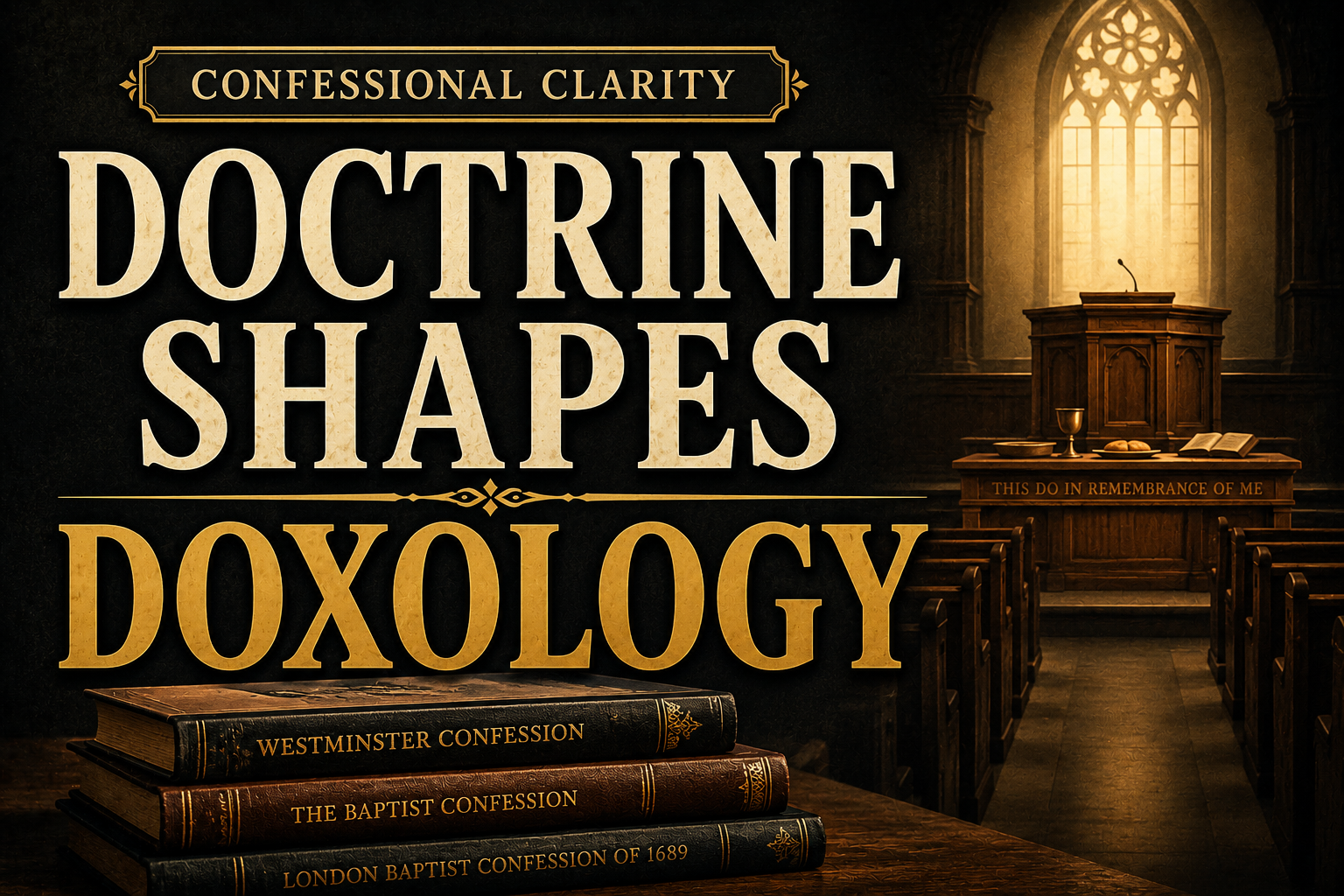
Doctrine Shapes Doxology
How Confessional Clarity Forms a Church’s Worship
Ask twenty Christians what the church is for and you will receive twenty different answers. Fellowship. Evangelism. Discipleship. Preaching. Counselling. Community. The list reveals a widespread confusion about the church’s identity and therefore its priorities. Yet Scripture is not confused. Writing to a church scattered across the Roman Empire, Peter identifies the church’s central calling without ambiguity: the people of God have been called out of darkness to “proclaim the praises of Him who called you” (1 Peter 2:9). Everything else—fellowship, evangelism, discipleship—flows from this single fountain and returns to it. The priority of the church is worship.
What a church believes, however, will always find expression in how it worships. The connection is not incidental but structural. Doctrine is never liturgically neutral. What a congregation confesses about God, the gospel, and the nature of the church will shape the form, content, and priorities of its corporate worship. The question every church must face is not whether its theology will shape its doxology, but if its theology is orthodox—which leads to orthodox worship.
I. Doctrine Is Never Liturgically Neutral
Every church has a theology of worship, even if that theology has never been articulated. Where doctrine is unexamined, it does not disappear—it simply works silently, shaping worship invisibly. The ancient principle lex orandi, lex credendi—“the law of praying is the law of believing”—cuts both ways. A church’s worship forms its beliefs as much as its beliefs form its worship. What is sung on Sunday reaches parts of the congregation that the sermon cannot. What is included, omitted, or given weight in corporate worship teaches a doctrine as surely as any catechism.
This is why the pastoral epistles place doctrinal clarity first. Paul’s opening concern in 1 Timothy is not polity, programmes, or pastoral care—it is doctrine. Sound teaching is the air superiority of the spiritual battle. Without it, nothing else works. A healthy church cannot be built on a vague doctrinal foundation any more than a cathedral can be built on sand. When doctrine is vague, worship follows it into vagueness. And vague worship similarly begins dissipating the doctrinal clarity of a church.
The worship wars of the last half-century have not been, at their root, battles about music style or aesthetic preference. They have been battles about doctrine: about who God is, and what He deserves. Churches that have lost doctrinal clarity have not merely changed their worship culture; they have quietly changed their god.
II. What a Church Believes About God Determines How It Approaches Him
The primary and most determinative doctrine for a church’s worship is the doctrine of God—specifically, the holiness of God. The word “holy” is commonly understood to mean God’s moral purity and sinlessness. But while moral perfection is part of its meaning, it is not the primary meaning. The primary meaning of “holy” is otherness. To be holy is to be set apart from what is common and familiar. God’s holiness is His uniqueness—what makes God, God. Nothing in all creation is a full or perfect analogy of God. He is unlike anything we can imagine or conjure up.
This is precisely why God has always insisted on regulating His own worship. If God is like nothing we know, what happens when sinful human beings attempt to approach Him on their own terms? The answer is idolatry. Left to ourselves, we recreate God in our image—familiar, manageable, responsive to our instincts. Nadab and Abihu did not worship a foreign god; they did not abandon their priestly garments or neglect the sacrifice. They simply substituted fire of their own devising for the fire God had commanded. They were sincere. They were zealous. But they died before the Lord.
A church with a thin doctrine of God’s holiness will default, almost automatically, to casualness and informality. When God is conceived primarily as a friend, a companion, a therapeutic presence, worship becomes a celebration of that companionship rather than an encounter with the living and holy God. Calvin understood this clearly. Near the beginning of his defence of the Reformation, he placed “a knowledge of the mode in which God is duly worshipped” ahead of soteriology as the first foundation of Christianity. A church that knows the gospel but has lost the gravity of the holy God will produce worship that gradually empties that gospel of its weight.
The regulative principle of worship—the conviction that God must be worshipped only as He has prescribed in His Word—is not an arbitrary piece of Reformed ecclesiology. It is the logical conclusion of a robust theology proper. A God who is wholly other must tell us how to approach Him.
“The acceptable way of worshipping the true God is instituted by Himself, and so limited by His own revealed will, that He may not be worshipped according to the imaginations and devices of men.”
Westminster Confession of Faith
The regulative principle is, in short, downstream of the doctrine of God.
III. What a Church Believes About the Gospel Determines What Worship Celebrates
Soteriology sets the emotional and theological register of corporate worship. A fully-orbed doctrine of sin, grace, and substitutionary atonement produces particular emphases in what is sung, prayed, and preached. Where sin is taken seriously, confession carries weight. Where grace is understood as grace—unmerited, particular, purchased at infinite cost—gratitude runs deep. Where the atonement is clearly substitutionary, the cross is not a decoration but the centre of gravity around which every element of worship orbits.
The gospel is the boundary of the Christian faith. It is the message by which people are saved (1 Corinthians 15:2; Romans 1:16). Remove or soften the doctrines that constitute it—human guilt before a holy God, the impossibility of self-salvation, the wrath propitiated at Calvary, the righteousness imputed to the believing sinner—and what remains may still be called Christian, but it will worship differently.
Where these doctrines weaken, worship trends inevitably toward the therapeutic: it becomes a celebration not of what God has done for sinners, but of what we feel in His presence. The emotional intensity may remain or even increase, but the object has quietly shifted from God to the worshippers themselves.
The Lord’s Supper functions as a doctrinal anchor in the liturgy precisely because it will not allow the gospel to be abstracted into sentiment. At the Table, the church does not merely sing about the cross; it shows it (1 Corinthians 11:26).
In some ways the Lord’s Supper is the high point toward which gathered worship moves—the moment when reading the Word, praying the Word, singing the Word, and preaching the Word all come to a focus. Bread and cup preach a sermon that no amount of therapeutic reframing can entirely domesticate.
A church that marginalises the Lord’s Supper—treating it as an occasional appendage rather than a recurring climax of gathered worship—is, almost without knowing it, making a doctrinal statement about the centrality of the cross.
IV. What a Church Believes About the Church Determines Its Worship Priorities
Ecclesiology shapes the gathered assembly. The most basic question a congregation must answer is: who are we when we assemble, and why? Scripture answers it in stark terms. The church is a temple of living stones, a royal priesthood, a holy nation, a people gathered not by social preference or geographic convenience but by divine calling (1 Peter 2:4–5, 9).
The church is not a voluntary meeting of spiritual consumers. Christ’s church is the assembly of the covenant people before their covenant God. As Paul declares, God is glorified “in the church by Christ Jesus to all generations, forever and ever” (Ephesians 3:21)—and the church is the instrument through which God has chosen to display His wisdom and power. The thing that brings God the most glory in this age is, remarkably, the church.
A high ecclesiology—a robust doctrine of the church as the body of Christ, the household of God, the community of the new covenant—produces worship with weight, reverence, and Word-centredness. When the congregation understands itself as the people of God assembled before God, what they do together carries a different register than what happens in a spiritual interest group.
The sermon is the proclamation of the living Word to the covenant assembly. Prayer is the corporate cry of God’s people to their Father. The elements of worship—reading, preaching, singing, praying, and the ordinances—are not services rendered to the congregation but spiritual sacrifices offered to God.
A low ecclesiology produces consumer-driven, event-oriented worship. If the church is essentially a voluntary spiritual society, then the gathered meeting is evaluated primarily by whether individual spiritual consumers found it satisfying. Worship becomes a service rendered to the congregation rather than a sacrifice offered to God.
The result is inevitable: every element of the service becomes subject to the verdict of the audience. And an audience, given sufficient time, will always edit the worship into something more comfortable than holiness.
V. Confessional Clarity as an Intergenerational Anchor
The history of evangelical Christianity is littered with movements that burned brightly for a generation and faded by the third. The pattern is consistent: first-generation zeal carries second-generation practice, but practice without doctrinal rootedness cannot sustain itself into the third. A church that agrees on what to do on Sunday morning but has never agreed on why is a church whose children will fight over it.
God’s prescriptions for worship are, at their core, protective. They act as a preservative against the corrosive effects of our own idolatrous hearts; a defensive wall against the heart’s endless capacity to reshape God’s worship into self-worship.
This is why a deviation from God’s prescriptions, introduced by one person in a position of authority, usually produces outright idolatry by successive generations. What is done in the name of corporate worship carries an authority that the other realms of the Christian life do not. When church leaders include elements not prescribed by God, they effectively baptise those elements as necessary and right.
Confessions function as a deposit held in trust across generations. They are the accumulated doctrinal wisdom of the church, preserved precisely so that what the first generation discovered does not need to be rediscovered by the fifth. A church anchored to a confession has resources for evaluating every worship decision that transcend the preferences and blind spots of its current leadership.
David’s preparations for the Temple were not preparations for his own generation alone. They were a doctrinal deposit laid down so that Solomon and every generation after him would know how to worship the Lord. The confession functions the same way. It is the architecture that makes faithful worship durable.
Conclusion
Worship renewal is always doctrinal renewal first. A church that wants to worship better must think more carefully about God: about who He is in His holiness, what He has done in the gospel, and who His people are when they gather in His name. The instinct to separate worship practice from doctrinal clarity is widespread, but it is the instinct of a church that has forgotten what it is doing and why.
The practical implication is this: a church’s confession must function as a living liturgical document. Pastors and elders who plan worship should do so not by asking what is current, what is popular, or what worked elsewhere, but by asking what the church’s doctrine requires.
The confession is the primary filter for every corporate decision, from hymn selection to sermon length, from the frequency of the Lord’s Table to the weight given to corporate prayer.
A church that confesses clearly will worship faithfully. A church that drifts doctrinally will, in time, worship something other than the God it once knew.