⏱️ Estimated Reading Time: 12 min read
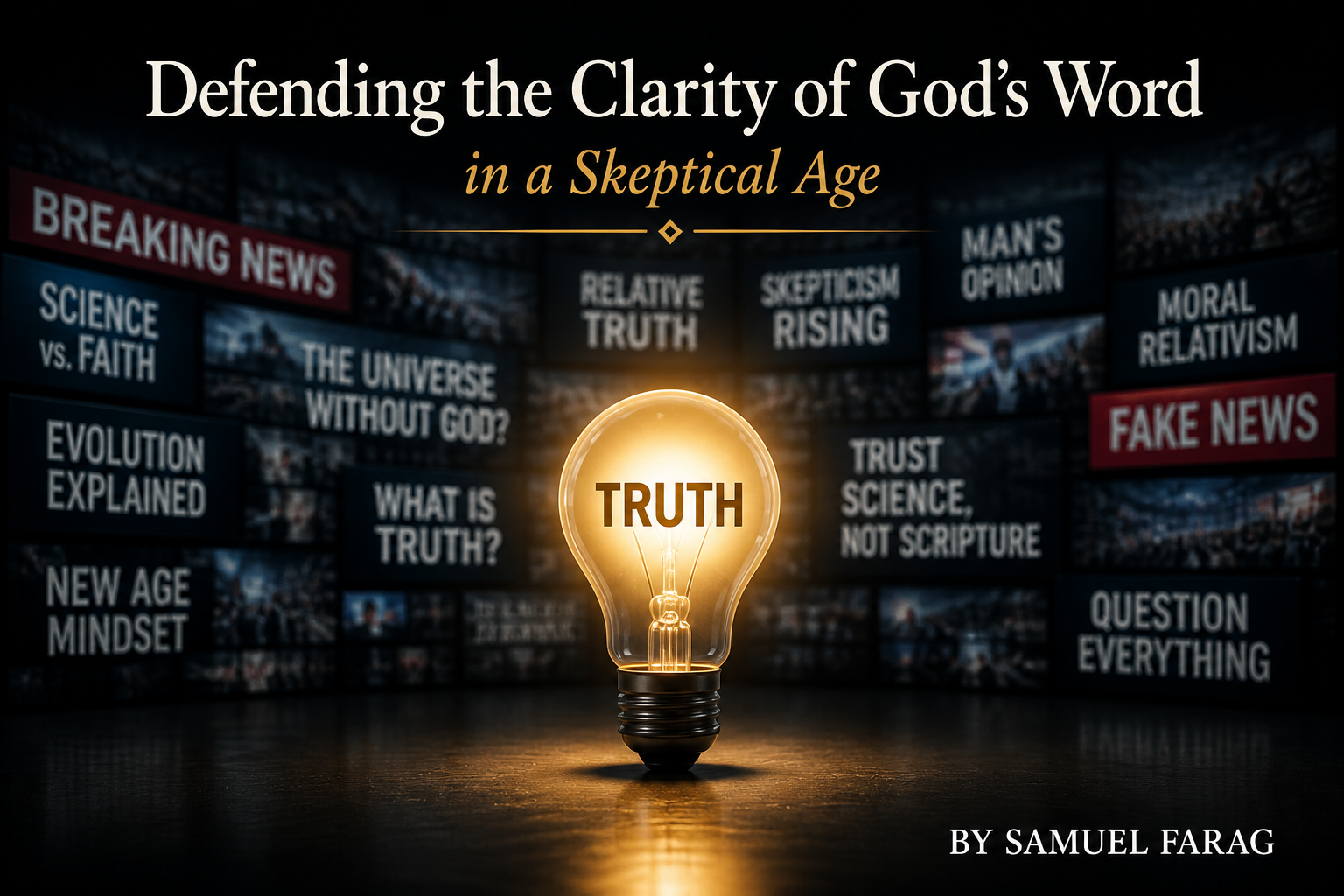
Defending the Clarity of God’s Word in a Skeptical Age
By Samuel Farag
In 2025, according to the Pew Research Center, it was reported that, “Overall, 44% of U.S. adults say the Bible is extremely important or very important in their lives, while 19% say the Bible is somewhat important, and 37% say the Bible is not too important or not at all important.”[i] That means at least 56% of Americans do not understand or appreciate the fact that the Bible is not just any ancient text, but it is truly the God-breathed Word of God.
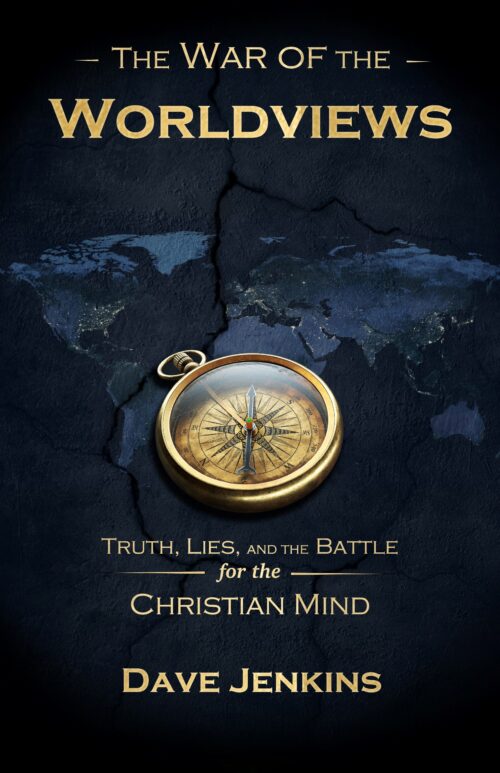
This lack of reverence for God’s Word is due to the skeptical age we are in. Most people today are far more willing to put their faith in science, nature, or the New Age than in the God of all Creation. There is a true battle raging in our society of a variety of worldviews, but basic logic and common-sense demand that we conclude that only one worldview can be right. And when all worldviews are put to the test, when they are all put on the fire, only one stands tall. The worldview that is built on the Bible (for a wonderful book that I highly recommend on this battle of ideologies, see The War of the Worldviews: Truth, Lies, and the Battle for the Christian Mind[ii] by Dave Jenkins).
Now, anyone can claim that any book is divinely inspired. Anyone can claim their religious text is true, and all should follow it. So, why should anyone put their faith in the Bible and build their worldview on this text, as opposed to the myriads of other options the world offers? Well, trusting in the truth found in the Bible is not an act of blind faith, as it is often presented by its opponents. We, as the followers of Christ, have a very reasonable faith.
Consider what Dr. Andrew A. Snelling says in article 5 of the series “Is the Bible True?”, titled, “Scientific Accuracy: Seven Compelling Evidences”, featured in Answers Magazine:
The Bible is clearly unlike any other document in history. Every claim it makes about science is not only true but crucial for filling in the blanks of our understanding about the origin of the universe, the earth, fossils, life, and human beings. The more we study and learn about the world, the more we come to appreciate the Bible’s flawless, supernatural character…Over the centuries the Bible has been rigorously tested for scientific accuracy, and it has never failed. Not only is God’s Word always true; it has proven to be the key to understanding God’s world today![iii]
It is no small or unfounded claim that Bible-believing Christians make when we say that the Word of God is inerrant and infallible. We are able to back up that claim, not just from the Bible itself, but when we evaluate science, archaeology, and history, there is not a single contradiction found in the Bible. There may be apparent contradictions, but not a single claim thrown at the Bible has ever stuck.
Every apparent contradiction, when honestly studied and evaluated, has revealed that the Scriptures (both the Old and the New Testaments) are error-free. All 66 books of the Bible fit perfectly with science, archaeology, and history. In fact, over time, conclusions in science, archaeology, and history have had to change with new evidence that was discovered. But the Bible has never needed a revised or updated edition.
It was considered a “scientific fact” by many at one point that the Earth was the center of the universe. It was an “archaeological fact” at one point that there was no evidence for Pontius Pilate. It was a “historic fact” at one point that Israel never had a Davidic line in their history of kings. All those “facts” were turned on their heads when new evidence was discovered. However, the Bible never needed to come out with a correction. No ancient text, or even modern text, can make a claim like that and prove it like the Word of God.
In his sermon, “Does the Bible Agree with Science?”, John MacArthur said:
All creation truth is from the Creator as recorded in Scripture. All geological, astronomical, biological, scientific data fit the Bible. True science has no argument with Scripture. Genesis 1 to 3, as I said, tells us exactly the truth about creation, and that establishes the fact that the Bible tells us the truth about everything. Modern scientists, now long past Darwin, have in a very unscientific move decided that they’re going to be irrational, and they’re going to be amoral when it comes to the Bible. They want to say that chance is the creator: accident, coincidence, a kind of randomness I guess you could say. They want to believe in blind luck that everything came out of nothing, produced in an intricate complex of ecosystem microcosms, macrocosms, complexity, all interacting successfully by accident. There is not a more significant absurdity in the thinking of humanity than that, that nobody times nothing equals everything is insanity; that all of this complexity came out of nowhere, nothing, nonintelligence is a fool’s paradigm. Now, some scientists are beginning to say, ‘Look, maybe there is some intelligence.’ Maybe there is some intelligence out there somewhere because you have to come to that point. You can’t have intelligence and personality and complexity coming out of non-intelligence, non-personality, and non-complexity. That’s foolishness. And so there is some interest in what is called intelligent design—that’s a kind of new buzzword—intelligent design. It stops short of acknowledging God, but it does say there has to be some intelligent force behind this.[iv]
Hence, the presupposition that the Bible is accurate because it was God who authored it is clearly no far-fetched claim. In fact, it is the only claim of truth that has any real weight behind it. So, we should take seriously what it says in passages from the Word of God, as found in 2 Timothy 4:1-4, which says, “I charge you in the presence of God and of Christ Jesus, who is to judge the living and the dead, and by his appearing and his kingdom: preach the word; be ready in season and out of season; reprove, rebuke, and exhort, with complete patience and teaching. For the time is coming when people will not endure sound teaching, but having itching ears they will accumulate for themselves teachers to suit their own passions, and will turn away from listening to the truth and wander off into myths.”
Worldviews and ideologies, such as New Ageism, communism, socialism, humanism, Marxism, scientism, etc., all make bold claims. They often tickle the ears of their listeners with appealing assertions. But God’s Word is the only source of truth that can be used to faithfully and genuinely reprove, rebuke, and exhort anyone.
Likewise, 2 Peter 1:20-21 says, “Knowing this first of all, that no prophecy of Scripture comes from someone’s own interpretation. For no prophecy was ever produced by the will of man, but men spoke from God as they were carried along by the Holy Spirit.” Thus, the Scriptures are not just a collection of random books. They are not just amazing works of literature. They are not just ancient masterpieces. They are the authority that we need to submit to, as they are written by the Holy Spirit, God Himself.
The Clarity of Scripture
In addition to the authority of Scripture, we must also bring up the clarity of Scripture. Though there are some texts that require deeper study in order to interpret them correctly, the gospel message and the overall message of Scripture are clear to those with eyes to see. Jesus would constantly appeal to Scripture during His earthly ministry and rebuke the man-made and man-centered teaching of the religious elite of His day with God’s Word (see Mark 7:1-13 for a powerful interaction Jesus has with the Pharisees who tried to rebuke Him and His disciples for not following their “Tradition of the Elders”). Even the crowds that followed Jesus’ ministry saw that Jesus taught with authority, versus the teaching of those in religious authority (Matthew 7:29). The reality is that God is not the God of confusion (1 Corinthians 14:33), so we should expect His Word to bring clarity.
Even when the Apostles were spreading the gospel truth of Christ, it was the Bereans who were viewed as most faithful, as they examined all of Paul and Silas’s words on the authority of Scripture. As Acts 17:10-11 says, “The brothers immediately sent Paul and Silas away by night to Berea, and when they arrived they went into the Jewish synagogue. Now these Jews were more noble than those in Thessalonica; they received the word with all eagerness, examining the Scriptures daily to see if these things were so.” Thus, it is right and good to claim that the Scriptures are clear enough for understanding if we approach them with a genuine and humble attitude.
The Sufficiency of Scripture
Lastly, the Word of God is fully sufficient. The idea that Scripture is not enough, and that additional doctrines, writings, or traditions are needed, is foreign to the entire Bible. Paul wrote in 1 Corinthians 4:6 that “I have applied all these things to myself and Apollos for your benefit, brothers, that you may learn by us not to go beyond what is written, that none of you may be puffed up in favor of one against another.”
Paul made it clear that we are never to go beyond what is written in God’s Word. There is a true assurance found in following God’s truth by having a pure devotion to the Word of God. As 2 Timothy 3:16-17 says, “All Scripture is breathed out by God and profitable for teaching, for reproof, for correction, and for training in righteousness, that the man of God may be complete, equipped for every good work.” The Scriptures give us the complete teaching we need for salvation, and they are our only true source to lead us to accomplish every good work (a by-product of saving faith) that God acknowledges.
As this study comes to a close, I want to bring to attention what is recorded in Luke 16:19-31, which says, “‘There was a rich man who was clothed in purple and fine linen and who feasted sumptuously every day. And at his gate was laid a poor man named Lazarus, covered with sores, who desired to be fed with what fell from the rich man’s table. Moreover, even the dogs came and licked his sores. The poor man died and was carried by the angels to Abraham’s side. The rich man also died and was buried, and in Hades, being in torment, he lifted up his eyes and saw Abraham far off and Lazarus at his side. And he called out, ‘Father Abraham, have mercy on me, and send Lazarus to dip the end of his finger in water and cool my tongue, for I am in anguish in this flame.’ But Abraham said, ‘Child, remember that you in your lifetime received your good things, and Lazarus in like manner bad things; but now he is comforted here, and you are in anguish. And besides all this, between us and you a great chasm has been fixed, in order that those who would pass from here to you may not be able, and none may cross from there to us.’ And he said, ‘Then I beg you, father, to send him to my father’s house—for I have five brothers—so that he may warn them, lest they also come into this place of torment.’ But Abraham said, ‘They have Moses and the Prophets; let them hear them.’ And he said, ‘No, father Abraham, but if someone goes to them from the dead, they will repent.’ He said to him, ‘If they do not hear Moses and the Prophets, neither will they be convinced if someone should rise from the dead.’”
So, even if one were to see a person rise from the dead, as amazing and spectacular as that would be, that wouldn’t be enough to convince someone of God’s truth if they refuse to accept what is penned in the Scriptures. You see, when Abraham said they had Moses and the Prophets, he was referring to the Old Testament Scriptures. And he said those writings were enough! Likewise, the Old and New Testament is enough for us today. We don’t need to accept any extra-biblical source that claims it is some kind of missing truth. I can promise you, on the authority of the Word of God, the Holy Spirit did not somehow neglect to provide us with the truth we need in the 66 books of the Bible that we hold in our hands. Scripture is authoritative, clear, and sufficient. The truth found in the Word of God has everything we need for salvation! To God be all the glory!
References
[i] https://www.pewresearch.org/religion/2025/02/26/importance-of-religion-and-the-bible/
[ii] https://servantsofgrace.org/product/war-of-worldviews-book/
[iii] https://answersingenesis.org/is-the-bible-true/5-scientific-accuracy/?srsltid=AfmBOoqUaRO5sUqECd8y365JrCVb8pOTffmhWN7m2ywMw5mDkmQOFJqb
[iv] https://www.gty.org/sermons/82-16/does-the-bible-agree-with-science
Clarity in Scripture: The Authority, Clarity, and Sufficiency of God’s Word
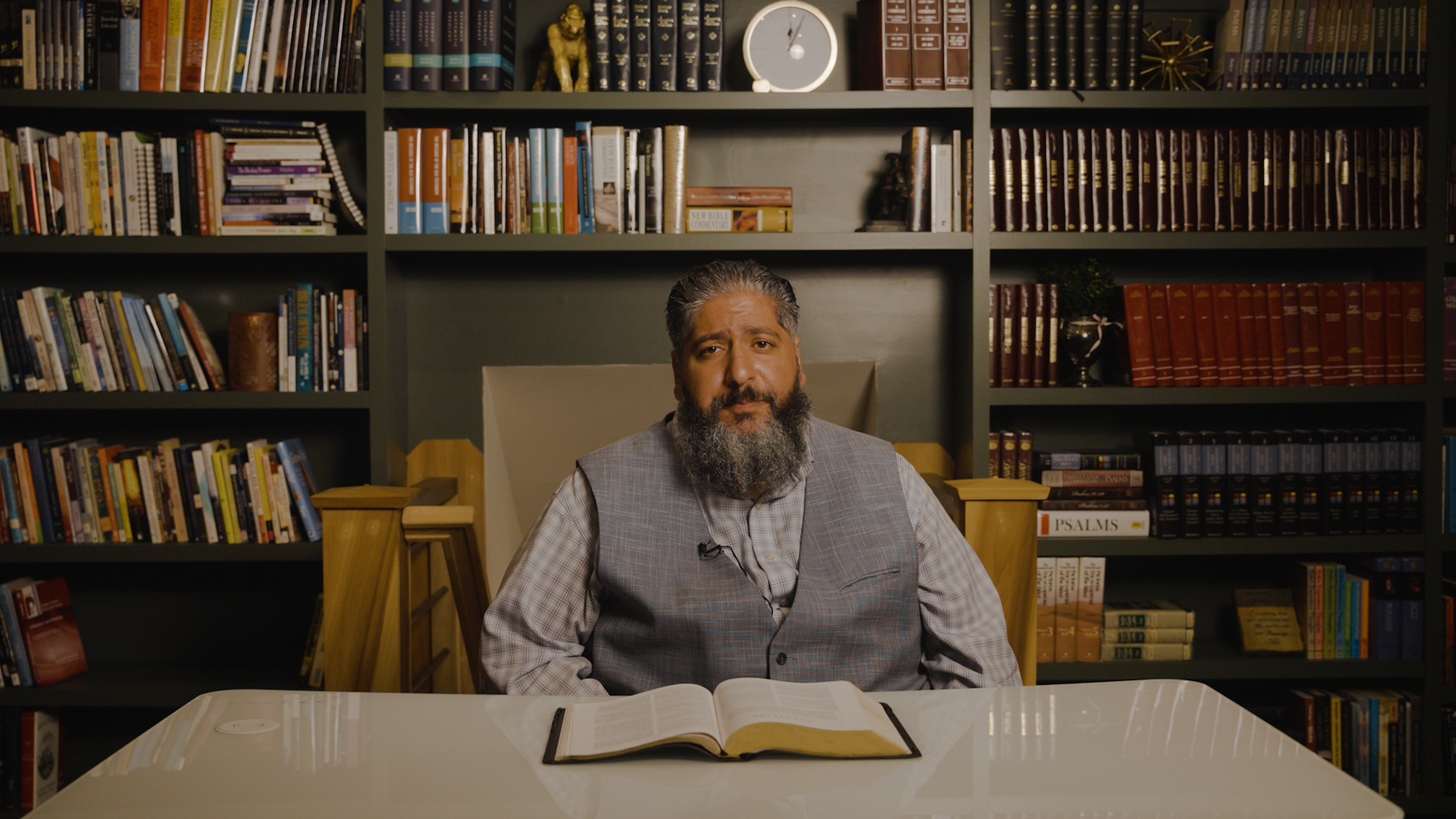
Samuel Farag is the pastor of Bethel Baptist Church of Gorham, New York, a missionary with Village Missions, and the founder of Expositing the Word Ministries.
Samuel grew up and spent 32 years in the Coptic Orthodox Church. In the summer of 2017, the Lord graciously saved him when God opened his ears to hear the true Gospel, and he surrendered his life to Christ in repentance and faith.
After being born again, Samuel sensed God’s call to preach and teach the Word of God. He began his theological training at Liberty University and later earned a Master of Theological Studies degree from Southwestern Baptist Theological Seminary. He is currently pursuing a Master of Divinity degree and, Lord willing, plans to pursue a PhD in Church History.
Samuel currently serves as the pastor of Bethel Baptist Church of Gorham, NY, and as a missionary with Village Missions. He is also the founder of Expositing the Word Ministries, a teaching ministry committed to the faithful exposition of Scripture and the proclamation of the biblical Gospel.
His articles and sermons can be found at ExpositingTheWord.org, and his preaching ministry is also available through the podcast Expositing the Word with Samuel Farag.
Samuel has a deep love and compassion for those who are in—or considering—the Oriental and Eastern Orthodox Churches. Having come out of the Coptic Orthodox tradition himself, he is committed to clearly proclaiming the true Gospel of Jesus Christ according to Scripture and to exposing theological errors within Orthodoxy that promote a different gospel that cannot save.
Samuel is married to his wife, Mercy, and they live in the Finger Lakes region of Western New York with their two daughters.