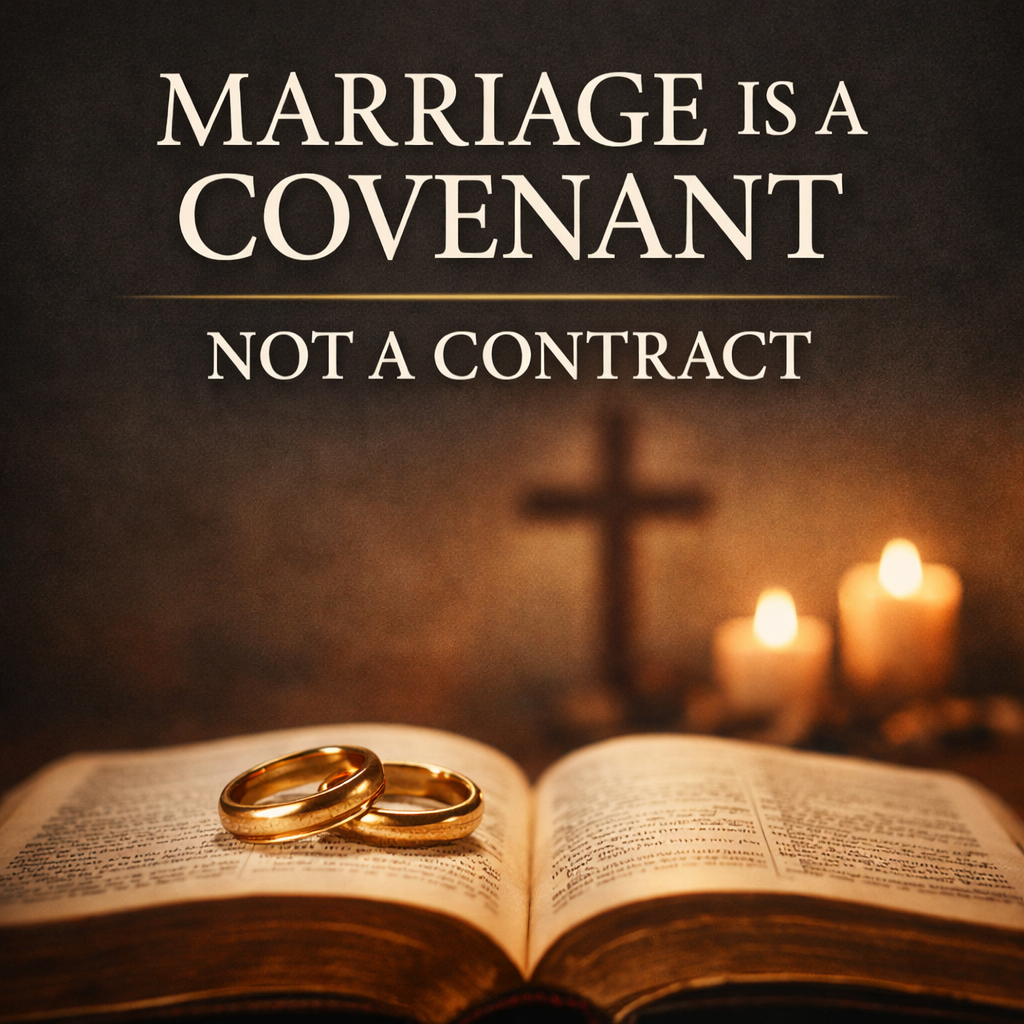
Marriage Is a Covenant, Not a Contract
Series: Love, Marriage, and the Christian Life
Author: Dave Jenkins
Category: Christian Marriage • Practical Theology • Discipleship
Marriage in our culture is often treated like a contract.
It is entered into with hope and enthusiasm, but beneath the vows sits an unspoken clause: as long as this works for me. As long as I feel loved. As long as my needs are met. As long as I am fulfilled. When those conditions weaken, the commitment often weakens with them.
Scripture speaks differently.
Marriage is not a negotiated agreement between two consumers seeking mutual satisfaction. It is a covenant made before a holy God. And until we recover that truth, we will struggle to understand both the beauty and the weight of Christian marriage.
In Malachi 2:14, the Lord rebukes Israel for faithlessness toward “the wife of your youth,” calling her “your companion and your wife by covenant.” That language matters. Marriage is not merely a partnership. It is a covenant bond—solemn, sacred, binding. Genesis 2:24 describes a man leaving his father and mother and holding fast to his wife, becoming one flesh. Jesus reaffirms this in Matthew 19:6, declaring, “What therefore God has joined together, let not man separate.” Marriage is not primarily a human invention. It is a divine joining.
A contract protects rights. A covenant binds hearts.
A contract is sustained by performance. A covenant is sustained by promise.
In a contract, if one party fails to uphold their end, the other may withdraw. In a covenant, faithfulness is not first conditioned upon convenience. It is anchored in a pledged word. This does not mean covenant ignores sin or tolerates abuse; Scripture makes clear there are biblical categories for separation and protection. But covenant means the orientation of the heart is toward perseverance, repentance, and restoration—not escape.
Our culture has steadily redefined marriage through a consumer lens. Happiness becomes the foundation. Compatibility becomes the measure. Personal fulfillment becomes the goal. When fulfillment declines, doubt rises. When conflict surfaces, departure feels justified. Marriage becomes something that serves the self rather than something through which the self is shaped.
But covenant love reshapes that instinct.
Covenant says: I am not here merely to extract happiness from you. I am here to give myself to you. I am here to remain faithful even when affection fluctuates. I am here to forgive because I have been forgiven. I am here to pursue reconciliation because Christ pursued me.
This is why Christian marriage is inseparable from theology. God Himself is a covenant-keeping God. Throughout Scripture, He binds Himself to His people by promise. Exodus 34:6–7 describes Him as “abounding in steadfast love and faithfulness.” Psalm 136 repeats again and again, “His steadfast love endures forever.” Even when Israel is faithless, God’s covenant loyalty remains the controlling theme of redemptive history.
The ultimate display of covenant faithfulness is Christ Himself. Ephesians 5:25 anchors marriage in the relationship between Christ and the church: husbands are called to love their wives “as Christ loved the church and gave himself up for her.” That is not contractual language. It is sacrificial, covenantal devotion. Christ does not abandon His bride when she struggles. He cleanses, nourishes, and sustains her. He remains faithful because His love is rooted in promise.
When we treat marriage as a contract, we inevitably reduce it to emotional stability. When we see it as covenant, we understand that its stability rests not on the constancy of our feelings but on the faithfulness of God.
This becomes especially important when affection fades.
Not every struggling marriage is explosive. Some grow quiet. Some grow distant. There may be no dramatic betrayal, only slow erosion. In those moments, a contractual mindset asks, Am I still happy? A covenant mindset asks, How can I remain faithful? How can I pursue warmth again?
Covenant love does not deny disappointment. It does not pretend hurt is absent. It does not silence grief. But it chooses endurance. It chooses repentance when wrong. It chooses forgiveness when wounded. It chooses humility over pride. It remembers that sanctification often happens not in seasons of ease but in seasons of friction.
Marriage, rightly understood, is one of God’s primary instruments of sanctification. It exposes selfishness. It confronts impatience. It reveals pride. And through that exposure, it invites growth. A contractual mindset resents this refinement. A covenant mindset receives it as part of God’s design to shape two sinners into Christlike maturity.
Yet covenant must not be confused with enabling sin. Scripture never commands someone to endure abuse or ignore unrepentant, destructive behavior. Faithfulness does not mean passivity in the face of evil. Covenant seeks restoration, but it does so through truth, accountability, and sometimes necessary boundaries. The goal is always redemption where biblically possible, not preservation of appearance.
Ultimately, the only foundation strong enough to sustain covenant marriage is the gospel.
- Only forgiven people can forgive deeply.
- Only humbled people can repent quickly.
- Only those secure in Christ can love sacrificially without constantly demanding repayment.
If marriage depends solely on human resolve, it will eventually fracture under the weight of disappointment. But when it is rooted in Christ’s covenant love—when two believers understand that they are first recipients of grace—endurance becomes possible.
Marriage is not a contract negotiated for mutual advantage. It is a covenant entered into before God, sustained by grace, and designed to display something greater than itself. It reflects the steadfast love of the Lord. It mirrors the unbreakable bond between Christ and His church. It proclaims to a watching world that faithfulness is possible because God Himself is faithful.
In an age of exit strategies and disposable commitments, recovering the covenant nature of marriage is not merely traditional—it is deeply countercultural and profoundly hopeful.
Because the God who calls us to covenant faithfulness in marriage is the same God who remains faithful to us in Christ.
Reflection Questions
- Do I tend to approach marriage as a consumer seeking benefits, or as a covenant partner committed to faithfulness?
- Where do I need to repent of selfishness, impatience, or pride in how I relate to my spouse?
- How does Christ’s covenant love for His church reshape the way I think about sacrifice, forgiveness, and endurance?
- What is one practical step I can take this week to pursue warmth, humility, and faithfulness in my marriage?
For more from our latest series please visit here or at our YouTube.