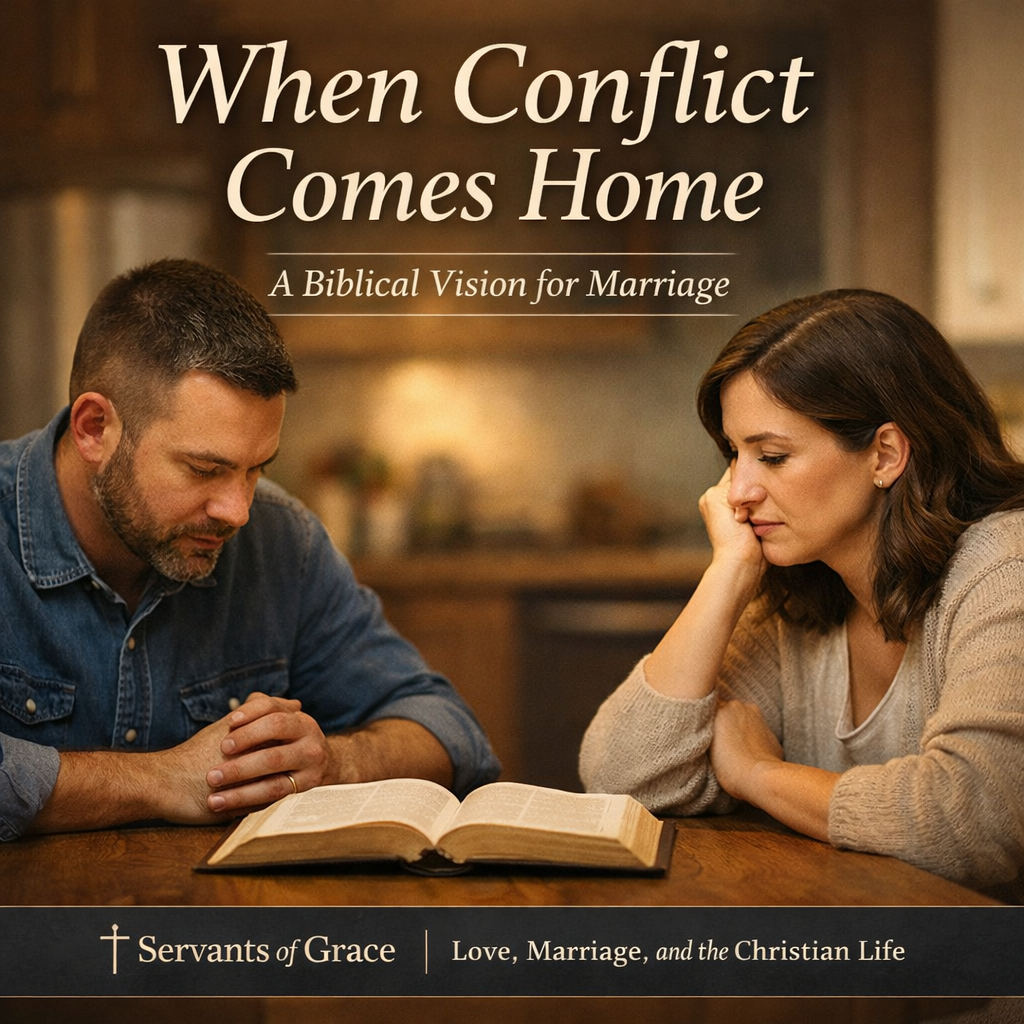
Marriage is one of God’s most beautiful gifts, but it is also one of His most refining tools. Every husband and wife enters the covenant with hope, joy, and expectation. Yet sooner or later, conflict comes home.
Even the strongest, most Christ-centered marriages experience tension. Words are spoken too quickly. Expectations go unmet. Silence lingers longer than it should. The presence of conflict is not proof that a marriage is failing. It is proof that two sinners, though redeemed by grace, are still being sanctified.
Scripture does not treat conflict as an abnormal interruption to the Christian life. Instead, it exposes the deeper realities beneath it. James 4:1–2 asks a searching question: “What causes quarrels and what causes fights among you? Is it not this, that your passions are at war within you?” While James is addressing believers more broadly, the principle applies clearly within marriage. Conflict rarely begins with the surface issue. Finances, parenting approaches, schedules, or communication styles may be the spark, but the fire usually burns in the heart.
When a preference becomes a demand, peace disappears. When “I would like” quietly transforms into “I must have,” tension escalates. Beneath sharp words and emotional reactions often lie pride, fear, disappointment, or a desire for control. The problem is not merely miscommunication; it is disordered desire. Proverbs 4:23 reminds us, “Keep your heart with all vigilance, for from it flow the springs of life.” If the heart is not guarded, the marriage will not be guarded.
This is why Scripture places such emphasis on speech. Ephesians 4:15 calls believers to speak “the truth in love,” and verse 29 adds that no corrupting talk should come from our mouths, only what builds up. In the context of marriage, this means refusing sarcasm that wounds under the guise of humor. It means resisting the temptation to keep score. It means not resurrecting sins that have already been confessed and forgiven. It means laying aside the silent treatment as a form of punishment.
The goal of communication in marriage is not victory. It is edification. Tone, timing, and posture matter because they reveal what we treasure in that moment. Are we trying to win, or are we trying to love? The difference often determines whether conflict escalates or softens.
Yet even careful speech will not preserve a marriage without forgiveness. Colossians 3:13 commands believers to forgive “as the Lord has forgiven you.” Marriage is not sustained by compatibility alone. It is sustained by repentance and grace. Forgiveness does not minimize sin, excuse patterns of harm, or eliminate consequences. But it does release vengeance. It refuses to weaponize the past. It chooses reconciliation when repentance is present.
The cross of Christ stands at the center of Christian marriage. There, we see both the seriousness of sin and the depth of mercy. A husband and wife who remember how much they have been forgiven will find it increasingly difficult to cling to bitterness. We cannot cling tightly to resentment while claiming to cling to Christ.
There are times, however, when conflict reveals deeper patterns that should not be ignored. Cycles of explosive anger, prolonged withdrawal, manipulation, or ongoing bitterness signal that something more than a momentary disagreement is occurring. Proverbs 11:14 reminds us that “in an abundance of counselors there is safety.” Seeking wise, biblical counsel is not a sign of weakness; it is a sign of humility. God often uses the local church and faithful biblical counselors as instruments of restoration and growth.
Ultimately, the pattern for resolving conflict in marriage is found not in technique but in Christ Himself. Ephesians 5:25 calls husbands to love their wives as Christ loved the church and gave Himself up for her. But the call to self-giving humility extends to every believer. Philippians 2 urges us to do nothing from selfish ambition, to count others more significant than ourselves, and to look to the interests of others. When humility grows, conflict changes. The central question shifts from “How do I prove I’m right?” to “How can I reflect Christ right now?”
Marriage was never designed merely to maximize comfort. It was designed to display Christ and to shape us into His likeness. Conflict, when handled biblically, becomes a tool of sanctification rather than a wedge of division. It exposes pride that needs repentance. It reveals fears that need to be entrusted to the Lord. It forces us to practice patience, gentleness, and forgiveness in ways that theory alone never could.
If conflict has entered your home, do not despair. The presence of tension does not mean the absence of grace. Christ is not surprised by your weakness, nor is He absent in your struggle. He is committed to your growth and to your good. As husbands and wives repent quickly, forgive freely, speak carefully, and pray together, they discover that even painful moments can deepen intimacy when surrendered to the Lord.
The goal of marriage is not the absence of disagreement. It is Christlikeness. And as the Lord patiently shapes two sinners into a more faithful reflection of His love, conflict itself can become a means of grace.
For more from our latest series please visit here or at our YouTube.