⏱️ Estimated Reading Time: 6 min read
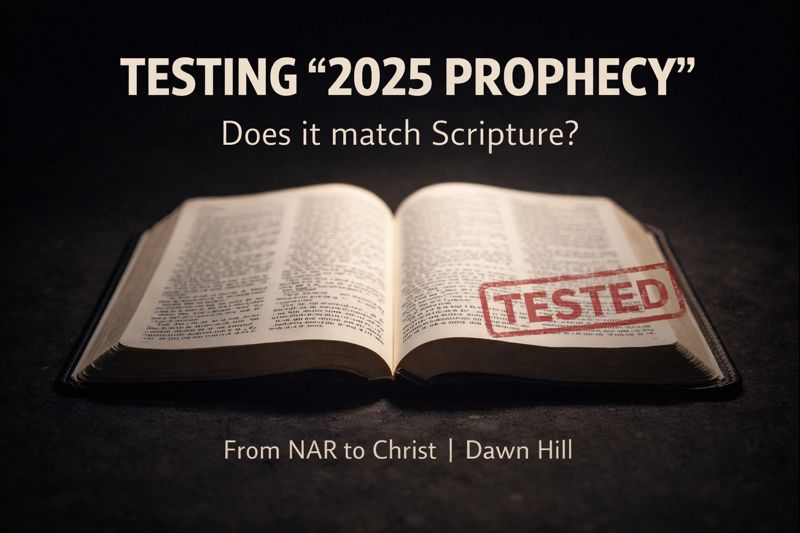
Testing a 2025 Prophetic Word: A Biblical Evaluation of Modern Prophecy
Show: From NAR to Christ with Dawn Hill Author: Dawn Hill Date: January 29, 2026Show Summary
In this episode of From NAR to Christ, Dawn Hill examines a widely shared “prophetic word” for 2025 and applies the biblical tests Scripture gives for evaluating prophetic claims. Rather than accepting vague statements or post-event reinterpretations, this episode calls believers to obey God’s command to test everything, hold fast to what is good, and anchor their confidence in the sufficiency of God’s Word.Audio Player
Video Player
- 1 Thessalonians 5:19–22
- 1 John 4:1
- Matthew 24:4–14
- Deuteronomy 18:20–22
- Acts 11:27–30 (Agabus and the famine)
- Acts 21:10–14 (Agabus and Paul)
- Hebrews 4:12
- 1 Corinthians 15:1–4
Episode Highlights
- Why testing prophetic claims is obedience to Scripture—not “despising prophecy.”
- The three biblical tests applied in this episode: fulfillment, orthodoxy, and lifestyle/morality.
- Why vague claims and “reading the room” do not match the pattern of prophecy in Scripture.
- Why “prediction” is not the same as speaking authoritatively on behalf of God.
- How misquoting Scripture and redefining prophecy undermines Christ-centered faith.
Full Article
Scripture commands believers to test what is claimed to be spiritual truth. In 1 Thessalonians 5:19–22, Paul instructs the church not to quench the Spirit or despise prophecies, but to test everything and hold fast to what is good. Likewise, 1 John 4:1 tells us to test the spirits because many false prophets have gone out into the world.Testing prophetic claims is not optional. It is one of the Lord’s means of protecting His people from deception and keeping the church anchored in the truth. In this episode, Dawn Hill revisits a 2025 “prophetic word” that was later re-framed as accurate and “tested.” The episode then evaluates those claims by applying the biblical standards Scripture gives.The Biblical Standard Has Not Changed
One of the recurring problems in modern “prophetic” movements is the assumption that prophecy can be fallible, approximate, or partially true. But in Scripture, when someone speaks as a prophet of God, they are claiming to speak on behalf of the Lord. God’s Word is authoritative, infallible, and never confused or misleading.That does not mean prophets were sinless people—only God is perfect. But it does mean that when God speaks, He does not stutter, speculate, or guess. When the biblical prophets spoke, they spoke thus says the Lord—and what they said came to pass.Three Biblical Tests for Prophetic Claims
This episode uses three commonly recognized biblical categories for evaluating claims of prophecy:- The Fulfillment Test — If someone claims, “God said,” what they claim must prove true. Scripture does not present a category of “almost” prophecy or “practice prophecy.”
- The Orthodoxy Test — What is claimed must not contradict Scripture, the gospel, or the doctrine taught in God’s Word.
- The Lifestyle / Morality Test — The character and integrity of the one claiming prophetic authority matters. Scripture repeatedly warns that false teachers and false prophets are known not only by their words but also by their fruit.
When “Prophecy” Becomes Reading Headlines
A major issue addressed in this episode is the use of broad, vague statements that can be applied to almost any year: wars, instability, political unrest, disease, and societal turmoil. Yet Jesus Himself warned that there would be wars and rumors of wars (Matthew 24). In other words, we do not need “fresh words” to confirm what Scripture has already told us plainly.When someone claims prophetic insight but relies on generalized language and existing trends—then later declares victory because something “aligned” with their statements—this is not biblical foretelling. It is often a form of retroactive validation that depends on the audience not checking original words, timestamps, context, or accuracy.Prediction vs. Prophecy
Another key concern in this episode is the shifting language used to defend claims: what was called a “prediction” is later promoted as a fulfilled “prophecy.” But these are not the same thing. A prediction is a human estimate based on observation, and it can be wrong. Prophecy is presented as divine revelation spoken on God’s behalf—and therefore carries weight, accountability, and seriousness.If something is not prophecy when it is spoken, it cannot be rebranded as prophecy later simply because an outcome can be loosely connected to it.Why This Matters for the Church
False prophecy is not a harmless mistake. It misrepresents God, confuses His people, and often redirects trust away from Scripture and toward personalities, platforms, and “new revelation.” It trains believers to treat truth as flexible and encourages a culture where claims can be revised, re-framed, and defended without repentance.Scripture is clear that the church must mark and avoid those who deceive (cf. Romans 16:17) and must guard the flock with discernment, courage, and clarity.Six Questions to Ask When You Hear a “Prophetic Word”
- Is this actually foretelling, or is it commentary on what is already happening?
- Is the claim specific and testable—or vague and adaptable?
- Does it align with Scripture in context—or does it redefine doctrine to protect the claim?
- Is the messenger marked by humility and integrity—or by manipulation and self-vindication?
- Is Christ and the gospel central—or is the focus on the prophet, the platform, and the “word”?
- Does this move you toward the sufficiency of Scripture—or toward dependence on ongoing revelations?
Takeaways / Reflection Questions
- Do I evaluate spiritual claims by Scripture—or by charisma, confidence, and popularity?
- Have I been trained to excuse failed “words,” or to test them with biblical seriousness?
- What would it look like for me to grow in discernment through steady exposure to God’s Word?
- How can I help someone I love who is entangled in modern “prophetic” movements?
Call to Action
If this episode helped you, please share it with someone who needs clarity and encouragement. Subscribe for more episodes of From NAR to Christ, and remember: the safest place for your conscience is under the sufficient, living Word of God.Gospel reminder: Jesus Christ died for our sins according to the Scriptures, was buried, and was raised on the third day according to the Scriptures (1 Corinthians 15:1–4). Our hope is not in modern revelations, but in the finished work of Christ and the trustworthy Word of God.For more from Dawn please visit her page at Servants of Grace or at our YouTube.
Dawn Hill is a Christian blogger known as The Lovesick Scribe, and the host of The Lovesick Scribe Podcast. She is passionate about sharing the truth and pointing others back to Jesus Christ through the written Word as the standard of authority for Christian living and instruction while being led by the Holy Spirit into maturity. She is the author of NonProphet Woke: The Reformation of a Modern-Day Disciple. She writes articles for Christianity.com, Servants of Grace, and her blog posts have been shared by individuals such as Tim Challies. She will be featured in the upcoming docuseries, American Gospel: Spirit and Fire. She co-leads a women’s support group with Emily Massey called Snatched from the Flames, where they minister to women who have come out of the hypercharismatic and New Apostolic Reformation movement. She is a wife to Nicholas and a mother to Anabel and Ephraim. You can follow her on The Lovesick Scribe and Instagram.