⏱️ Estimated Reading Time: 8 min read
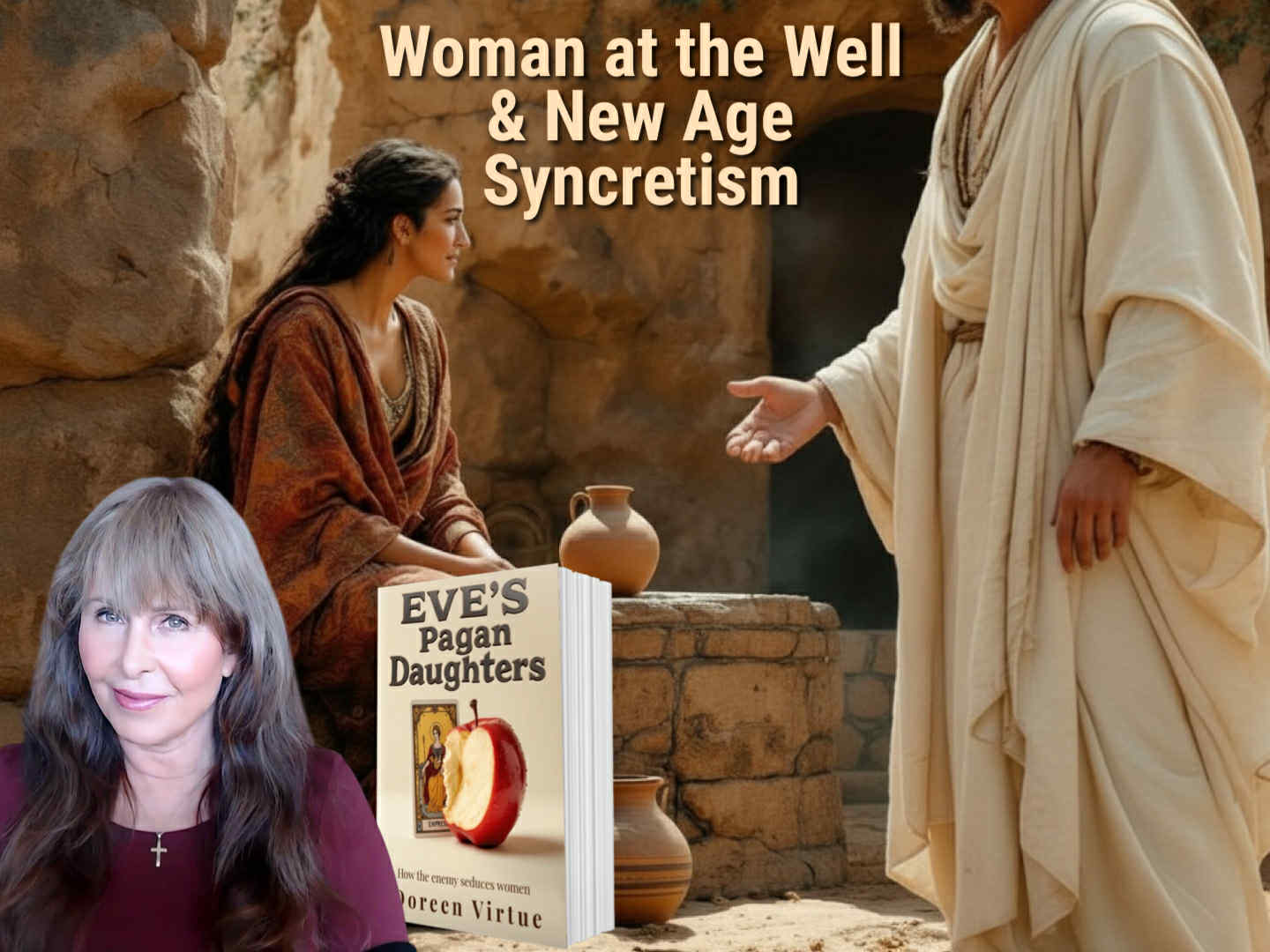
The Woman at the Well and New Age Syncretism
By Doreen Virtue
Author of “Eve’s Pagan Daughters”
Have you ever felt like your sinful past disqualified you from God’s love, or prevented you from being useful for God’s Kingdom? The story of the woman at the well puts those fears to rest.
The meeting between Jesus and the Samaritan woman at the well as recorded in John 4:1-26 gives encouragement for all of us who’ve been saved out of darkness. This story reveals the heart of the Gospel but also a powerful warning about spiritual syncretism which is the attempt to blend truth and error, faith and superstition, worship and idolatry.
The Woman at the Well and the Heart of the Gospel
The Samaritan’s faith combined the worship of God with pagan practices and beliefs inherited from the nations transplanted into the region after Israel’s exile. Their religion had elements of truth with the worship of God, yet it was corrupted by compromise. Jesus’ dialogue with the Samaritan woman exposes this distortion and contrasts it with the pure worship of God “in spirit and in truth.”
In many ways, Samaritan syncretism mirrors the modern New Age movement. Both claim a connection to the divine while rejecting God’s commandments and authority. Both mix fragments of truth with falsehood, producing spirituality without repentance and worship without truth. Jesus’ words to the Samaritan woman remain the ultimate corrective: “The water that I will give him will become in him a spring of water welling up to eternal life” (John 4:14).
Samaritan Religion and the Roots of Syncretism
After the northern kingdom of Israel fell to Assyria in 722 BC, the conquerors resettled the land with people from various nations (2 Kings 17:24-33). These foreigners brought their own false idols and customs, yet also adopted some practices of Yahweh’s worship to appease the “god of the land.” The result was a hybrid religion, a syncretistic blend of Mosaic tradition and pagan superstition.
The Samaritans accepted only the Pentateuch (the first five books of the Bible) as Scripture. They rejected the books of the prophets. They built their own temple on Mount Gerizim, claiming it was the true place of worship. While they retained certain biblical practices, they weren’t obedient to God’s Word.
This syncretism persisted for centuries. By the time Jesus met the Samaritan woman, this counterfeit spirituality had produced confusion and division. Her response to Jesus, “Our fathers worshiped on this mountain, but you say that in Jerusalem is the place where people ought to worship” (John 4:20) showed her spiritual uncertainty.
Jesus Confronts False Worship
Jesus’ request for water from the woman opens the door to a deeper conversation about spiritual thirst.
The woman, steeped in her culture’s mixed beliefs, initially misunderstands Him, thinking only of physical water.
Jesus redirects her to the heart of the issue: “If you knew the gift of God, and who it is that is saying to you, ‘Give me a drink,’ you would have asked him, and he would have given you living water” (John 4:10).
In this moment, Jesus contrasts her dead religion with His living relationship. The woman’s faith tradition offered worship without truth, exactly as the New Age promotes. Her confusion about worship locations symbolized the error of focusing upon works rather than knowing the true God. Jesus corrected her: “You worship what you do not know, we worship what we know, for salvation is from the Jews” (John 4:22).
The Samaritans had preserved fragments of biblical truth, but mixed it with pagan rituals. Their religion was therefore sincere but misguided, just as modern New Age spirituality is today.
Syncretism and the New Age Pattern
Syncretism always begins with partial truth. It acknowledges the existence of God but reshapes Him into something more acceptable to human preferences. It blends biblical language with pagan concepts, producing a false gospel.
For the Samaritans, this meant worshiping God while also glorifying pagan deities and rejecting parts of Scripture.
For New Agers, it means twisting Scripture and using biblical sounding words in empty ways. For example, New Agers speak of “Christ consciousness,” “divine energy,” or “the source,” while denying the exclusivity of Christ and the authority of Scripture. These systems refuse to bow to God as He has revealed Himself.
Syncretism borrows and redefines biblical terms. This makes deception easier to accept, because it sounds spiritual while subtly replacing God’s truth with demonic deception.
Blended Beliefs
The Samaritans tried to blend worshiping God with worshiping false idols. Similarly, New Agers try to blend Christianity with Eastern mysticism, psychology, and occultism. Both claim to honor God while rejecting His authority.
Works-Based Spirituality
The Samaritan woman’s question about “which mountain?” reflects a works-based system of worship. New Age spirituality likewise says that being a “good person” gets you into Heaven, and prioritizes experiences and emotion over revelation, claiming that all paths lead to God.
Subjective Truth
The Samaritan woman’s tradition had twisted and omitted Scripture to soothe egos. New Age spirituality does the same by reinterpreting Jesus as a moral teacher or energy being and blasphemously claiming that He used occultic practices, trying to diminish His deity and cross. The New Age is also relativistic and teaches that we each have our “own” truth.
Thirst Without Satisfaction
The woman had sought fulfillment through multiple relationships. Her emotional and spiritual thirst mirrors humanity’s endless search for meaning apart from God. New Age practices promise to quench that thirst through “mastery,” yet they leave the soul empty. Jesus confronted this with one statement: “Whoever drinks of the water that I will give him will never be thirsty again” (John 4:14). He offered new life.
Living Water and Broken Cisterns
Throughout Scripture, “living water” symbolizes God’s life-giving Spirit (Jeremiah 2:13, John 7:37-39). By offering living water, Jesus identified Himself as the source of spiritual life. The Samaritan religion offered only stagnant water. New Age spirituality does the same by promising renewal through energy alignment or universal love, but providing only adrenaline rushes instead of reconciliation with God.
Jeremiah condemned Israel for the same error: “They have forsaken me, the fountain of living waters, and hewed out cisterns for themselves, broken cisterns that can hold no water” (Jeremiah 2:13). The woman at the well stood beside such a cistern, both literally and figuratively by drawing from a spiritual well that could never satisfy. In the same way, the New Age offers broken cisterns such as yoga, astrology, Reiki, and spirit guides which are all empty substitutes for the Living Water that only Christ gives.
True Worship in Spirit and Truth
Jesus’ declaration in John 4:23-24 is the heart of the passage: “The hour is coming, and is now here, when the true worshipers will worship the Father in spirit and truth, for the Father is seeking such people to worship him”.
True worship comes from praising and obeying God, without trying to blend in mysticism or self-worship. New Age is spiritual but not of the Holy Spirit. It’s sincere but not grounded in truth. It tries to replace repentance with self-affirmation. Jesus’ words cut through all such counterfeits.
Christ Revealed and a Life Transformed
When the woman spoke of the coming Messiah, Jesus revealed: “I who speak to you am he” (John 4:26), which is a clear revelation of Christ’s divinity because He didn’t present Himself as merely an enlightened teacher or a mystical guide but as the promised Savior.
His revelation corrected her theological confusion and transformed her life. She left her water jar (the symbol of her old thirst) and ran to tell others about Him (John 4:28-30). This transformation is what separates true faith from false spirituality. The New Age promises awakening through self-discovery, while Jesus offers transformation through repentance and belief in Him.
A Warning for Today and an Invitation to Come and Drink
The modern world, like ancient Samaria, is saturated with religious pluralism. Many professing Christians try to blend biblical faith with Eastern meditation, mindfulness, astrology, or universalism. This is precisely the kind of syncretism Jesus confronted at the well. It may use Christian vocabulary or quote Scripture verses, but it redefines them to mean something entirely different.
In both cases, the result is spiritual thirst. Without Christ, no amount of ritual or mystical experience can satisfy the soul’s longing for God.
The story of the Samaritan woman concludes in redemption. The woman who once sought meaning in relationships became a witness for Christ. She was one of the first Gentile evangelists, showing that God can use us despite our sinful past. Her transformation displays the power of Living Water to cleanse, renew, and satisfy.
For those entangled in New Age spirituality, the invitation is the same. Jesus offers Himself as the true Source of life. The same Savior who sat by Jacob’s well still calls the thirsty: “If anyone thirsts, let him come to me and drink” (John 7:37).
The Samaritan religion and the New Age movement share the same mixtures of truth and error, worship and self, spirituality and deception. Jesus’ encounter with the woman at the well exposes the futility of syncretism and the sufficiency of the Gospel.
As long as humanity drinks from broken cisterns, the thirst will remain. But whoever drinks the Living Water that Christ gives will never thirst again. In a world filled with spiritual counterfeits, the words of Jesus still separate the true from the false: “God is spirit, and those who worship him must worship in spirit and truth” (John 4:24).
For more from Doreen please visit her page at Servants of Grace or at our YouTube.

Doreen Virtue holds a Master’s degree in Biblical & Theological Studies with highest honors from Western Seminary (56 units / 2021), and an MA in Counseling Psychology from Chapman University. Prior to being saved by God‘s grace and mercy in 2017, Doreen was a psychotherapist specializing in women’s issues, rated in the top 15 most influential living spiritual teachers by Watkins, and the top selling new age author in the world. She was born and raised in new thought churches which she attended for 33 years, before segueing to new age and Wicca in 1991 while touring with a mind-body-spirit conference organization. Before her salvation, Doreen frequently appeared on Oprah, CNN, The View, Coast to Coast and other liberal secular media. After the Holy Spirit convicted her of her sins, while she read Deuteronomy 18:10-12, Doreen repented and gave her life to Jesus as her Lord and Savior. Doreen has been helping professing Christians to identify and avoid new age and new thought deception. Doreen volunteers in discipling women who’ve been saved out of New Age in a private Facebook group. Doreen was a speaker at the Answers in Genesis 2025 women’s conference at the Ark Encounter. She has been featured on American Gospel 3, American Gospel TV, Daily Wire, Moody Radio, Spillover, Christianity Today, Cultish, New York Magazine, Spiritual Counterfeits Project, Servants of Grace, and other Christian media.